_PNG.png)
What Are The Wild Obsessions Behind Abstract Water Art And Artists?

Updated: Jul 27

Are you someone hooked on intuitive painting? Do you like to spread colors on canvas and work them slowly without any prior plan or agenda? Would you like to embrace some happy accidents like Bob Ross? How about some abstract water art for your splatters and drips?
No wonder water has a charm of its own—an irresistible attraction of the ripples and reflections, a graceful flow, and boundless forms. Water continues to fascinate visual artists all over the world, as it has been doing for ages. Artists try to capture the unmistakable charm in every possible form and style, celebrating the formless forms. That’s the reason for abstract expressionism; water has been a natural source of inspiration as it resists any rigid, representational structure. It rebels. It goes beyond rules.
Innumerable artworks shine on their own merit, painting the essence of fluidity. Unlike architecture or portraiture, water shifts, dissolves, and transforms. Visual artists often find this dynamism perfectly suited for abstraction.
In this blog, let’s rediscover some stories behind the famous abstract water paintings by Claude Monet, David Hockney, William Turner, Helen Frankenthaler, Gerhard Richter, and Mark Rothko, so that you can find your own inspiration. These masterminds have created stunning water reflections effortlessly, capturing the essence of fluidity from calm waters to turbulent waves. Now, it’s your turn.
Claude Monet’s Abstract Water Lily Paintings: Bridging Impressionism and Abstraction
Claude Monet (1840-1926), the great French Impressionist, was not celebrated for his abstract style. Yet in the later years of his painting career, he deliberately deconstructed forms while painting the Giverny pond and the water. The latter part of Monet water lilies series pushed his creations toward abstraction in incredible ways. His obsession with atmospheric painting, light, shadows, and reflections created a silent revolution on canvas.

The Story Behind Monet’s Dreamlike Canvases: Were They Unintentional?
While painting his garden in Giverny, Monet painted water not as an object but as an atmosphere and impression created by shifting lights.
What makes his story worth mentioning here is that Monet’s move towards breaking form may have been due to his failing eyesight. His cataracts blurred his vision of colors and edges. With time, his paintings started looking like surreal, abstract, and immersive canvases.
Art historians believe that this shift might be unintentional and that it pushed his works towards abstraction. For Monet, water in the pond became less about realism and more about perception, memory, and reflection.
He used soft blending layers, often resembling the wet-on-wet techniques, to paint the fleeting reflections on the water.
That’s how his giant canvases blurred horizons and dissolved structures, which was quite radical for the early 20th century.
Helen Frankenthaler: Soak-Stain Techniques of Abstract Watercolor Paintings like Water Itself
For a celebrated artist of abstract expressionism, Helen Frankenthaler (1928–2011), water worked as both a medium and an object. She created magical paintings with her famous abstract water color-inspired ‘soak-stain’ technique.

Spreading of Color Like Water: Creating Abstract Flowing Edges
Frankenthaler poured diluted paint on raw canvas instead of using broad brushstrokes and let colors spread naturally like water.
The effect was no less than revolutionary: it created flowing edges and allowed accidental movements of colors, adding an emotional depth to paintings.
That’s how her paintings often look, atmospheric, celebrating the fluidity of water without depicting oceans or water bodies.
Spontaneity was crucial to Frankenthaler’s creations, as she was keen on painting free-flowing emotions like water. She treated water not as a subject but as a process.

William Turner: Riding Storms and Waves of Abstraction
Famous for his dramatic seascapes, J.M.W. Turner (1775 to 1851), or William Turner, embraced abstraction long before abstract expressionism even existed. Many of his storm paintings represent the contemporary vibes of formless form, dissolving perspective, and curating emotional landscapes.

Turner’s Obsession with Storms: How Painters Often Risked Their Lives While Doing Dangerous Ocean Paintings
Legend has it that William Turner would reportedly tie himself to a ship's mast during storms to experience the turbulent sea closely. It must be an incredible thing to experience nature’s violence with all its severity. But there were many marine painters who would risk storms and rough seas, nearly giving their lives to portray the ocean's wrath while studying the movement of water.
He painted water as a symbol of chaos and motion, where ships were dissolved into mists, melting horizons with emotion. At times, his marine paintings were criticized for disappearing forms, but they were the precursors of a greater movement, Abstract Expressionism.
Abstract Water Paint of Mark Rothko: Painting Emotion Like Deep Water
Mark Rothko (1903 to 1970), the great abstract painter of giant canvases, showed emotion like deep water, though he never approached painting literal oceans or rivers. Standing in front of Rothko’s massive creations overwhelms viewers with the emotional depth and intensity that each frame holds.
Floating Color Fields of Rothko: Connecting Viewers Emotionally

Like the versatility of water, his floating color fields resemble the dissolving horizon in fog, the deep-seated silence of underwater oceans, and the immersive feeling and stillness of water. Thus, his paintings become psychological blocks of color.
The stillness and expanse of his abstract watercolor paintings have touched viewers all over the world. Many of the spectators reportedly cried before his fluid-like abstract canvases, not because of their intellectual capacity but because of the emotional intensity that was palpable.
How Gerhard Richter Blurred Water and Memory
One of the influential artists of the contemporary era, Gerhard Richter, has moved between realism and abstraction, blending memory, experience, and surreal emotions in image-making.
His experience of World War II, living under a Nazi regime in Germany, and negotiating a divide between East and West artistic ideologies shaped Richter’s abstract canvases. His abstraction often reflects water in various moods and manifestations, like raindrops on glass, water currents, and water as fog and atmosphere.
Gerhard extended his artistic possibilities beyond convention and created some unique compositions like blurred photo-paintings and layered color experiments, creating emotional chaos. Thus, he moved between the photographic and the real and the abstract.

Richter’s Fluid Canvases Represent Accidental Textures and Blurred Layers
Richter used giant squeegees to drag paint across the surface, creating accidental textures and dissolved layers. It is striking to watch the emotional uncertainty, constantly shifting reflections, and distorted water images, which deny any fixed interpretation, like water.
Zao Wou-Ki: Painting Water as Energy and Space
Zao Wou-ki blends Chinese Ink techniques with Western Abstractionism to show the inherent energy of water. That’s why his compositions look more lyrical than realistic.
Zao’s Chinese Ink and Wash Paintings Capture the Flowing Energy of Water
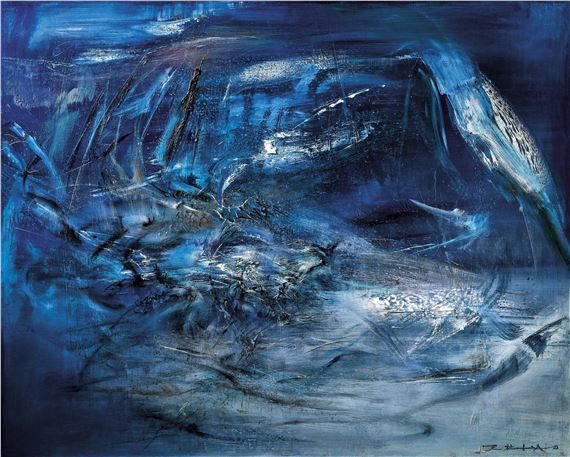
Some of his abstract paintings, like Hommage à Monet and the Sans titre series, represent scenes like storms, oceanic depth, atmospheric paintings of mist, and flowing energy.
One can hardly recognize any specific theme, but a strong and intense emotion guides his lyrical watercolor abstract works.
They look more spiritual as part of nature, where water is almost invisible but working as a strong force behind the rhythm and motion.
When Water and Abstraction Team Up to Work Wonders
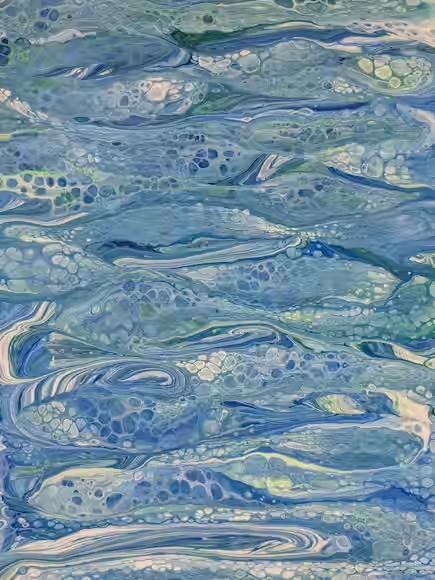
Are you ready to do the magic with water-inspired abstract art? While the online art gallery TERAVARNA hosts its next juried art contest on abstract art, make it a perfect opportunity to experiment with the unlimited possibilities of non-representation with this fluid medium.
Play with unpredictability, emotional chaos, and constant transformation of forms and shapes. For that, you need to return to the abstract art of water, invisible yet invincible. Not to paint it verbatim, but to paint through it.
Because in abstraction, water behaves differently.
It stops being a subject of portrayal or a mere landscape.
It becomes raw emotion, navigating tranquility and turbulence at the same time.
Like water, great art refuses to stay still.
It’s time to show your abstract genius to flow beyond words!