_PNG.png)
Ghibli AI Art

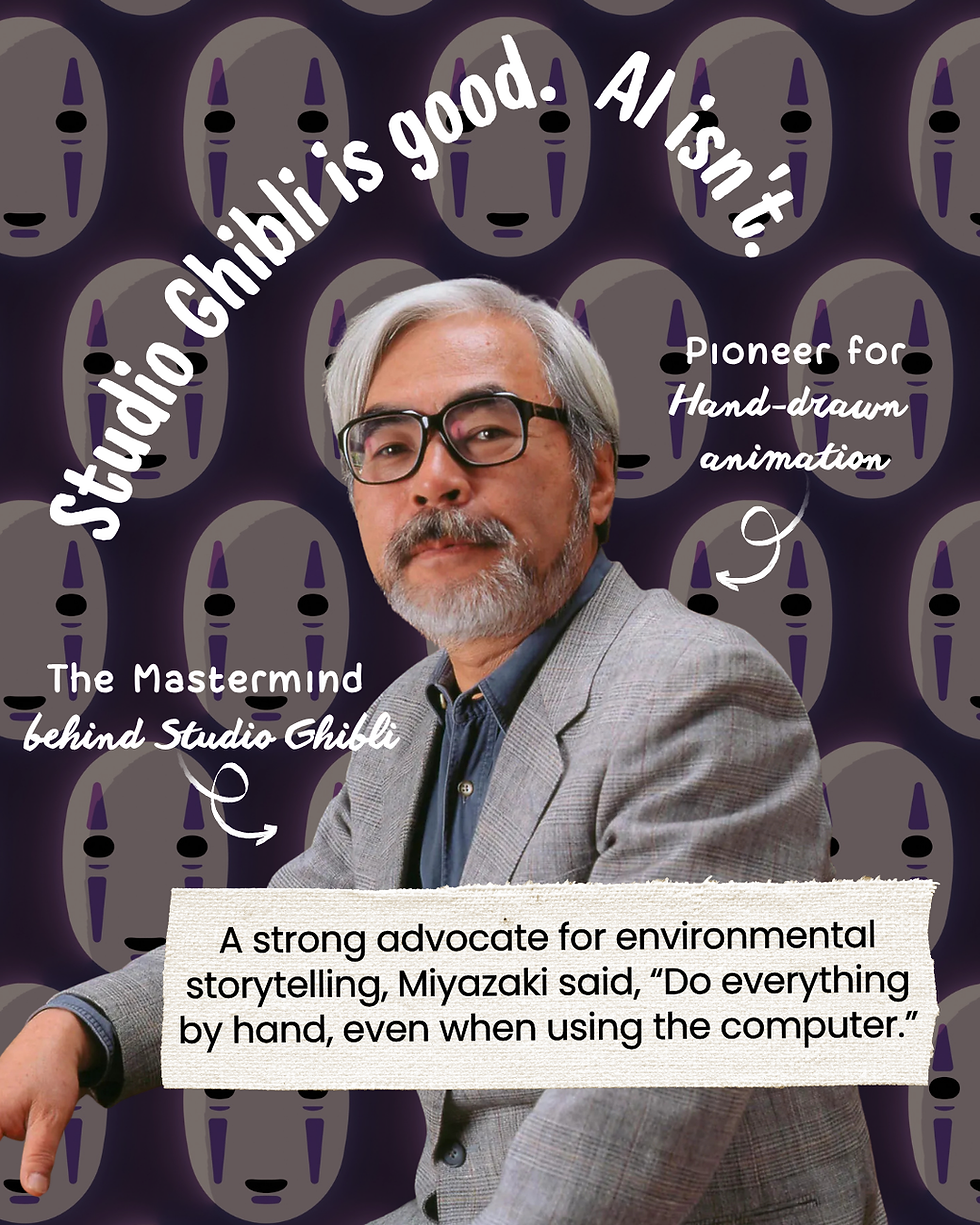
This trend is viral today, but an ethical disaster tomorrow.
There has been an influx of posts on social media related to the AI recreation of images in the style of Studio Ghibli art, with your past/future self, with your favorite celebrity, or reimagining different artistic concepts by various artists. All it takes is a prompt, and you can get a ‘piece of art’ for increasing your social media engagement.
However, what appears to be a celebration of the artists and their art style is actually much more than an ecological disaster. Not only do these trends lead to massive energy use, but they also contribute to water scarcity, as data centers require significant amounts of water for cooling. Furthermore, they fail to acknowledge the artist in any way.
While you are ‘generating’ art and funding this ecological crisis, an artist is silently thinking of giving up on their art, not only because their passion has failed to generate substantial income, but also because of the demand for perfection and immediacy, as that of an AI model. It is impractical, because art is not supposed to be quick or perfect. It is supposed to provoke you, make you cry, and infuriate you, and that takes time. In fact, it took three to five years on average for Hayao Miyazaki to create a single Studio Ghibli movie. And, most importantly, his own work strived to emphasize the need for humans to live in harmony with nature and warn against ecological destruction.
When you think that you are just ‘following a trend’ and mirroring someone’s artistic style, the images that are generated show the lack of a soul and the lack of art itself. Because art is not just what you see; it is also a continuous process of rigorously compiling your thoughts and emotions. Often, it also comprises a message that an artist has tried to convey. It is supposed to evoke an emotion and potentially lead you to contemplate your life’s choices. And, if the message of art is disrupted or misunderstood, the artist’s work is insulted.
In Spirited Away, the emphasis lies on retaining one's identity and surviving in a consumerist society that brainwashes people into forgetting who they are. So, perhaps to truly honor Miyazaki’s art, one might stand out by not subscribing to these trends that aid the climate crisis.
But, in 2026, when there are debates upon consideration of AI-generated art as art, one must rethink the ‘human’ aspect of humanity—that does not lie in getting a captcha correct, but also in feeling, thinking, and creating.
Sooner or later we might have to incorporate AI into art perhaps, but not while humans can still feel the sun’s rays on a winter morning and ‘think’ how good being alive ‘feels,’ not while art therapy exists, not while you can pick up a crayon or a pen while contemplating life, and surely not while you still care about the greatest art of all time—nature.