_PNG.png)
Surrealism & Dreams: The Influence Of Freud And Jung On Artists

Updated: Jul 27

At the beginning of the 20th century, the foundations of Western art trembled; it was like a cultural earthquake through surrealism. As the world was stumbling over the mechanical carnage of World War I, a group of artists and writers headed by André Breton attempted the creation of a new reality, a surreal one. They thought the rational mind, logic, and social restraints were the cause of the world in its confusion. In search of truth, they had turned inside, into the maze of the human mind.
The Surrealism art movement was not just a way of selection of aestheticism; it was also a psychological journey, and the theories that were central to this journey were the theories of Sigmund Freud and Carl Jung. Although the Surrealists had a most notable debt to Freud with his book "Interpretation of Dreams," the broader movement, more generally, and its subsequent developments echoed the "Collective Unconscious" of Jung. Combined, these two giants of psychoanalysis gave the compass to other artists, such as Salvador Dalí, René Magritte, Max Ernst, and Leonora Carrington, to explore the landscape of the dream world.
Sigmund Freud: The Architect of the Personal Dream
The “Interpretation of Dreams” (1900) by Sigmund Freud served as the main Surrealism imagination manifesto. According to Freud, the human mind was split: its conscious part, called the Ego, served as a filter, whereas the reservoir of repressed dreams, fears, and primal instincts, called the Id, was located in the Unconscious.
Mechanism of Displacement and Condensation
According to Freud, the art of surrealism occurs from dreams, which became the royal road to the unconscious, but it is coded. The two main processes that he identified are the following:
Condensation: In which one dream image denotes the chain of thoughts (e.g., a figure that at the same time is a father and a frightening creature).
Displacement: To avoid the mind censor, the emotional force of an important thought is given to an inconsequential object.
These mechanisms were put into use as technical tools by surrealist painters. The melting watches in “The Persistence of Memory” by Salvador Dalí (1931) are a typical example of Freudian displacement, and it is one of the classic surrealism art paintings. The tough beige reality of time is made tender as a manifestation of a deep-rooted human anxiety over not being in control and the passing of time. Liquefying a hard object in this way, Dali emulates the dream logic of the fluidity of time and space in which the laws of Newton do not apply anymore, illustrating a perfect surreal art experience.
Automatism and Freudian Slip
Freud and his technique of free association interested Andre Breton, who had studied medicine and had served in neurological wards during the war. He defined surrealism as "pure psychic automatism.
The artists would strive to subdue their conscious control, and the hand would move over the canvas in an involuntary manner. It was aimed at seizing the Freudian slip in pictorial expression—to expose the repressed facts that the intellect otherwise conceals. The masters of this technique became Joan Miro and André Masson, who did biomorphic forms that were similar to organisms growing out of an early psychic soup.

Carl Jung: The Gatekeeper of the Collective Unconscious
Where Freud was concerned with the repressed biography of the individual (the personal unconscious), his former pupil Carl Jung directed attention to something larger, the collective unconscious. He encouraged the creative process of surrealism and surreal art. According to Jung, there was a shared psychic heritage, a storehouse of pictures and ideas shared by all humankind, which he referred to as "archetypes," that were below our individual memories.
Archetypes and Universal Symbols
To the Surrealist painters, the theories of Jung presented a way out between the clinical and the mystical. Surrealism art canvases started to be filled with such archetypes as “the Shadow," “the Anima/Animus," and “the Wise Old Man."

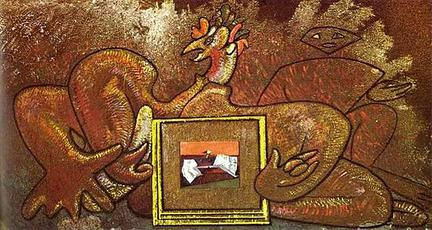
Artists such as Max Ernst frequently tapped into these universal symbols. His recurring surrealism art paintings of the bird-man character, "Loplop," are a personal totem, which plays a Jungian archetype: the go-between of the earth and the spiritual. Most of his work was done with Frottage (rubbing) and Grattage (scraping), techniques that gave him the opportunity to explore the images in the texture of the surface in a way that resembles Jungian “active imagination," where the individual interacts with the spontaneous images occurring within the mind.
The Alchemical Process of Surreal Art
Jung had a strong interest in alchemy, which he perceived as a metaphor of the process of individuation—that is, integration of the conscious and unconscious self. This Jungian view attracted many women in the Surrealism art movement, including Leonora Carrington and Remedios Varo. Their work frequently portrays the laboratories, mystics, and transformation of matter. In the “Creation of the Birds” by Varo, we get a picture of a man in an impressive celestial instrument creating life on a page, an ideal illustration of the Jungian assumption that art is a divine connecting point between the cosmic and the personal.

Comparative Influence: Freud vs. Jung in Surrealism
The tension between Freud and Jung created two distinct "flavors" of Surrealism art:
Feature | Freudian Surrealism | Jungian Surrealism |
Focus | Repressed trauma and sexual desire. | Myth, ritual, and universal symbols. |
Dream Logic | Dreams as "masks" for hidden meanings. | Dreams as "portals" to ancestral wisdom. |
Key Artists | Dalí, Magritte, Delvaux. | Ernst, Carrington, Varo, Pollock (early). |
Technique | Direct representation of "impossible" objects. | Symbolic, textured, and narrative-driven. |
Where Freud helped the Surrealists with the demolition of the ‘facade’ of the Victorian ego, Jung provided the means of constructing an entirely new mythology. One can see his influence in the clinical, hyperrealistic dream artworks of René Magritte, in which the uncanny is created by the replacement of the usual (the appearance of a train in a fireplace). The influence of Jung is more evident in the more timeless, mystical paintings, in which the canvas is used as a place of spiritual change.

To Sum Up
Freud and Jung had an impact on painters whose contributions permanently redefined the meaning of art. The art of surrealism inspired many artists and creators. It transferred the gaze of the artist out of the window to the mirror. Art was no longer to be merely a reflector of the outside, as it was now called to record the inside.
In the era when AI can create images depicting Surrealism in a second by simply reorganizing the information, Freudian and Jungian emphasis on human will and physical activity is more topical than ever. A machine can resemble the appearance of a Dali painting, but it will never have the Freudian uncanny or the Jungian epiphany.
Surrealism art taught us that dreams are not only nocturnal entertainment, but they are also the speech of our innermost being. The fact that this language was translated into paint meant that the secrets of the human mind would always be seen and felt and would never cease to arouse.