_PNG.png)
What Was Aeropittura—Unusual Aeropainting of Vertigo, Velocity, and Flight

Updated: May 1

Imagine yourself looking into the vast expanse of land, looking down from the sky. How does the aerial landscape look from a high vantage point? Do you feel elevated like God or a voyeur, enjoying the top-down images of cities, streets, lands, and rivers receding like tiny blocks? Or do they make your head reel? Whatever way you may feel, artists dramatized this perspective long ago. They drew farmlands, roads, and buildings as geometric patterns where cities look like a grid, and rivers wind like curved lines. And beyond that, they created illusions of space and a sense of flight.
During the Futurism movement, Italian artists were obsessed with aerial art, and they sought to introduce concepts that challenged accepted notions. This unique concept of aeropainting was ideated by a group of Italian artists, especially Tullio Crali, who was so fascinated by flight that he thought of translating his awe into art. Crali flew for the first time in 1928, which influenced his art to a great extent.
He joined the Futurism movement in 1929 after he came into contact with the founder of the movement, Marinetti. In the same year, the concept of Aeropittura was introduced in the manifesto, titled Perspectives of Flight, signed by a group of Futurist artists.
Thus, the word Aeropittura refers to the Italian word for 'aerial painting,' which originated as an offspring of Futurist styles in the early 1930s. In this Italian Avant-garde artistic style, artists used to paint objects related to the sky, like airplanes, parachutes, propellers, changing landscapes, and flying machines. Like other Futuristic artworks, here we also see the use of dramatic perspectives, creating a sense of speed and movement, and intersecting lines to mimic motion, enhanced with bright colors.
In the previous series of art and science blogs, we have discussed famous astronomical paintings and space drawings; now we’ll explore more awe-inspiring facts about aerial art, research on aeropainting that can be found in the first draft of the Manifesto dell'Aeropittura Futurista, published in 1929.
What Was in the Aeropittura Manifesto of 1929?

"Perceptions of Flight"—the name suggests the newfound reality that was different from the traditional notion of a terrestrial perspective. To paint this shifting realism, the artist must look beyond details, synthesize, and transform the given reality. This was the proclamation of the 1929 manifesto on Aeropittura.
What was the Focus of Aeropittura?
Aeropittura artists aimed to engage viewers with an unusual sense of motion in an aerial space. They added elements of fear and the thrill of flight, seen from an aviator’s perspective. It was an emotional experience to trigger the concepts of vertigo and velocity while portraying the overwhelming combat scenes seen from a height. The portrayals often provided a distorted, fragmented, and abstract perspective of floating landscapes.
Aeropainting, or aerial art, represented the second generation of Futurism, creating illusions of high velocity and distorted perspectives of cities and landscapes seen from above.
Tullio Crali: The Master Artist of Aeropittura

Though there were several reputed artists like Depero, Dottori, Fillia, Marinetti, Benedetta, Prampolini, Somenzi, and Guglielmo Sansoni of Futurism who signed the manifesto of 1929, Tullio Crali deserves a special mention when it comes to creating incredible aeropaintings.
Crali was a second-generation Futurist painter who became popular for his aerial paintings of military planes, aerial squadrons, and aerial duels. It was a transitional period between the First and Second World Wars, which demanded a shift in artistic expression in terms of mechanical art. Thus, a sense of rhythmic movement was created in art, often turning real spaces into abstract visuals.
Most of Tullio’s paintings falling in this genre represent motion, speed, and modernity. He masterfully blended technical precision with his unbound imagination. The rest was history.
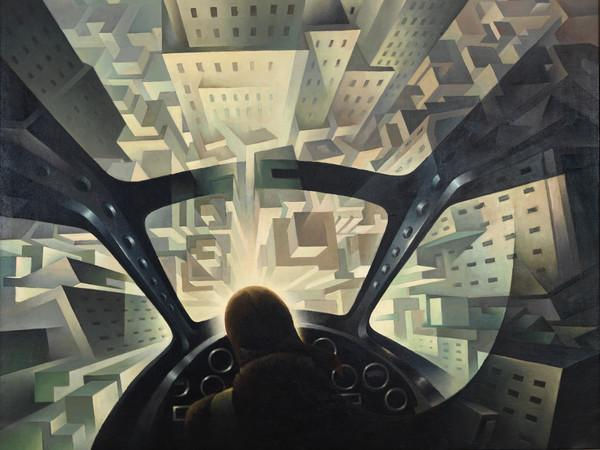
From 1930 onwards, he shifted to realism to make the viewers understand a sense of flight. Some of his best works, like Nose Dive on the City, show an aerial dive, taken from a pilot’s perspective, revealing dizzying buildings from an aerial view. Other works include aerial acrobatics in Aerocaccia I (Hunting Duel).
He was invited to exhibit in Paris in 1932 by Marinetti for the first-ever exhibition of Aeropittura. Again in 1935, he participated in the Rome Quadrennial, followed by his showcase in Venice in 1940. He also showcased with Dottori and Prampolini in the International Exhibition of Sports Art at the Berlin Olympics in 1936.
Crali was enthusiastic and energetic; he organized various Futurist events in Italian cities under the guidance of Marinetti. In the troubled times of war, he synthesized the idea of art and war artfully, as he was fascinated with the aesthetics of flight since his teenage years. Most of his aerial paintings show dynamic spatial distortion from the pilot’s point of view.
He also published works like ‘Manifesto of Musical Words – Alphabet in Freedom.’
Aeropittura and the Second World War: National Identity and Aerial Art
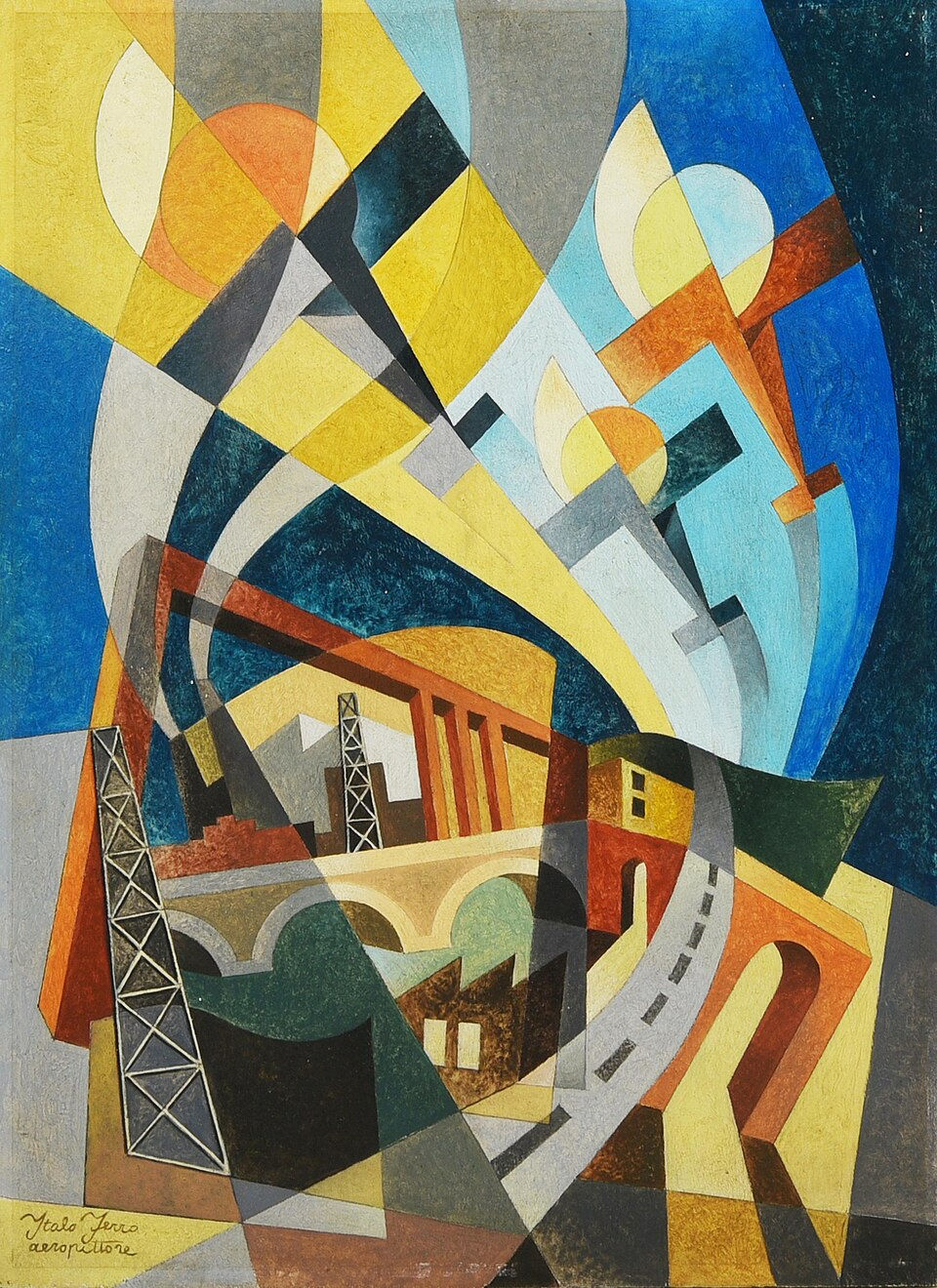
During World War II, the art of Aeropittura became more attached to images of war and flying machines used in battle. Art was blended with aeronautical subjects to depict Futurist forms. Gradually, scenes of aerial combat and bombing were added to these paintings. Here, airplanes symbolized power and superiority, dominance, and technological progress.
The movement of Futurism was closely associated with a Nationalist fervor among Italian artists, voicing opposition towards fascism and anarchy. Art reflected the patriotic zeal through remarkable aeropaintings. In essence, they celebrated industrialization in Italy, showcasing aerial combat and military strength.
To be precise, Aeropittura translated the experience of wartime flying into compelling art, adding innovation and dynamism to it. They could capture the harsh realities of combat scenes during World War II with aesthetic balance.
Masterpieces from Gerardo Dottori and Enrico Prampolini: Exploring Aerial Landscapes
Other leading figures of this art form were Gerardo Dottori and Enrico Prampolini. Gerardo concentrated more on lyrical and spiritual aerial landscapes, viewed from a great height. Some of his famous aerial paintings include 'Umbrian Spring’ and ‘Fire in the City.’
Prampolini focused on an abstract and experimental approach to aerial art, a ‘new extra-terrestrial spirituality.’ Instead of investing in realistic landscapes, he explored the cosmic and mechanical energy of his art form, pushing Aeropittura towards modern spatial exploration.
Italian Aeropittura Captures the Modernist Art Market: The Popularity of Aerial Painting Still Endures!
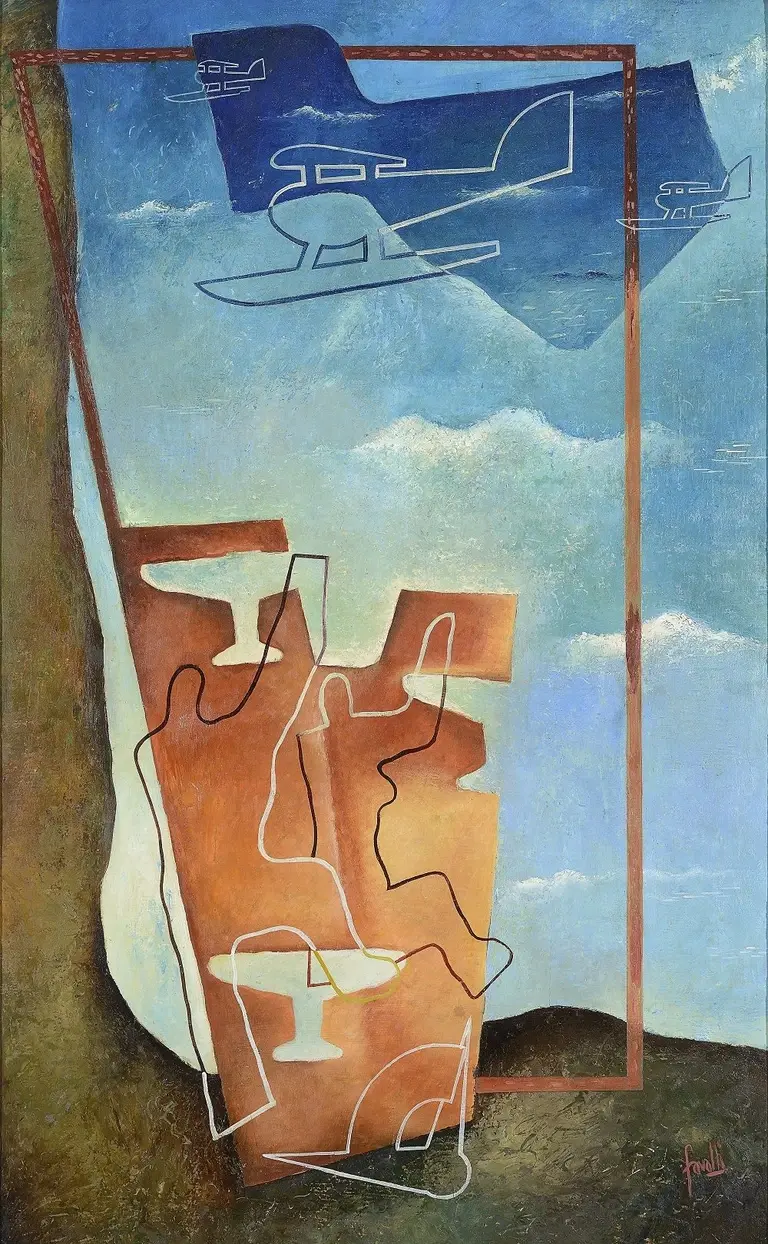
Aeropittura captured the attention of viewers and art critics for quite a long time and had an international reach through exhibitions organized in Berlin, Paris, and major cities in Italy.
The Futurism movement started in the 1920s and continued its impact for the next two decades. Contemporary research shows how Futurist artists participated in grand events like the Venice Biennale from 1926 to 1942, and in the Rome Quadriennale from 1931 to 1943. The exhibitors were none other than Filippo Tommaso Marinetti, the leader of the movement; Gerardo Dottori; Tullio Crali; and Prampolini as they sought official recognition for this art in Italian cultural circles and beyond.
The recent surge in sales of Aeropittura paintings by artists like Enrico Prampolini, Tullio Crali, Gerardo Dottori, Giacomo Balla, Giulio d’Anna, Tato, and Domenico delle Site reveals the popularity of these painters alongside other Modernist and Impressionist masters of that era. It is amazing to see how this art is gaining the attention of an international audience after almost a century.
The 21st-century viewers appreciate Aeropittura perspectives as seen by aviator-artists—an ultimate display of aeropictorial imagination during the troubled times of war.