_PNG.png)
10 Strange Facts About Henri Rousseau Paintings: Imaginary Jungles He Never Visited!

Updated: Sep 4

What if you painted places you have never been to and made people think that you’ve been there? That’s what made the French artist Henri Rousseau’s name worth a mention.
His jungles, exotic creatures, enormous grasses, mysterious animals, and lush forest landscapes seem like keen observations from a tropical jungle exploration. But evidence says something different. Rousseau never left France. He never visited jungles that he claimed to have witnessed. Most of his life was spent in and around Paris.
So, how did such elaborate and mysterious things appear in Henri Rousseau paintings?
The answer is fascinating: they could be derived from imagination, or copied from children’s illustration books, or his city zoo visits!
Let’s discover more awe-inspiring facts and myths surrounding this artist who inspired the Avant-Garde style and thus was wisely called a fountainhead of modern art.
Who Was Henri Rousseau? Was He the Father of Modern Art?
The post-impressionist painter Henri Rousseau was born in Naval, France, in 1844. He was a self-taught artist who never received any formal training as a painter. Rousseau worked in the customs office for decades and retired early to devote himself to painting.
Famous for his jungle paintings, Rousseau did not follow the conventional Salon style or the styles pursued by the art academy in France. Being an outsider to the art world, his naïve and childlike creations were often ridiculed by the cultural elites in France.
He developed a style of his own with a primitive approach to painting – simple forms, flat surfaces, crisp outlines, and unusual placement of animals and plants. Though they were criticized, these childlike and flat-looking paintings inspired Avant-Garde painters like Pablo Picasso. He deeply admired Rousseau’s art.
Initially, some of his paintings were rejected from exhibiting in the main Salon in Paris, so he first exhibited his paintings in the Salon des Refusés in 1885, where discarded artworks were displayed.
1. Henri Rousseau Never Actually Visited a Real Tropical Jungle
This was the most surprising thing about the post-impressionist painter. Henri Rousseau jungle paintings were filled with tropical vegetation and exotic animals, but he never visited such places in person.
He was a self-taught artist who claimed that he served the French army in Mexico, from where his jungle paintings had their inspiration. In reality. He studied plants and animals at Jardin des Plantes in Paris, where botanical gardens were combined with the zoo.
Besides visiting zoos in Paris, he also drew inspiration from animal illustrations in children’s books, magazines, postcards, museums, and exhibitions. He created his illusory world of flora and fauna from the direct references that were available to him.
And the result was no less than fascinating. That’s how he made the imaginary jungles feel real, though they never could have existed. But then, he had studied vegetation in the zoo quite meticulously.
2. His Jungle Was a Puzzle Made from Real Plants

Though Rousseau never went to any art school, he observed his subjects with great precision and detail. He didn’t simply invent them out of nothing. He observed tropical plants in the Jardin des Plantes and transformed those impressions into artworks.
In one of his paintings, ‘Tropical Forest with Monkeys,’ he painted enormous leaves and grasses from his observations in the Paris Zoo, but they were dramatically enlarged. Here he blended the real and the impossible worlds.
His placement and arrangement of objects often look out of proportion. That’s why Rousseau’s works were mostly discarded as naïve and childlike.
3. His Animals Didn't Always Belong Together
The way Rousseau painted his animals looks strange from a closer look.
You’ll notice discrepancies in the way he put together the animals and the foliage in an imaginary environment. This could be because Rousseau was not creating his artworks based on scientific principles but following his own logic of fantasy. He was creating jungle portraits in a dreamlike fashion.
It seems that his animals behaved like characters in a play, watching, hiding, hunting, and staring straight at the audience. His painted monkeys exhibit some human-like qualities. Though some of his painted subjects appeared out of place and disproportionate, they nonetheless looked charming and interesting.
4. He Painted More Than Twenty Jungle Scenes

It seems that Rousseau was obsessed with the jungle theme. Since the 1890s, he started painting jungle scenes, and during his career as an artist, he painted more than twenty jungle portraits. Most of his paintings feature lions, tigers, monkeys, jaguars, snakes, and exotic plants.
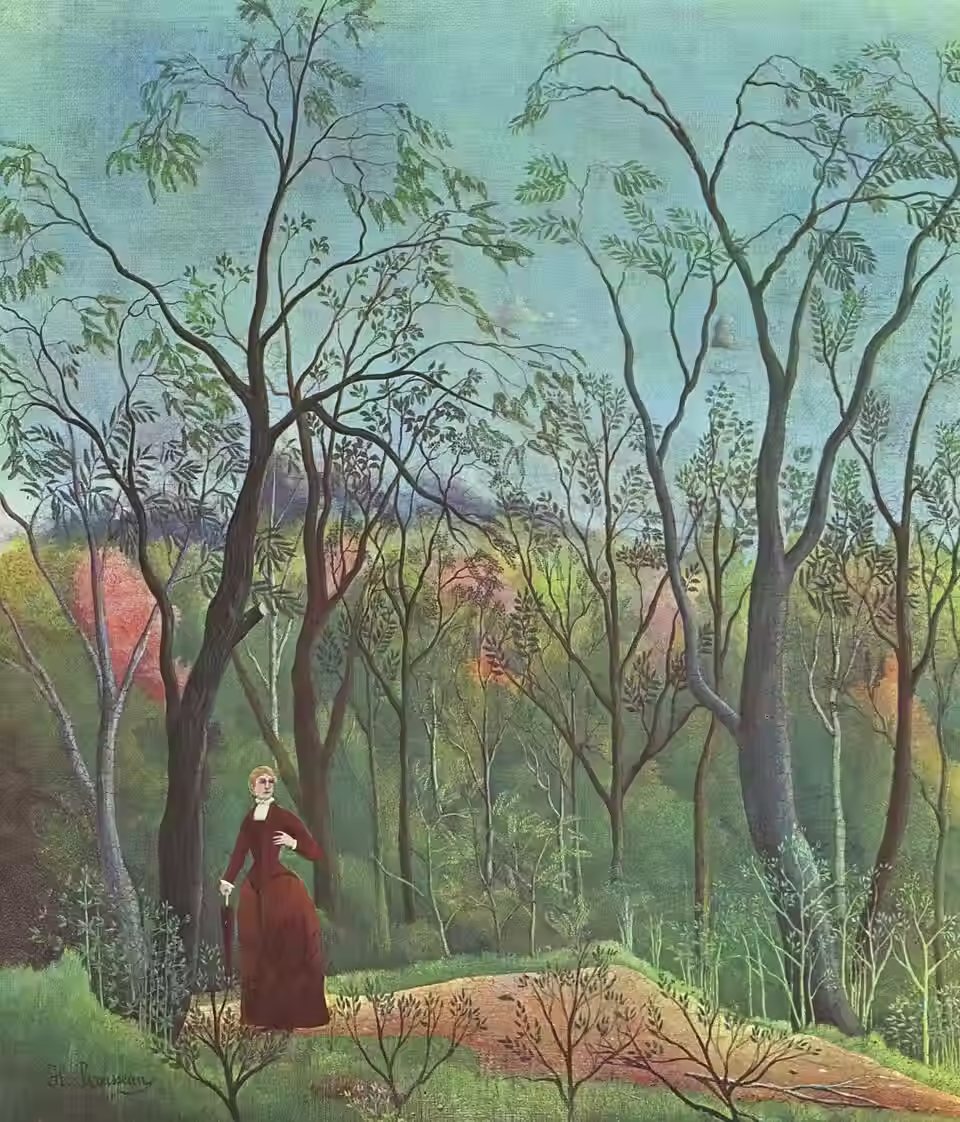
Some of Henri Rousseau famous paintings include Tiger in a Tropical Storm, The Dream, Black Man attacked by a Jaguar, The Walk in the Forest, Nude and Bear, Scout Attacked by a Tiger, The Snake Charmer, The Sleeping Gypsy, Surprised!, and others. They create a visual world of wonder that eventually became a signature of Henri Rousseau.
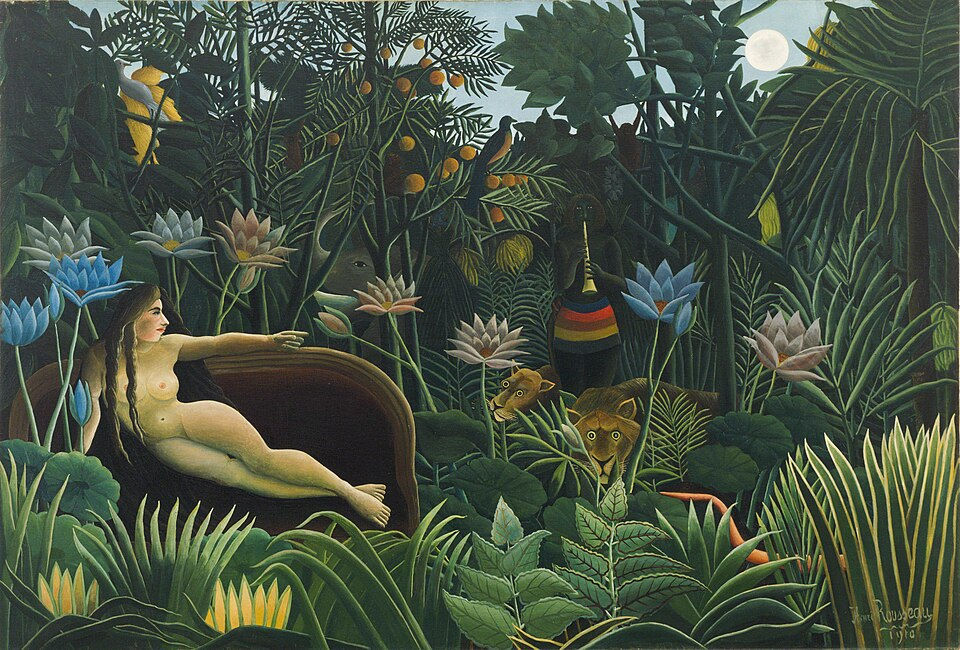
‘The Dream,’ painted in 1910, was his largest painted jungle scene, measuring 6 ft 8.5 inches x 9 ft 9.5 inches.
5. The Painting ‘Surprised!’ Reveals Some Strange Details

One surprising thing to notice: most of his animals are drawn from a side angle.
According to art historians, as most animal drawings were copied from illustration books and magazines, it was easier for him to draw them that way instead of trying to draw them from different angles.
In the painting called ‘Surprised,’ the tiger is standing on the grass, but the grass is not bending. Even most of the plants are painted as big and exaggerated, as if they were not drawn from real jungle scenes.
In another painting, ‘Scout attacked by a Tiger,’ it is interesting to note the horse’s image is much smaller compared to the grass. Perhaps it is the same tiger he had painted in ‘Surprised!’ – he must have taken a mirror image while painting the second one.

6. ‘The Dream’ Put a Sofa in the Jungle!
One of the most famous Henri Rousseau paintings, The Dream (1910), enhances the mystery of wilderness even further, placing a sofa in a jungle!
A woman is seen lying on a sofa in a dense tropical forest, surrounded by monkeys, birds, plants, and a mysterious musician playing a horn! Crouching images of lions appear in the middle of the image.
Isn’t that just strange?
Rousseau explained that it was a dream sequence where the woman was transported. So the impossible makes sense. It was not meant to be a real jungle. It was a dream!
7. Did Rousseau’s Paintings Point Towards Surrealism?
Though Rousseau died before Surrealism emerged as a prominent style in Western art, some of his paintings contained dream logic. Even if we think of ‘The Dream,’ the painting suggests some dreamlike suggestions often seen in surrealist paintings. A woman on a sofa in a jungle with a musician playing a horn. Plants growing to absurd heights, creatures drawn from unimaginable worlds with distorted proportions.
8. Picasso and the Avant-Garde Took Him Seriously
During his lifetime, Rousseau was often ridiculed for his childlike paintings in the Parisian circle, but emerging artists embraced his style. The Avant-Garde painters saw great possibilities in his ideas that conventional critics couldn’t discover.
Picasso liked the freedom and originality in his works, the way he challenged the conventions of academically sophisticated art. His painting style was modern, with unusual perspectives and dream imagery, enriched with an unmistakably personal voice.
In 1908, Picasso even hosted a famous Paris gathering presenting Rousseau with a medal.
Interestingly, the medal was made of huge cardboard, hand-painted by Picasso, and addressed to the world’s greatest painter. And Picasso hung this medal around Rousseau’s neck while others laughed awkwardly. Though embarrassed, Rousseau gallantly professed ---
“We are the two greatest painters of the era—you in the Egyptian genre, I in the modern genre.” – Source: MoMA
9. Henri Rousseau Was Buried Three Times!
Henri Rousseau was buried three times! He died in 1910, pauper and penniless, buried in the pauper’s grave with no headstone. Years after his death, Picasso and his friends arranged for his second burial in Paris. Eventually he was buried in Laval in France in 1947, where he was born.
10. For Rousseau, Jungle Was Never the Point: It Was a Celebration of Imagination
Perhaps the most remarkable thing about Henri Rousseau's artwork was that he didn’t have to visit a jungle to draw one. For artists looking to break away from rigid realism, Rousseau's self-taught approach was liberating. He showed them the way how one can create something new guided by intuition.
His jungles were never geographical destinations; they were places found in imagination.
He inspired artists to modernism and later Surrealism, while he became a bridge between the 19th century and the 20th century’s experiments with art.
And thus, Rousseau inspired the next generation of creators with the enduring lesson that there’s no harm in painting the world you imagine it could be.
In his paintings, he did not imitate reality; he recreated it on his own terms.