_PNG.png)
Art as Emotional Catharsis: 5 Artists Who Turned Trauma Into Art

It is a well-known fact that suffering creates great art. It doesn't. There are many people who suffer and do nothing, and there are great artists who lived comfortable lives. When certain artists, however, have pain they can't describe and project it onto a canvas, then something more specific and more interesting does happen. The work that comes out isn't a symptom. It's a strategy.
The concept of art as emotional catharsis is one of the most ancient notions in Western aesthetics, as Aristotle used the term to explain the catharsis that tragedy brought to the audience. The thread was picked up by modern psychology and art therapy for trauma is now a clinical practice with veterans, abuse survivors, and persons with chronic illness. But long before there was a treatment protocol, painters were doing it instinctively. This blog is a look at five such artists who are expressing emotions through art.

Why Painting Reaches Where Words Don't
For years, fables have been told about the power of paint. Trauma's odd relationship with language. Those who managed to live through some terrible event frequently say that they can't tell the story; it is not a story at all, but rather a memory in bits and pieces, images and sensations. Trauma researchers have noticed this discrepancy between what a person carries and what they are able to say for a long time.
It's in that space that visual work can help. No one needs to string together a sentence when expressing themselves through art. It lets you distort, contradict, and scale— a little figure in a big sky, a split body, a wrong color… The painter is able to set aside what has transpired and not explain it, and more importantly, to stand back and view it as an external entity.
This is the act of externalization, which is the most mentioned mechanism by art therapists. When we express our emotions through art, we make something that is too heavy and inside our head, something tangible and out there. It is a thing that you create, not a thing that happens to you!
Let's see how it's applied to five of the great artists in history–let's dive into emotional expression through art.
Frida Kahlo: The Body as Subject
At 18 years old in 1925, Frida Kahlo was traveling by bus in Mexico City when the bus hit a streetcar. A metal handrail that went through her abdomen and pelvis. She had fractures of her spine, collarbone, ribs, and right leg. She had dozens of surgeries during the remainder of her life and many months confined to body casts.
She began to paint while lying in bed in front of a mirror fixed above her bed, which is the working origin of her unabated self-portraiture. However, Frida Kahlo's experience of pain in art is more than an account. In pieces such as “The Broken Column”, she visualizes her spine as a crumbling classical column; her skin is split open, nails driven into her body. In “Henry Ford Hospital”, she floats naked on a bed that is bloody after a miscarriage, strings to her a fetus, a pelvis, a snail, and an orchid, all in red ribbons.

They're not rhetorical figures of speech. They are an effort to make the invisible interior visible to another person. In her own words, Kahlo is said to have painted her own reality; a reality that included medical trauma, infertility, and a stormy marriage that few artists of her day would have painted at all.
Edvard Munch: Grief That Never Quite Set
At age five, Munch's mother died of tuberculosis. At the age of 13, his sister, Sophie, lost her life from the same disease. Another sister was admitted to a home for mental illness, and Munch himself was afflicted with severe anxiety; at a later age, he had a breakdown and was admitted to a hospital.
"The Scream" of Edvard Munch is like a vision of his trauma. It is normally discussed in terms of the face of the figure, which is distorted, but the more telling detail is the landscape. The sky writhes. The bridge is strong. In the distance, two figures go away, looking indifferent. The image is believed to be about the person's inner world having overflowed and taken over the external one, and everybody else is going along — something that anyone suffering from a panic disorder will understand right away.

Munch used the same themes over the decades, and “The Sick Child”, which was inspired by Sophie's death, indeed, was worked on numerous times over four decades. That repetition is a tale in itself. He wasn't trying to draw what had happened in the past. He was processing one, again and again, the way trauma tends to demand.
Francisco Goya: The Walls of a Deaf House
At the age of 40, Goya suffered a terrible illness which left him permanently deaf. He then survived the Peninsular War and saw the horrors of that conflict. He later documented those atrocities in his etchings titled “Disasters of War”. He was in poor health and in isolation by his seventies and was residing in a farmhouse outside Madrid called the Quinta del Sordo, the House of the Deaf Man.
There, he painted directly on the plaster walls. The Black Paintings were never commissioned and never exhibited, never explained. They include “Saturn Devouring His Son”, a god with a wild face and a body being ripped apart, and “The Dog”, a little dog's head barely visible emerging from a vast expanse of ochre.
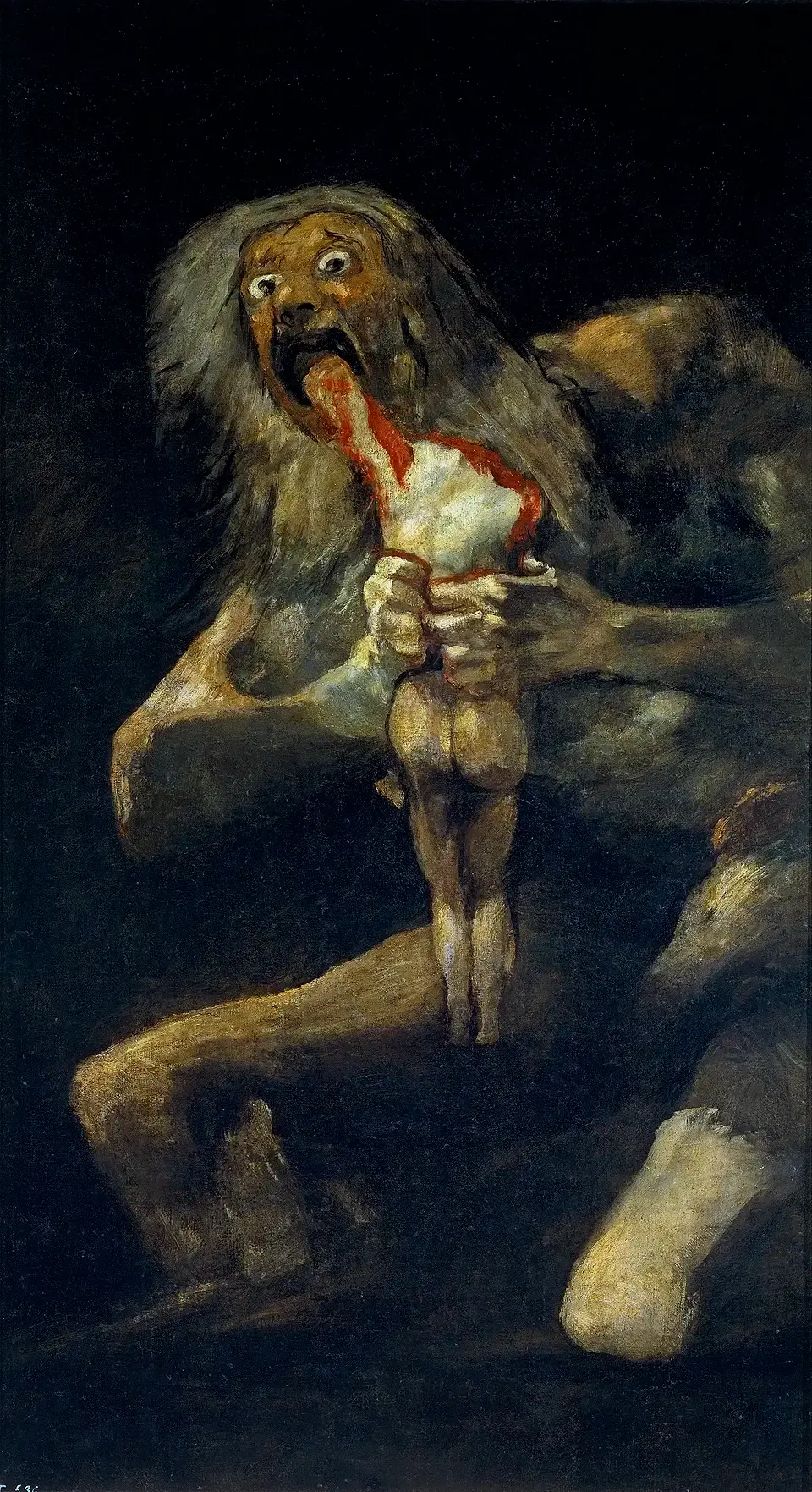
In trauma in art history, Goya’s Dark Paintings are unique; the artist created images with no audience in mind whatsoever. Goya had nothing to sell, nor had a reputation to build. He was painting for himself, which makes the Black Paintings perhaps the purest example of catharsis in the Western canon.
Artemisia Gentileschi: Rage Given a Sword
Artemisia Gentileschi was raped by her early 17th-century tutor and painter, Agostino Tassi, who was working in Rome. Her case was subsequently at trial in a public court in 1612, where she was tortured with thumbscrews to substantiate her testimony. Tassi was convicted, and as a result, escaped punishment.
When talking about Artemisia Gentileschi's trauma art, it is often limited to a single picture, but this is the one to reflect on. She's known for her portrait of “Judith Slaying Holofernes”, a painting of the biblical heroine who slew the Amalekite general by beheading him, a theme that had been explored by many male artists as something elegant or symbolic. It was Gentileschi's painting of physical labor. Judith supports herself on her arm; her maid pins the man down; blood flows across the sheets. No distance to flee, no allegory, no flinching.

There's a lot of disagreement among art historians about how directly the piece reacts to her assault; it's not a bad idea to refrain from reading every canvas as autobiography. Its refusal to be a mere pawn in a man's hands, its insistence on female force and competence, is much more than evident, however, and is one of the most powerful reclamations of agency in art history.
Yayoi Kusama: Turning Hallucination into Structure

Since childhood, Kusama reports having recurrent hallucinations, such as a field of dots, nets, and repeating patterns that invaded her consciousness. She grew up in an abusive family in wartime Japan. She worked every day in her studio, in the vicinity of her psychiatric sanatorium in Tokyo, Japan, since 1977, walking there voluntarily.
She didn't ignore these visions, but she did come up with ways to produce them at scale. The Infinity Nets, the polka-dot installation art, the mirror rooms – Kusama has said that this is self-obliteration, dissolving through the pattern rather than being dissolved by the pattern. She has said loud and clear that it is creating art that has saved her life.
What These Lives Actually Tell Us
Nice to think these people were healed by art. It didn't. Munch drank heavily. Kahlo remained in pain until her death. Goya died in exile.
What art gave them was a place to put it. In fact, the truth of the matter is that creation does not cure pain; creation brings structure, distance, and means of expression when language is not available in trauma. The masterpieces, in a way, were an afterthought. Survival was the real work.
You don't need talent to use this. A sketchbook that no one will ever see does the same thing that a wall in a farmhouse did for Goya.
Creative expression can really help if you're dealing with something weighty, but only if used in addition to help—and not in lieu of it. The therapist can be the difference-maker, especially if they are trained in trauma-focused or art therapy approaches.