_PNG.png)
The Changing Face of Mirror Art: How Artists Turn Reflections into Artworks

Updated: Aug 20

‘Mirror, mirror, on the wall, who is the fairest one of all?’
This is a famous line from the fairytale ‘Snow White and the Seven Dwarfs.’ The beautiful queen possessed a magic mirror that one day revealed the most uncomfortable truth to her. What was it? We know the later part of the story.
Mirrors have fascinated us since their invention. Numerous metaphors, stories, and imagery are related to mirror reflection throughout the ages. The surface of a mirror can be compared to the surface of a lake, reflecting the surrounding imagery while hiding what we think we know.
In this blog, we’ll discuss how artists have used mirror art and mirror symbolism to mean something profound – why contemporary artists keep coming back to mirrors to decode secrets, warnings, and distortions and to decipher themes like vanity, mortality, identity, and space.
We will deep dive into the maze of mirrors in art.
What Happens When Mirrors Become Art
What happens when mirrors do more than just reflect images? How do they become part of something greater, like an immortal artwork?
Artists tried to capture and immerse themselves in the other reality, which is deep and complex, as seen in the tragic myth of Narcissus, who fell in love with his own reflection.
Mirrors don’t always tell you the truth; reflections can be deceptive – showing a reality and revealing something new. A painted mirror often studies an illusion within another illusion, a second version of reality. That’s why artists have used these references to question what we actually see and how we understand the world through these perceptions. It’s interesting to note how a mirror stops being a physical mirror in the artworks.
Mirrors and Identity: Self-Portraits with Mirror
For ages, artists have tried to transform mirror paintings into something more than just physical appearance and explore the concept of identity. Mirrors let an artist look into facial expressions and subtle emotions. If we look into some of the self-portraits with mirrors, we will observe that the canvases look different from ordinary reflections. Artists produce more than resemblances; they go beyond that realm.
Parmigianino’s ‘Self-Portrait in a Convex Mirror’

Parmigianino's ‘Self-Portrait in a Convex Mirror’ displays the artist’s reflection in a curved mirror, where his face looks distorted and disproportionately scaled – an ordinary observation turned into something personal and fascinating.
While looking at self-portraits, we get to distinguish between appearance and self-study; it depends on artists as to how much they scale, distort, reveal, or hide the physicality. The resultant image shows how they wish the world to see them. It moves into a broader realm of self-awareness.
When the Reflection Reveals More Than the Subject
Jan Van Eyck’s ‘The Arnolfini Portrait’

If you notice Northern Renaissance artist Jan Van Eyck’s ‘The Arnolfini Portrait’ closely, you will see the mirror in the painting not only reflects the people standing in front of it but also the objects that are overlooked in the overall canvas. The convex mirror shows an expanded space where some figures can be seen otherwise missing in the main composition. That shows how a mirror reflection expands the scene beyond the scope of the composition.
Édouard Manet’s A Bar at the Folies-Bergère

Similarly, in Édouard Manet’s A Bar at the Folies-Bergère, a large mirror is seen behind the barmaid, Suzon, central to the painting. Her placement in the image adds more depth and complexity. It challenges our understanding of space and the agency of women in modern urban life. At times, it looks like an impossible vision, the way Manet placed objects and figures, ignoring conventional perspective.
That’s how mirrors in art become more than a medium of reflection, adding a new visual space to artistic compositions.
Girl Before a Mirror by Pablo Picasso
Picasso painted his muse in ‘Girl Before a Mirror’ – which doesn’t reveal her actual face, but a different woman with a transformed and contrasted image. It again triggers the concept of identity and self-perception. Here, reflection has turned into transformation.
Mirrors and Mortality: Vanitas Paintings and More
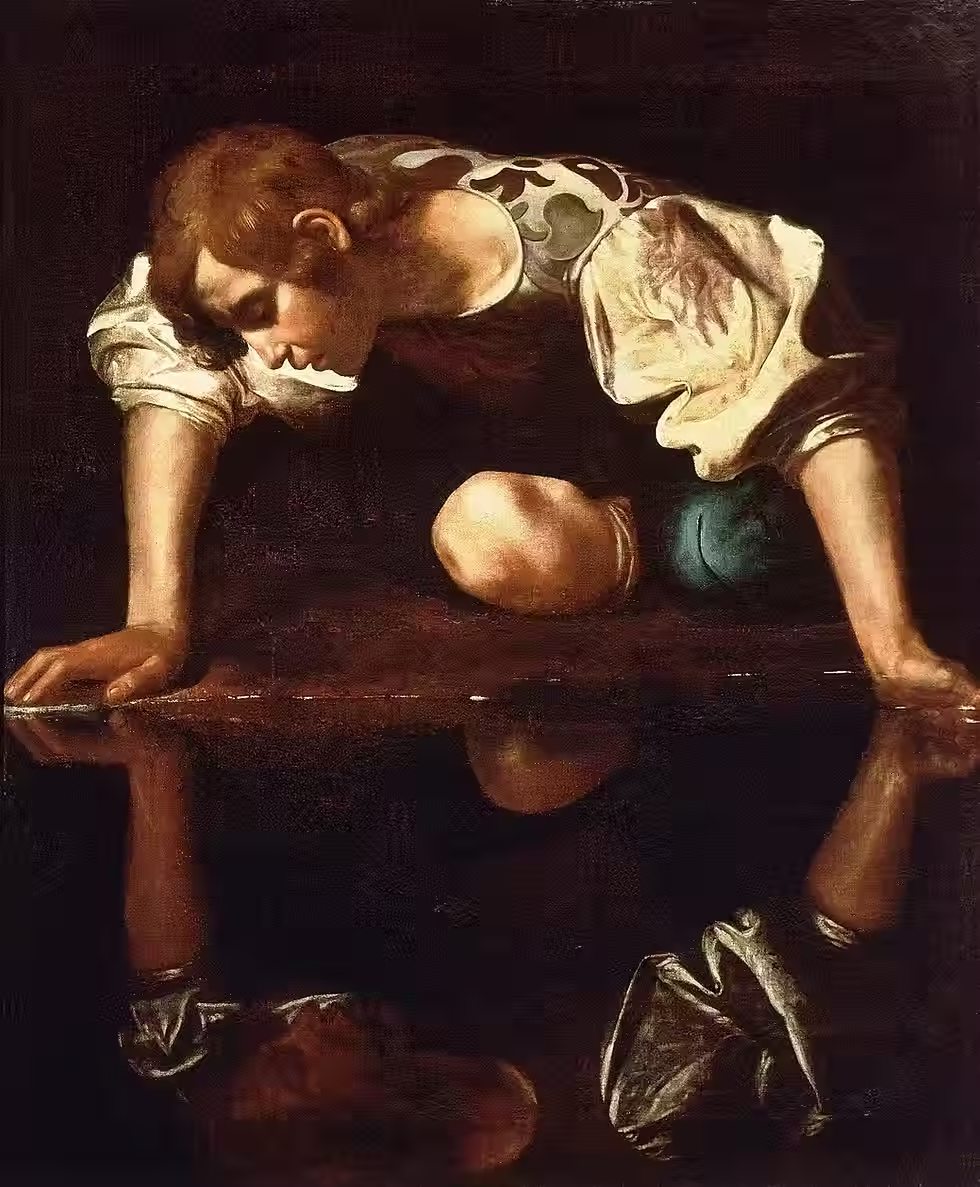
The dual meaning of the mirror is aptly captured in ‘Narcissus’ by Caravaggio through his art of chiaroscuro, revealing Narcissus looking at his reflection intensely to show how someone can be obsessed with his own self. The dark background depicts negative emotions of pride and vanity.
In Vanitas paintings, mirrors are shown alongside skulls, cosmetics, and other symbols of earthly pleasures, which remind the viewers about impermanence, just like the painting by Lukas Furtenagel.
The Painter Hans Burgkmair and His Wife Anna by Lukas Furtenagel
Sometimes a mirror can show us harsh truths of life we often overlook. In a painting by the German artist Lukas Furtenagel, it reveals a portrait of Hans Burgkmair and his wife, Anna, and the mirror shows a pair of skulls. The painting suggests ‘know thyself;’ the skulls here show us the inevitable destiny of decay and death captured through the mirror.

Art Deco Mirrors: How Mirrors Become Part of Modern Design
If you’ve been to antique shops, museums, or old mansions, you must have seen mirrors that look grand and luxurious, with geometric patterns and unusual shapes. The concept of art deco mirrors emerged between 1920 and 1930, showcasing diverse motifs such as sunburst motifs, fan-shaped, and other decorative patterns, while the frames were made of brass, wood, or chrome. This is how mirrors moved from mere reflections to a medium of interior design.
These mirrors reflect the changing times, the spirit of an era, glamour and craftsmanship, adding light and depth to the interiors, making everyday objects look extraordinary.
Contemporary designers still refer to art deco mirrors to add depth and movement to an interior, balancing functionality and ornamentation.
Mirror Paintings: Mirrors Used as Art Materials
With evolving mirror art, artists began to use actual mirrors rather than painting them as depictions. Italian artist Michelangelo Pistoletto’s mirror paintings show how a contemporary artist engages viewers as part of the paintings. His remarkable creations combine silkscreens with reflective surfaces so that every time a viewer looks at the painting, the perspective changes. That’s how a real mirror in an artwork can make viewers and surroundings part of the creation. These paintings bridge the gap between art and reality, between an artwork and an observer.

Mirror Wall Art: Viewers Become a Part of Artworks
With changing times, the concept of mirrors has evolved, keeping pace with a digitized world. The shift has changed from merely seeing ourselves to creating an active image. Now, smartphones are used to capture real-time images, touched up with filters. Now, we are technologically advanced enough to appear the way we feel. Still, something fascinates modern artists who return to the world of mirrors.
Mirror wall art adds a new dimension to mirror art with a shifting perspective of space. It’s intriguing to note how images appear, disappear, and get overlapped by other images.
Mixed media artists and sculptors are using mirrored surfaces along with painting, text, and pieces of sculpture. In mirror wall art, the entire room becomes a part of the composition, where the artwork changes every time a viewer walks into the room and encounters the art piece.
Contemporary artist Jeppe Hain, known for his ‘Mirror Labyrinth NY’ and ‘Mirror Wall,’ creates shifting reflections. In ‘Mirror Wall,’ a large mirror is featured, which starts to vibrate and distort a viewer’s reflection, changing the perspective of space.
Anish Kapoor uses concave mirrors to create 3D illusions and a changed perception of space. His stainless-steel sculptures ‘Iris,’ ‘Turning the World Inside Out,’ and ‘The World Turned Inside In’ show his experiment with light, movement, and perception of space.

Yayoi Kusama adds a similar perspective of depth in her installation art ‘Infinity Mirror Rooms,’ where viewers’ reflections are multiplied, creating an illusory space.
Thus, modern mirrors not only invite us to look at them but also to step into them, feel them, and be a part of the whole artistic experience.
Do you think smartphone selfies can truly replace what mirrors reveal?