_PNG.png)
Codes, Closets, and Canvases: How Historic Queer Artists Hid and Signaled Identity

Updated: Jul 21
Anyone who visits a big metropolitan museum these days sees a highly curated, deeply sanitized version of human history. The art history canon, as it is written in the world, has been largely heterosexist in its approach.
There are masterpieces which show grand romances, or the pain, struggle, and grief of love, sometimes deep sorrow or even psychological intimacy, but they are frequently read as the relations of close friendship or comradeship. People use safe and socially acceptable terms such as "artistic camaraderie" and "classical allegory," among others.
However, there exists a world beyond that of the classical and modernist masterpieces. LGBTQ+ people have been a part of society for centuries, where their needs and desires were criminalized, pathologized, and socially condemned.
To paint openly meant that you risked a prison sentence, exile, or the complete ruin of your career. But there is no such thing as suppressing the expression of human beings. Instead of saying nothing, historic queer artists created a very localised arsenal of visual subversive language. They made the canvas a place of freedom and coded freedom.
Hidden Meanings In Paintings
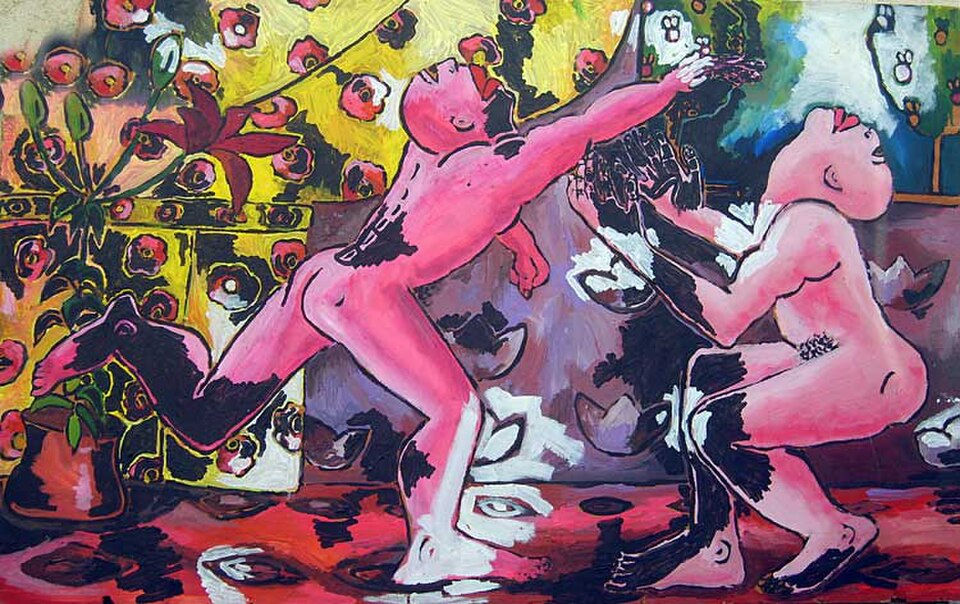
When we revisit queer history through the lens of queer art history, we see an abundant heritage of queer symbolism in modern art and classical painting. Artists used distorted faces and conventional iconography misapplied for subversive purposes, and clear double entendres to communicate directly to members of their own audiences without ever getting through to the eye of conservative patrons and censors.
This journey into LGBTQ art history examines the coded imagery revealed in artworks and the ways famous LGBTQ artists from history learned to live, love, and communicate their true selves from within the walls of the closet.
So, today, we are diving into some coded art symbols and will discuss the history of famous LGBTQ painters.
Marsden Hartley's Portrait of a German Officer (1914)–The Cryptographic Eulogy

In the early 20th century, the rise of modernism offered a new set of tools to those artists interested in the means by which they could mask and reveal their own truths. Marsden Hartley's majestic artwork of the German officer, Portrait of a German Officer (1914), may be the most emblematically coded of all modernist art history secrets.
The painting looks, at first glance, like a dynamic and striking early 20th-century Cubo-Futurist work that is covered in bits of military pageantry, intense primary colors, and imperial German iconography, all set against a hard-edged black surface.
Hartley's painting was considered a semi-cubist work of European war hysteria to the straight, mainstream art world in early 20th-century America. However, this outward bravado and hyper-masculinity are underpinned by one of the most affecting public eulogies in the history of avant-garde art.
It was not a typical portrait of a soldier but a secret portrait of the young Prussian lieutenant Karl von Freyburg that Hartley had loved, who had been killed recently on the Western Front, during World War 1.
What was so brilliant about Hartley was his use of a hyper-nationalistic, militaristic iconography to cloak an intense and forbidden gay romance. There is no literal head in the painting, but von Freyburg's physical and historical substance is instead charted by an array of coded art symbols:
The Initials "KvF": Explicitly painted in the lower-left quadrant of the canvas, directly connecting the abstract composition to Karl von Freyburg.
The Number "24": Clearly visible in the lower center is the number "24", symbolizing von Freyburg's age at the time of his untimely passing.

The Iron Cross: von Freyburg was awarded this posthumously for courage; Hartley's Iron Cross is in the centre, and in its form and placement, it becomes a sacred headstone for his lost love.
The Red "4" is a reference to von Freyburg's regiment, the Fourth Regiment of the Foot Guards.
Patterns of Identity and Movement: Overlapping patterns that recount the geographical identity and movements of the young lieutenant in the Bavarian Chessboard and Prussian Flags.
The use of his lover as a repository of his own personal things, badges, and numbers allowed him to openly mourn in public galleries on a massive scale, that his lover was gone. The bold patterns are a modernist delight of abstract geometry, and a public monument to a love that could never be voiced.
Still, it's a testament to the power of queer grief to be loud and very clearly present, and at the same time, not very clearly present to anyone else.
Lotte Laserstein's I and My Model (1929) and its relation to the Studio Gaze
In moving from early American modernism to the highly dynamic, socially free decades of the Weimar Republic in Germany, strategies for marking queer sexuality became increasingly abstract and eventually figurative.
Weimar is renowned for the moment when the queer community was able to flourish in a short, bright flash of visibility, when institutional art, however, continued to be extremely masculine and conservative. Enter Lotte Laserstein, a trailblazing German/Swedish painter and one of the first female graduates of the prestigious Berlin Academy of Arts.
1929: Laserstein paints her masterpiece: I and My Model (Ich und mein Modell). The painting serves as a statement of a very deep art history canon recontextualization. The "Artist and Model" image was a common, highly gendered one in the Western art world that, for centuries, has been a feature of art: a nude woman stands empowered while the artist stands at his easel, in charge of the image and often engaging in what is clearly a voyeuristic activity.

In I and My Model, Laserstein is sitting confidently at her easel, “practical and professional” in her attire, with her brush in hand. To her left, her favorite model, her muse, and her very intimate, lifelong female partner, is Traute Rose.
Laserstein does not make the nudes the passive property of the male gaze (passive and heterosexual), but creates a setting of high equality, mutual respect, and gentle, shared intimacy.
The gaze of the traditional male master, the predatory gaze, is absent from Laserstein's portrayal of Traute, whose gaze is tender, professional, and deeply collaborative. An equal creative and emotional partnership is documented on the canvas. Unlike the academy's male-dominated aesthetic, Traute Rose's pose is relaxed, unforced, and completely free from the stereotype of the exaggerated eroticism prevalent in male photography.
In taking the role of creator, Laserstein simultaneously broke with the traditional form of painting by being clearly moved by her female subject. The painting was a bold statement of lesbian identity, female agency, and domestic partnership in the art form, delivered with staggering technical skill, to an audience who were part of contemporary underground queer circles in Berlin.
More to discover: The Evolution of Pride Flags Through Art: From Gilbert Baker to Contemporary Artists
A Subtle Motif and a Subversive Tradition: The Hidden Lexicon of the Avant-Garde
Some artists, such as Hartley and Laserstein, made an impact with their own individual masterpieces, but hundreds of other great LGBTQ artists throughout history created a significant impact by utilizing a transnational network of subtle motifs. These symbols were a sort of secret handshake throughout Europe and America, and allowed the artists to communicate with their communities without letting the rest of society know.
Start to Arrange Flowers and Use Them as Symbols

Floral arrangements in still-life and portrait paintings had significant and symbolic meanings that were far from obvious, even before the green carnation became popular as a symbol of queer masculinity in the late 19th century.
For example, the appearance of columbine, violets, or particular combinations of calla lilies often indicated non-normative desire. The viola is a flower whose origins go back to the homoerotic poetry of Sappho on the island of Lesbos, and was often used by Sapphic artists to make a subtle statement of their orientation to women.
The placement of a vase of flowers on a table in the studio was far from a simple artifice; it could instead be an intentional expression of identity.
The Cult of Saint Sebastian

St. Sebastian—perhaps no other figure has been appropriated so much into the queer subtextual pantheon as has been the case in classical and Renaissance-inspired fine art. In late nineteenth- and early twentieth-century art, the portrayal of Sebastian was transformed, becoming a symbol of intense physical suffering, a figure that was represented in exquisite, youthful homoerotic beauty, making it a symbol for the closeted suffering of queers and the forbidden desire.
When someone was depicted painting or displaying a portrait of Saint Sebastian, they were implicitly implying awareness of the phenomenon of closeted trauma and male-on-male attraction.
Mythological Springs and Arcadian Landscapes

An alternative approach was to use the classical, mythological framework to rationalize same-sex spaces. The images of bathers at a classical spring, pastoral landscapes populated by mythological nymphs, or representations of the god Apollo and his doomed lover Hyacinthus provided queer artists with a secure shield of classical education under which they could paint homo-romantic desire.
When a conservative critic sought to comment on the closeness of two male or female shapes, the artist could simply show them the Ovidian Metamorphoses, which were not being censored, and communicate queer desire to the cognoscenti.
The Canvas: What's the Point of Decoding Queer Art History?
The discovery of these secrets of modern art history is not the retroactive application of modern terms to historical artists who would never have known them. Instead, it's about the reattaching of the original depth, the multi-layered depth of works removed by centuries of heteronormative archival erasure.
It is important to look at the work of Marsden Hartley with knowledge of his passion for Karl von Freyburg, for without it, he is missing an emotional engine in his modernism. Indeed, the absence of an awareness of her sapphic relationship removes any awareness of the radical political subversion of Lotte's gaze.
In decoding these canvases, we see that LGBTQ+ is no new phenomenon, but always has been and always will be here, defining the very cutting edge of human culture and visual expression. These hidden codes are proof of the tremendous strength of queer makers in the past.
When people were not given access to the public sphere, they claimed the canvas, creating a lasting visual legacy that will speak across generations, reminding all of us that love and identity will always find their way to make themselves known.