_PNG.png)
When Art Meets Geometry: How Artists Used Math Art in Their Masterpieces?

Updated: Aug 5

Scoring good grades in math is not everyone’s cup of tea, but we can hardly think of any creative work without rudimentary mathematics. Even the sceptics would admit that there’s a little bit of math in everything – right from making a cup of tea to something as profound as art and aesthetics.
Yes, there’s a long historical reference of math in art, be it the Greek and Roman architectures or the chunk of math used by Michelangelo in the Sistine Chapel Ceiling, or the golden ratio of Phi used in da Vinci’s famous anatomical drawing ‘The Vitruvian Man,’ or Picasso’s Cubism – breaking geometry apart!

Think of robust Renaissance sculptures or Art Nouveau architectural marvels – how could we think about all these magical creations without proportion, symmetry, balance, and the understanding of space?
Here comes the concept of geometry.
Remember how we all learnt to draw human faces and figures with some crazy circles, squares, and rectangles? To map human perfection, artists have always depended on geometric shapes in art. Anatomical drawings were based on mathematical calculations and a good deal of geometry.
Geometry helps to create a certain balance, harmony, and visual rhythm, as human eyes always crave symmetry.
Geometry in art can be traced back to ancient temples of Greece or Rome, Egypt, or the Inca. These wow-worthy math art and geometric patterns have floored us with their precision of calculation, more than thousands of years ago!
It’s fascinating to see how geometry in art and math art show numerical precision, enhancing visual aesthetics and emotional impact.
Ancient Foundations: Geometry as Sacred Language of Art
Since antiquity, geometrical patterns have been used to suggest spiritual and symbolic meanings. This is referred to as sacred geometry. Symmetrical shapes are found in art and architecture, from intricate coiling found in the sea shells to mind-blowing geometry explored in ancient temples all over the world – the harmonious and repetitive patterns that exist everywhere in nature.
Now, let us find out how religious iconographies and symbolic meanings were derived through some basic mathematical shapes.
Circle – Circles are seen in Buddhist Dhamma wheels, in Hindu Mandala patterns, and in Halos. It is used to symbolize continuity, wholeness, and integrity.
Triangle – The three dotted lines meeting in a harmonious apex point symbolize the confluence of body, mind, and spirit (often signified by earth, water, and fire). Triangles are rapidly used in Egyptian Pyramids and Gothic cathedrals.
Spiral – Spirals are used in the spiritual realm, often meaning the recoiling of life, from life, death, and rebirth. It shows a journey of evolution.
Square – Squares are marked by cardinal directions, which adds stability to any earthly object. Frequently used in floor plans, layout of architecture, and city planning, it suggests order and balance.
Egyptian & Greek Proportions

Ancient Greeks and Egyptians used math in art, like grid systems to ensure balance in the murals, and ratios to suggest symmetrical drawings.
Geometric shapes in art reveal patterns in man-made Fibonacci sequences as well. Leonardo da Vinci followed this Fibonacci pattern to derive the Golden Spirals and to divide the canvas according to the ratio.
The Magic of Fibonacci

The famous Fibonacci sequence was named after an Italian mathematician, Leonardo Fibonacci. The pattern shows numbers like 1, 1, 2, 3, 5, 8, 13, 21… the first two numbers are added, and likewise, each number is the sum of the preceding two numbers.
While drawing quarter circles inside Fibonacci-patterned squares, the ongoing harmony creates a spiral. These spiral guides the viewer's eye, and creates a sense of flow and balance – a pleasing visual movement.

Math in Art as Used in the Vitruvian Man by da Vinci
Geometric shapes in art reveal patterns in man-made Fibonacci sequences as well. Leonardo da Vinci followed this Fibonacci pattern to derive the Golden Spirals and to divide the canvas according to the ratio.
Can you imagine how much math was in the painting of Mona Lisa or the Last Supper by Leonardo da Vinci? A great deal of it! The Fibonacci principle influenced these two masterpieces as well. The master artist used this divine proportion in his anatomical and compositional studies, like the Vitruvian Man. He also used circles and squares to ensure anatomical precision.
What is the Principle of the Golden Ratio
The Golden Ratio (Phi) creates a natural balance and harmony, so that it looks natural to the viewers' eyes. A 1:1 ratio would look predictable for a design, whereas a random ratio would look haphazard. But a ratio of 1: 1.618 would look natural yet symmetrical. Masters like Leonardo da Vinci used this proportion in his art to make them look naturally balanced.
Islamic Art: Geometry and Art Without Figures

Islamic art creates a feel of the infinite universe and the formless shapeless existence of all-pervading Allah. The figureless worship is complemented by geometry in art patterns, which looks intriguing yet complex. The use of star polygons, tessellations, repeating geometric patterns, and complex symmetrical sets symbolizes the divine unity and harmony.
In religious Islamic architecture (muqarnas) like mosques, these patterns are rampant. Even in Islamic manuscripts and architectural decorations, there are elaborate tiles and ceramic designs with these repetitive, symmetrical patterns.
Math Art in the Renaissance: Creating Depth and Perspective

The concept of realism added more precision and linear dimension as the journey of art movements evolved from antiquity to the Italian Renaissance. Not only Leonardo da Vinci, but there were also renowned artists like Piero della Francesca, Michelangelo, and Filippo Brunelleschi who embraced the linear perspective and complex math art.
Filippo Brunelleschi ideated a single vanishing point to offer a sense of illusion, and he was the founder of linear perspective. Renaissance artists were keen on mathematical accuracy while drawing figures and landscapes, and they followed the Golden Ratio or Phi to maintain that balance.
Architects like Leon Battista Alberti reinforced the importance of mathematical calculations while designing buildings. The illusion of 3D was created on flat surfaces by using math in art and geometric shapes in art.
The use of horizontal lines, vanishing points, and orthogonal (L-shaped) forms was frequent in artworks of the era.
Circles, triangles, and pyramidal shapes dominated the artistic landscape as seen in Raphael’s famous painting ‘The School of Athens.’
A mathematical perspective was used to create a 3D spatial construction that looked realistic. They preferred to create an immersive feel, creating spatial depth, rather than flat surface decorations.
Why Artists Were Influenced by Geometric Art?
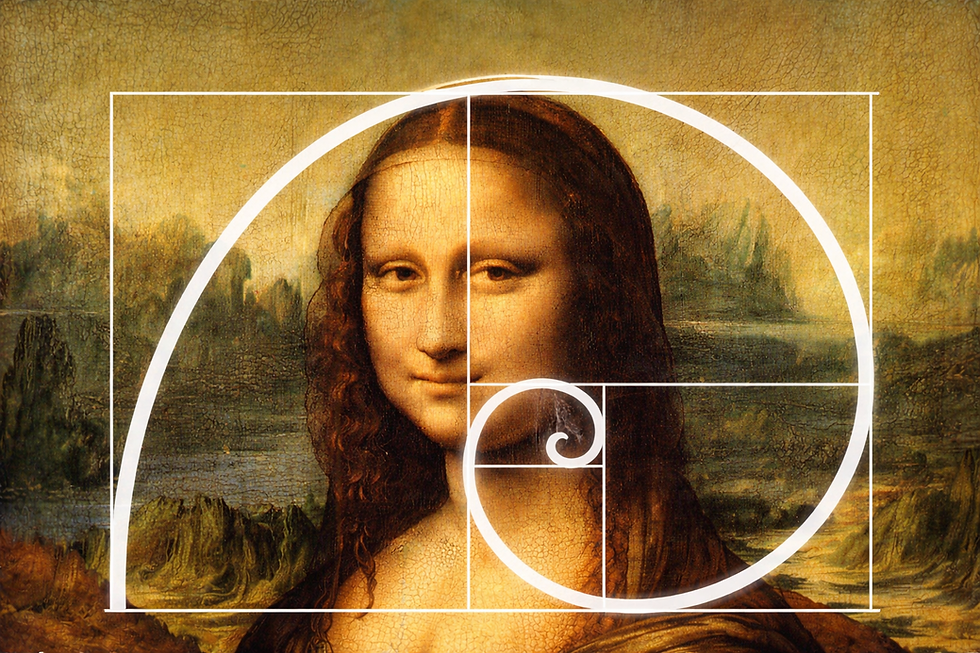
If you take a closer look at the painting of Mona Lisa by the extremely talented artist Leonardo da Vinci, you will be swayed by the subtle balance and the golden spiral embedded in the image. Da Vinci implemented the 1:1.618 ratio while doing the portrait of the lady with an enigmatic smile. The visual harmony is evident from the placement of perspective; her folded hands are seen from an angle, and her face, keeping a synergy with the hands at rest.
Mathematics transcends language, culture, caste, and creed, with its universal principles and logic. And artists depend of mathematic, especially geometric shapes in art, for structural clarity. It adds to the aesthetic satisfaction while organizing complex compositions.
But What Happened When Artists Took Geometric Art A Step Further?
In the next series, we will discover more mind-blowing facts about breaking away from conventional, linear patterns with the rise of art movements like Cubism by Pablo Picasso and George Braque. Stay tuned for the next series as we will be traveling through contemporary generative math art and fractal designs, how fragmented geometric patterns broke down the familiar canvas!
(… to be continued in the next series on geometric abstraction)