_PNG.png)
Existentialism Art: Radical Freedom & Absurdity in The Action of Painting

Updated: Jul 17

What is existentialism in art?
Existentialism art movement explores freedom in art. It's the philosophical movement that shows artistic expression that inquires about human conditions, their anxiety, and struggle. It prioritizes the perception of individuals over the objective reality, the freedom to be absurd, and the visual language of absurdity and meaning.
The 19th mid-century was the time of spiritual and intellectual disorientation. World War II was in the rearview mirror, leaving the world in the grip of a scene that was decidedly shattered. To most people, the old forms of meaning, religion, state, and even the development of civilization had disintegrated. It was in this sense of the void that an artist generation looks inward, not to discover a ready-made soul but rather to create one.
It was the beginning of existentialism in art, a movement that left the 'what' of painting to absolutely center on the 'how.' It had passed beyond the outbursts of color of the Orphists and the emotive outbursts of Fauvism and had settled in a new position where the very process of painting became a statement of being.
What Are The 4 Pillars Of Existentialism?
The 4 key characteristics of existentialist art are the following:
Freedom of Individuality: Emphasizing the freedom of expression, making your own choices, and defining existence through realizing that freedom of choice comes with consequences, and still the individual likes it.
Absurdness: Life is illogical and irrational, and sometimes we desperately want to see logic in everything. Here comes absurdity, embrace it. The search for meaning is not always essential; it is okay to just LIVE.
Isolation: Isolation is a hard part of life that we can't accept very easily, but life sends us alienation anyway, when we become alone and, for some reason or another, get cut off from society and the world
Fragility of Existence: Human life is of a precarious nature, so no doubt it is one of the key features of existential art. Trauma, vulnerability, grief—it changes a person, and art born out of suffering. The fragility of human conditions makes us an art in itself.
These are the cores of existentialism art, on which every existentialist paintings are based on—the freedom and struggles of human lives.
Existence Precedes Essence: The Philosophy of Existentialism Art
In order to comprehend the action of painting, one needs to comprehend the basic dictum of Jean-Paul Sartre's existentialism art, which is that ‘existence comes before essence’. This is an indication that we are born in this world without a blueprint or a purpose. We simply are. Our choices and our actions are what result in us becoming whatever we become; our "essence" is whatever we make ourselves.

This philosophy inverted centuries of tradition in the world of art. Traditionally, an artist began with a kind of essence (an idea, a sketch, a model) and transferred it to the canvas. The opposite was done by the existentialist artists, specifically the Abstract Expressionists. They came to the canvas without a plan, sketch, or image in mind. The real-time creation of the painting was done by establishing the physical existence of the artist's movement.
The canvas was not a window on the world anymore; it was a stage to play. Existentialism in modern art continues this freedom of being yourself, rather than letting the world decide who you are.
Jackson Pollock and the Dance with the Absurd
Since we are talking about existentialism art, none is more representative of “action painting" than Jackson Pollock. Action Painting follows the philosophy of existentialism in art. Also known as gestural abstraction, action painting focuses on the act of creating the painting instead of the finished piece.
It's an energetic process. Taking the canvas to the ground and leaving the brush to the drip, Pollock engaged in a physical, direct conflict with the void.

Physically, Pollock embodied radical freedom in the way that he made artworks. In an existential art sense, freedom is not a gift; it is a burden. When there are no rules, and there is no god to say what to paint, each drop of paint is a free choice, horrifyingly or beautifully. The drip was not accidental on the part of Pollock, but it was the rhythm of presence. He did not paint something; he was painting being.
But this freedom is irreconcilably connected with the absurd. The Absurd was the antagonism between the human desire to obtain order and the silent, unorganized universe, as defined by Albert Camus. This tension is manifested in Pollock. A casual viewer can easily perceive a Pollock painting as chaotic. But to the artist, it was a fight to establish a personal rhythm in that confusion—a means of leaving a mark that counted in a world that did not give directions.
Existentialism art in the modern era carries the thoughts of Pollock—he always said that the painting has a life of its own. The most well-known existentialist paintings by Pollock are The She-Wolf (1943), Blue Poles (1952), etc.
Willem de Kooning: The Struggle of Being
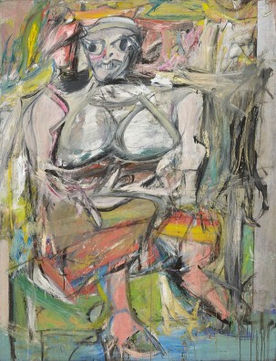
Where Pollock had discovered his liberty in the drip of the fluid, Willem de Kooning had seen it in the fight of force with the stroke. An example of existential art is his Woman series. The figures are not portraits in the old sense of the term; they are eroded and repainted and assaulted by the brush.
To de Kooning, painting was a cyclic process of creating and destroying. This is the existentialist art thought that identity never reaches any conclusion. The process of becoming is never neat and tidy; it is usually unpleasant. His impasto and violent lines depict the rubbing of elbows in the face of life—the angst (or Angst) of needing to redefine oneself again and again on a canvas that is hostile to you.
The Void and the Silence: Giacometti and Rothko

Existentialism in art is not necessarily loud and aggressive. It frequently becomes hidden in the soundlessness of the nothingness.
One of the close friends of Sartre, Alberto Giacometti, was the artist who depicted the nothingness that surrounds us. His thin, malnourished sculptures appear to be consumed by the air. They symbolize the lonely person in a cold and unresponsive world. The "action" in this case is the action of continuing; the figure stands or walks, though it is almost invisible.
Mark Rothko, on the other hand, employed action in a meditative but no less existential manner. Rothko’s color-field paintings are huge and aimed at devouring the viewer. When you are in close proximity to a Rothko, you lose your periphery; you are pushed into a conflict with the infinite.

Rothko even stated that he was only interested in conveying primary human emotions: tragedy, ecstasy, and doom. His art is the eye counterpart of the existential leap of faith. It has no plot, no character, and no direction, just the spectator and the hue, which is encountered in the emptiness of the gallery.
The Moral Weight of the Action Through Existentialism Art
Why does this matter today? The existential weight of the painting in an age of AI-created images and algorithmic routines is given to the action of painting.
AI begins with algorithms—they are conditioned on billions of existing pieces of data to produce an ideal result. It is unable to act since it does not have any existence to lose. It does not experience the angst of an untouched canvas; its experience is not the absurdity of making a decision that could go wrong. It's just data.
The existentialist paintings help us to remember the danger; this is the worth of human creativity. Whenever a human artist leaves a mark, he is declaring, "I have selected this." Although the world may be ridiculous, and the canvas may ultimately be destroyed, it is the act of choice that makes us human.
Conclusion: Creating Meaning in the Muddle
Existentialism art is a pathway of a journey between the "what" and the "how." It informs us that we never find meaning in the world; we create it by our actions.
The desperate motion of Jackson Pollock, the bloody strokes of De Kooning, and the silent step of the walkers of Giacometti—these artists demonstrated that the "action of painting” is a reflection of the action of living. We are all facing a blank sheet of canvas, with radical freedom and with the impossible yet beautiful challenge of making ourselves.
And when we go back to our own action, which may be drawing, or writing, or merely making the best of things, we may rest satisfied with the fact that the struggle is the thing that makes us who we are. It is not the masterpiece that is completed that matters, but the untidy, courageous, and crazy work of beginning.