_PNG.png)
The Color Revolution: Fauvism’s Lasting Impact on Orphism and Abstract Expressionism

Updated: Jul 21
Towards the beginning of the 20th century, art experienced a revolution. Classic realism was replaced by a resurgence of exploration; color turned out not to be a tool of description but a language of expression. This philosophy was the earliest to find adherence in modern art and was spawned by Fauvism, a modern art movement founded by Henri Matisse and André Derain. It not only shocked critics with its bold approach to using non-naturalistic colors but also formed the basis of subsequent movements, such as the Orphism art movement and Abstract Expressionism.
This blog tells about how the colorful experimentations in Fauvism gave rise to the other two revolutionary movements and changed the direction of art in modern times.
What is Fauvism? And What Did Fauvism Influence?
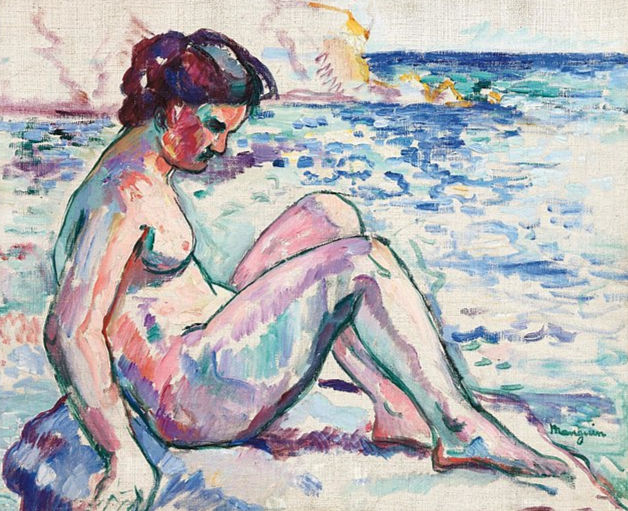
Fauvism was a movement that started in 1905. It was marked by the use of violent color schemes, the simplification of lines and shapes, and emotionalism. Basically, it was an avant-garde movement that focused on the emotions of color rather than reality or its standardized practices.
The artists were labeled “les fauves," which means "wild beasts," due to their extreme repudiation of realism.
An example of this style was the work of Henri Matisse in 1905 titled “Woman with a Hat," where the patches of green, pink, and orange were used to represent a face instead of natural colors.

Fauvist artists thought that color was more compelling in conveying inner emotion than realistic depiction.
Such philosophy—color as emotion and color as structure—became the pillar of further movements. The brief existence of Fauvism (which ceased in the year 1908) is inconsequential to its enormous contributions to the art of today.
What are the 5 Characteristics of Fauvism?
The 5 major characteristics of Fauvism are the following:
- Unnaturalistic, daring colors (green on the faces, pink on the skies).
- Minimalist and simplified forms, less concerned with detail.
- Brushwork that is expressive, energetic, and emotional.
- The focus is on the subjective sight of the artist, but not realism.
- Revolt against classicism in favor of flatness and decorative composition.
How Did Fauvism Influence Modern Art?
Fauvism's influence on modern art can now be seen in many art forms all around the world—it's the new normal.
This new practice was not only about the daring use of color that exerted the strongest influence on modern art, but also the fact that Fauvism challenged the artistic convention in a rather bold way.
The Fauves also freed the artist by rejecting the notion that art should be a replica of nature and allowed artists to be free in their experimentation with form, perspective, and technique. This attitude of rebellion inspired subsequent movements to venture into unexplored land - to the rhythmic geometry of Orphism or the raw emotive canvases of Abstract Expressionism.
Fauvism also redirected the interest of art towards internal vision rather than external reality, which has made modern artists conceive painting as an individual, psychological, and even spiritual exercise. In this, Fauvism was not so much a style as a manifesto: that the art of the modern could be about innovation, individualism, and virtually inexhaustible possibilities of creative expression.
Orphism Art Movement: Color as Pure Abstraction
By 1912, Guillaume Apollinaire used the term "Orphism" to refer to the paintings of Robert and Sonia Delaunay, František Kupka, and others. Orphism was basically Cubism with Fauvist color. A short-lived art movement that evolved from Cubism and focuses on bright, vibrant color and geometric abstraction.
For instance, the painting “Simultaneous Windows” (1912) by Robert Delaunay employed pictorial overlapping of geometric shapes and bright colors in order to produce rhythm and dynamics. Robert Delaunay’s Hommage à Blériot (1914) is another example of Orphism.
Orphism glorified color as the main theme, unlike the dark hues of Cubism.
There is an evident Fauvist legacy in it; Matisse and Derain, with their bold palettes, gave the Orphists a reason to drop representation in favor of pure abstraction with color. The wild colors in Fauvism were transformed into Orphism’s simultaneous contrasts.

Abstract Expressionism: Emotional Depth Through Color
In the 1940s and 1950s, the power of Fauvism was once more reemerging in the form of Expressionism. This movement was initiated in America and was headed by artists such as Jackson Pollock, Mark Rothko, and Willem de Kooning, and it focused more on spontaneity, emotion, and large canvases.
The color field paintings of Mark Rothko reverberate the Fauvist ideology of color as emotion, with huge blocks of red, orange, and blue to produce a spiritual experience.
The drip paintings of Pollock might not be very close to Fauvism, but the focus on pure vigor and the freedom of expression can be traced back to the Fauves breaking the rules.
Fauvism passed on the belief in color as the means of overcoming representation and speaking directly to the psyche of the viewer, which the Abstract Expressionists inherited.

The Common Thread: Color as Language
In these movements, the experiments of Fauvism with colors were a basis:
Fauvism: The expression of color in emotion.
Orphism: Rhythm and Color as Abstraction.
Abstract Expressionism: Color as depth, spiritual and psychological over objective reality.
Both movements re-read the radical application of color in Fauvism and transformed it into new situations and philosophies.
Conclusion
The period of Fauvism may have been just a couple of years, but the effects were felt decades later. The Fauves were the first to release color into abstraction, making the abstract geometry of Orphism and the emotionalism of Abstract Expressionism possible.
Simply put, Fauvism made color a universal language-a language that is still being used by artists today. It is a reminder of its legacy that the most radical experimentation can sometimes give rise to the longest-lasting revolution.
FAQs
Ques. Is Fauvism the same as Cubism?
Ans. No, Fauvism and Cubism are not the same.
Fauvism, which went on between 1905 and 1908, was based on massive colors and emotionalism, where, on the other hand, Cubism (1907-1914), started by Picasso and Braque, was to promote geometrical abstraction.
Fauvism made color free, and Cubism reinvented structure and form.
Ques. What are some famous Fauvist paintings?
Ans. Some iconic Fauvist works include the following:
Henri Matisse – “Woman with a Hat” (1905)
André Derain – “Charing Cross Bridge, London” (1906)
Maurice de Vlaminck – “The River Seine at Chatou” (1906)
Raoul Dufy – “The Regatta” (1908)
These paintings shocked audiences with their vivid, unnatural colors and expressive brushwork.
Ques. What’s the difference between Fauvism and Impressionism?
Ans. Impressionism (1870s-1880s) attempted to describe the light and atmosphere by means of soft, broken strokes of brushes and colors of nature. Fauvism, in its turn, rejected naturalism and focused more on the emotions over facts.
In simpler words, Impressionism was concerned with the outer world, Fauvism with the inner world of the artist.
Ques. Was Van Gogh a Fauvist?
Ans. No, Vincent van Gogh was not a Fauvist. He was a Post-Impressionist artist, practicing in the late 19th century. His expressionistic color and brushwork influenced the later movements, such as Fauvism.
Although Fauvism artists were in awe of Van Gogh because of his aggressive palette and rich emotional impact, he lived and worked several decades before Fauvism as a movement actually happened.