_PNG.png)
Beyond the Rainbow Flag: The Unexpected Symbols of Queer Art Throughout History
- Anushrita

- Jun 27
- 6 min read
Updated: Jul 20
Today, the rainbow flag has become a symbol that is widely recognized all over the world. It waves proudly at most every major pride parade; it shows up in galleries, public art installations, and also in social movements; and it stays a strong symbol of visibility and a broader feeling of inclusion. But way before Pride was recognized with the rainbow flag, for many years, LGBTQ+ people had their own rich visual ways of speaking—coded colors, certain flowers, artistic motifs, and hidden symbols—so they could communicate identity, love, and solidarity in a society that often needed them to be cautious and secretive.
Historically, artists, writers, and members of the lgbtq community developed these quieter and more subtle methods for spotting each other. Like a flower on a lapel, a particular shade of lavender, or a strategic design could carry meanings that never would have been obvious to just a casual viewer, though they were very significant to the ones who could read them.
These obscure icons offer one of the most extraordinary and inspirational histories of resilience, creativity, and resistance. They offer insight into art that became far more than decoration—it became a language of survival.
Why Queer Communities Needed Secret Symbols
It wasn't until recently, in the past few decades, that it was safe to openly identify as queer in public. In several countries, same-sex relationships were prohibited, and social pressures could lead to job loss, imprisonment, physical violence, or ostracization from their families and neighborhoods.
So, visual culture turned into a major way of communicating. Artists and members of the lgbtq community tucked away coded references in paintings, literature, fashion, jewellry, and even in small decorative arts. These covert symbols allowed people to identify each other without being noticed and offered plausible deniability in hostile settings.
Unlike the openly celebrated gender symbols we see today, such as the Pride banners and rainbow flag imagery waved in plain view, these earlier signs often worked below the surface. Their strength sat, precisely, in being subtle.
The Violet: A Flower of Hidden Desire
Among the earliest queer symbols is the violet flower.
Its association with same-sex love can be traced back to the ancient Greek poet Sappho. Her work often celebrated romantic affection between women. In several surviving fragments, Sappho talks about garlands and also crowns of violets.

By the late nineteenth and early twentieth centuries, violets had become tied to lesbian identity in some places across Europe and North America. Women would sometimes exchange violet bouquets, as a discreet expression of affection, and also as a sign of solidarity.
Later on, artists incorporated violets into paintings and illustrations, and other decorative works as quiet references to female same-sex relationships. For most of the public, the flower looked simple and innocent. But to those familiar with its meaning, it represented connection and belonging.
This duality made the violet one of the most enduring queer symbols in art history.
The Green Carnation and Oscar Wilde
No discussion of queer visual culture is complete without the green carnation.
The flower got associated with Oscar Wilde and the aesthetic movement of the late nineteenth century. According to popular accounts, Wilde encouraged friends showing up for the opening of Lady Windermere's Fan to sport green carnations in their buttonholes.
Even if it was meant intentionally or not, the green carnation slid into associations with queer identity in certain social circles fairly quickly. Artists and writers who were drawn in by Wilde’s flamboyant persona started using the green carnation as a sign for an unconventional identity, as well as a quiet form of pushback against strict social rules.

Unlike modern gender symbols, the green carnation offered ambiguity. It could be brushed off as just a fashion choice, while also symbolizing belonging in a hidden community at the same time.
For decades, it remained one of the most recognizable coded symbols in queer culture.
The Power of Lavender
Few colors have had a greater influence on queer history than lavender.
The connection came together from a mixture of cultural associations. Historically, blue has been associated with masculinity and pink with femininity. Lavender—a blend of both—therefore ended up symbolizing people who challenged conventional gender expectations.
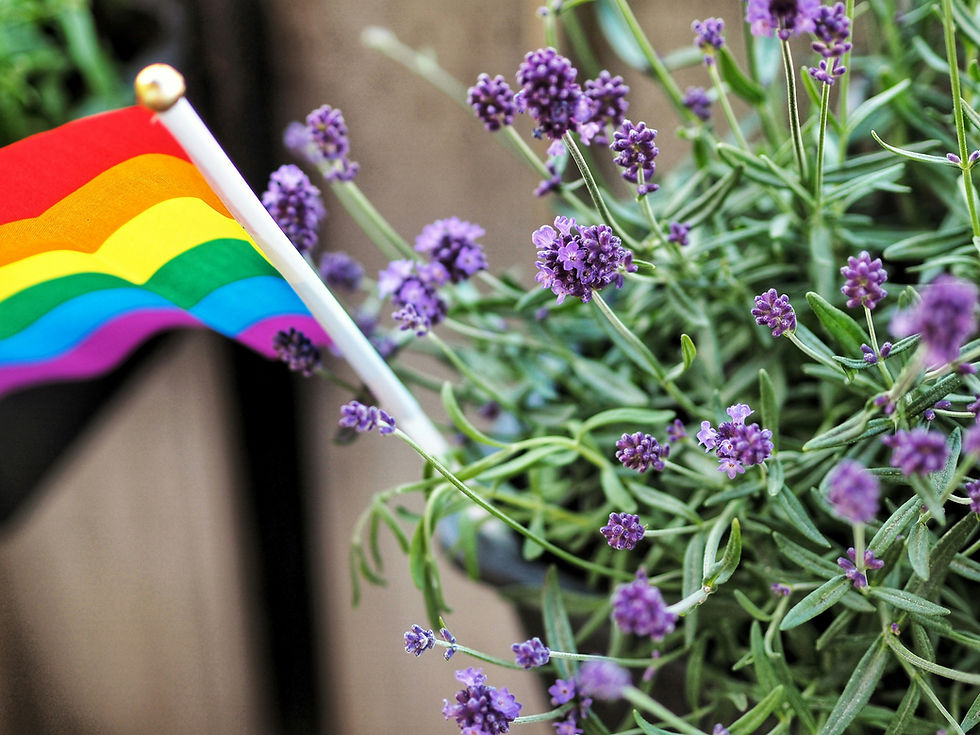
In the twentieth century, lavender showed up increasingly in LGBTQ+ activism, literature, and art. Things like “lavender menace” and “lavender scare” were pointing at discrimination, but also resistance, at the same time.
Artists adopted lavender because it could carry nuance and also express complexity. It made people challenge binary thinking, and it honored identities that existed outside the standard categories.
Today, even if the rainbow flag grabs most of the public attention, lavender is still one of the most important historical symbols in the lgbtq community.

The Pink Triangle: From Persecution to Resistance
Among all queer symbols, few possess a history as powerful—or as painful—as the pink triangle.
Under Nazi rule, gay men who were locked up in concentration camps were forced to wear upside-down pink triangles as identifying badges. It was supposed to isolate, stigmatize, and dehumanize them.

Decades later, activists started to reclaim the pink triangle and shift its meaning. In the gay liberation movements of the 1970s and 1980s, the symbol got picked as a reminder of past oppression and also as a call toward resistance.
Artists brought it into posters, murals, performance art, and political campaigns. At first, the pink triangle was a clear sign of persecution. But it ended up being a declaration of survival.
This change shows how a community can reclaim a visual language and redefine what it stands for through shared collective action.
Lambda: A Symbol of Unity
Before the rainbow flag became globally dominant, another symbol gained prominence: the Greek letter lambda (λ).In the early 1970s, activists picked lambda as a representation of unity, liberation, and collective strength. The symbol showed up on organizational logos, publications, banners, and various artworks across the expanding LGBTQ+ rights movement.

Lambda gave something crucial that a lot of earlier coded symbols couldn’t: visibility. It worked like a public statement instead of being a concealed signal.
While less common today, it remains an important chapter in the evolution of queer visual identity.

The Rise of Modern Gender Symbols
As discussions of 'identity' began to spread, the traditional male and female signs shifted to more inclusive gender symbols. Artists and designers began mixing, overlapping, and reimagining the classical planetary marks that people linked with Mars and Venus. These revised gender symbols reflected an increasing awareness of gender diversity and how people express themselves.
A lot of the contemporary pieces that are being created in the world today use gender symbols to explore identity, gender fluidity, connections, and social changes. Unlike the hidden codes from earlier generations, modern gender symbols are usually intentionally visible. They nudge people toward dialogue and not secrecy.
The Birth of the Rainbow Flag
In 1978, artist and activist Gilbert Baker made the first rainbow flag for San Francisco’s Gay Freedom Day Parade, after encouragement from Harvey Milk. The very first design had eight colors, and each one carried its own meaning. But then, later on, production headaches reduced the design to the six-stripe version everybody recognizes worldwide right now.
The rainbow flag represented something fundamentally different from earlier queer symbols.
It was not hidden. It was not coded. It was designed to be seen.

The flag spread fast through the global lgbtq community. It became a symbol of visibility, diversity, hope, and shared pride. As time kept going, newer versions emerged. These represented more identities and the different lived experiences within the community. Today, the rainbow flag is still the center of celebrations, activism, and every pride parade worldwide.
Art as a Language of Survival
The history of queer art is not only a story about aesthetics. It is also a story about communication.
When visibility was dangerous, flowers became messages. When language was restricted, colors carried meaning.
When identity had to be hidden, artists turned everyday things into unusual symbols of recognition and belonging. The violet, the green carnation, lavender, the pink triangle, lambda, modern gender symbols, and later on the rainbow flag each represent different chapters in a much larger narrative.
Together, they remind us that art is not just decoration and has always been more than that. For generations of people across the lgbtq community, it became a way to find one another, guard identity, resist oppression, and picture a more inclusive future.
Long before the rainbow flag started filling city streets at every pride parade, these quiet symbols held the hopes, the struggles, and the resilience of a community that was determined to be seen.