Before the Horror Movies, These Scary Halloween Paintings Existed!

Updated: 3 hours ago

October diaries are never complete without Halloween jump scares or uncanny social media feeds. But a lingering dread and supernatural terror were created long ago, before motion pictures existed, through horror art and Halloween paintings.
Medieval imagery focused on hell and mortality through its grotesque art. Romanticism art created psychological horror through the depiction of nightmares and occult symbolism in dreams, giving fear a visual form.
Renaissance artists turned to post-apocalyptic art of destruction, whereas German Expressionism of the early 20th century heightened the creepiness, altering psychological experiences through theatrical performances and films.
The Fine Line Between Art and Horror Movies
After World War I, Germany experienced a modern world of uncertainties. A new wave of transformation redefined civilization, artistic identity, and the relationship between humans and the changing world. German Expressionism transformed cinematic language through dramatic shadows, distorted shades of anxiety, fear, and psychological tension.

It was a time when established norms of creativity were overridden by new perspectives, proportions, and observation. The world seemed strange. The artistic expressions looked insane. Naturalism impacted how Expressionists visualized the world around them with emotional intensity.
Early horror filmmakers were greatly inspired by the shadowy depth of the art of chiaroscuro by Caravaggio. Modern directors inherited psychological dread from the famous dark paintings of past centuries.
The Cabinet of Dr. Caligari and film noir used chiaroscuro techniques of dramatic shadows and high contrast.
The scariest horror movies, like The Cabinet of Dr. Caligari, Nosferatu, and Fritz Lang’s Metropolis, expressed a chaotic world of creepy uncertainty and unrest. The unusual perspectives of film noir focused on complex stories of moral uncertainty that were dark and dreadful.
A familiar world became bizarre; the human body became a medium of terrifying expression. Horror art was not to be seen but to be felt.
Horror Existed in Centuries-Old Scary Paintings
These visual representations of horror existed in several Halloween paintings, depicting death, hell, nightmares, and a world infested by monsters, witches, and sorcerers.
Let’s revisit some of the scariest paintings in art history that explored the darker side of the human mind for centuries.
From Hieronymus Bosch paintings to Francisco Goya’s nightmares to Edvard Munch’s unsettling screams to William Blake’s supernatural visualizations, these creepy masterpieces proved that art history can be stranger than one can imagine.
The Garden of Earthly Delights: Hieronymus Bosch, 1450-1500

A triptych oil painting from the Northern Renaissance era. In this ghastly representation of imaginary hell, infested by monsters and other scary creatures, morality and the fate of humanity are tested. The sinners are tortured in hell with musical instruments. It’s a sinister warning to humans involved in lust and earthly sins to avoid a grueling fate.
The Witches’ Kitchen: David Teniers the Younger, 1660

The painting creates a dimly lit backdrop with a shadowy appearance of a supernatural identity. The scene reveals occult activities, with a human skull, glassware, and candles – giving the room a deeply unsettling and mysterious air. The room also includes some obscured figures along with a nude male figure participating in real witch trials.
Takiyasha the Witch and the Skeleton Spectre: Utagawa Kuniyoshi, 1843-1847
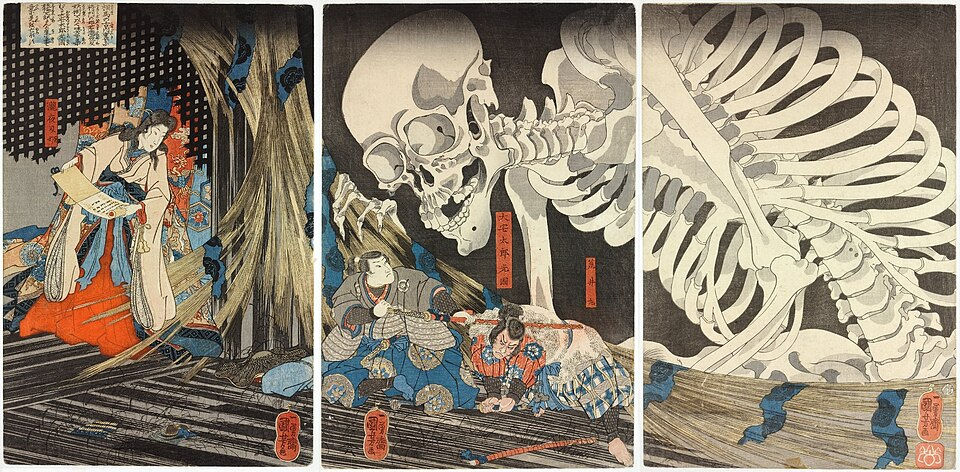
A Japanese Ukiyo-e woodblock print by Utagawa Kuniyoshi shows a massive skeleton bending over samurai warriors. The artwork tells a strange story of a Japanese princess, Takiyasha, who practiced witchcraft to plot revenge on her uncle, who killed her father.
She invoked a giant skeleton made from the bones of dead soldiers and haunted spirits of people who died of famine. As the skeletal figure looms over her uncle and his consort, the two soldiers shrink in fear and dread.
L'inhumation Précipitée (The Premature Burial): Antoine Wiertz, 1854

Antonio Wiertz’s painting portrays the most terrifying idea of burying someone alive. During the 18th and 19th centuries in Europe, cholera victims were treated as highly contagious, and most of them were hastily buried, which was worse than murder.
In this painting, a cholera victim, who was buried alive, lifts the coffin lid only to discover a grim scenario filled with the gloom of death, spiders, a human skull, and rats sneaking into adjacent coffins. The facial expression shows instant horror. The revival seems worse than death.
Skull of a Skeleton with Burning Cigarette: Vincent Van Gogh, 1886

Most of Van Gogh’s paintings are shrouded in mystery or a hidden story. The cigarette-smoking skeleton in this image might look creepy at first glance, but a closer look reveals it as a satire by Van Gogh, who ridiculed the conservative outlook of academic practices of the Royal Academy of Fine Arts in Antwerp, Belgium (RAFAA). He once attended the academy to pursue anatomical studies but left shortly after he found the sessions boring.
Fine Art Portrayed Horror Before Cinema Turned It into Nightmares

The modern perception of fear and dread is heightened by psychological thrillers — no wonder! Now, horror is commonly associated with the realm of cinema and theatrical expressions. Films like Silence of the Lambs, Hereditary, Psycho, etc., show how obsessed we are with our own world of fear and psychological tension.
But the scenario was different before cinema existed. Before dark films and horror movies turned our dreams into nightmares, fine artists illustrated our deep-seated fears of ghosts and monsters, demons and devils, and death and disease through scary illustrations and Halloween paintings for centuries.
Behind these spooky paintings lies a narrative of a terrifying gloom, loneliness, and the fear of the uncertain, which we don’t want to acknowledge right away. This sense of gripping fear and anxiety that we push away penetrates deep into our psyche.

These nightmarish depictions are not the devilish monsters but the insecure versions of ourselves!
This spooky Halloween season, let’s explore the true monsters we carry within, decoding the scary stories of the centuries-old haunting works that we may have missed last time.
Don’t forget to explore modern Halloween art to see how spookiness has found its new avatar in haunted chairs and moving fonts!