_PNG.png)
Art Nouveau vs. Art Deco: 5 Easy Ways to Differentiate The Iconic Trends

Updated: 3 hours ago

Let’s get on an art history tour, riding through a timeline when ornamental art rose to its peak with Art Nouveau and Art Deco movements. It was a period that began in the late 19th century and continued into the 1930s. Though these two consecutive movements may appear identical at first glance, Art Nouveau vs Art Deco differ in terms of presentation, aesthetics, and design logic.
While Art Nouveau revived natural and organic elements like flowing patterns, curls, and vines in a rapidly changing modern world, Art Deco concentrated on geometric precision in architectural designs, inspired by the emerging world of automation.
There are surer ways to tell them apart. Let’s step back and unfold a chapter in history to know how art evolved in a disillusioned society impacted by war and unrest.
Exploring the History of Art Nouveau: Where It Took Off

To understand what makes these two artistic trends distinct, we first need to step into the wonderland of Art Nouveau, where it all started. Derived from the French word, "Art Nouveau" meant something new in art. Indeed, it was a new wave that swept Europe for more than two decades.
In our previous blog on Gustav Klimt paintings, we discussed how the famous Austrian artist used stylized patterns in his golden masterpiece The Kiss. His creations reflect the aesthetic excellence of an era that diverged from rigid historic styles and focused on organic, floral forms inspired by nature. This was the era of Art Nouveau art, flourishing in Belgium, Italy, Austria, France, Germany, and some major American cities during the last decade of the 19th century.
Why Did This Shift Happen?
In the mid-to-late 19th century, Britain experienced the Arts and Crafts Movement, in reaction to the mass-produced goods of industrialization. This movement focused on handcrafted and skilled workmanship, integrating art into everyday life without compromising on the aesthetic aspect. Art Nouveau artists shared these ideas and pushed them further while introducing plant & floral motifs in an ornamental and modern style.
Thus, Art Nouveau was a response to the growing standardization of industrial Europe. Artists and designers wanted to bring something fresh into the designs that felt modern and expressive.
The effects of this movement were felt from the late 19th century to World War I and endured even after that period. It embraced various artistic genres such as typography, ornamentation, furniture design, jewelry making, photography, and architecture, along with painting.
The most intriguing part of this movement was making beauty a part of everyday life, not limited to designing objects or painting masterpieces.
How to Identify Art Nouveau? Follow These Design Patterns
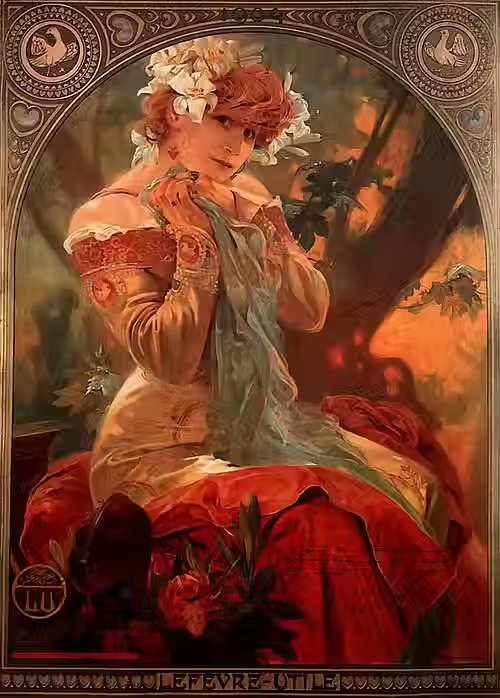
Are there any telltale signs of Art Nouveau art? Yes, you can identify the design patterns where you see bending stems of a flower, curling hair of a female, or a butterfly unfolding its wings – captured in precision. Art Nouveau meant flowing, organic lines and curves.
There are some prominent patterns—
Flowing, ‘S’-like curves and lines.
Natural forms used floral designs, patterns of leaves, and vines.
Female figures with locks caressing their faces, insects, and birds.
Stylized and harmonious designs with intricate details.
Rather than separating art from design, Art Nouveau often brought the two together. A poster could look like a painting; a chair could resemble something grown rather than manufactured; jewelry could transform flowers, insects, and animals into elaborate works of art.
Who Are the Famous Art Nouveau Artists?
The Art Nouveau movement flourished mainly in Germany, Austria, Belgium, Spain, and Italy in Europe. A Czech artist, Alphonse Mucha, added a visual identity to this movement with stylized designs of long-haired female figures, surrounded by floral motifs. He became one of the pioneering Art Nouveau artists along with Gustav Klimt.
Mucha’s posters of French actress Sarah Bernhardt showed his adoration of stylized beauty and elegance.

There were other prominent names in Art Nouveau architecture, like French designer Hector Guimard, Belgian architect Victor Horta, and furniture designers Émile Gallé and Louis Majorelle, who made their marks through their contributions to this art style.
Though Mucha was considered a pathfinder of this art trend, as he influenced the graphic style to a great extent, Art Nouveau was not made by a single person – it was a collective movement spread across many countries, with artists interpreting styles in their own ways.
What Defines Art Nouveau Architecture
The impact of these ornate patterns was felt more in Art Nouveau architecture. Architects and designers experimented with floral and plant motifs, curves, stained glass, and intricate ironwork.
Art Nouveau examples are Victor Horta’s ornate building designs in Brussels and the Paris Métro entrances designed by Hector Guimard. They showed how elegance in art can transform even an ordinary object into a visual feast. Instead of adding decorations, the architects made the patterns in such a way that they felt like one continuous design.
Ornate Posters to Bedazzled Jewellery: A Show of Elegance and Craftsmanship

The beauty of Art Nouveau lies in its inclusive logic. It was not limited to galleries and museums. Its effect was felt in everyday objects like advertisements, jewelry design, furniture, glassware, books, posters, textiles, and interior design.
René Lalique's jewelry and glassware design and Mucha’s graphic-styled posters show how the movement has spread across artistic disciplines. Everything that carried its elegance transformed the ordinary into something unforgettable.
Art Nouveau vs Art Deco: What Were the Distinct Styles
The two styles added ornamentation and beauty to their design logic, yet they were distinct in some ways. They represented two different cultural moments in history.
Art Nouveau | Art Deco |
|
|
|
|
|
|
|
|
|
|
Art Deco Followed Art Nouveau:

Art Deco followed the decades of Art Nouveau, but now the designers mainly focused on symmetry, geometrical patterns, and glossy, modern materials associated with a machine age.
There is a very thin line to draw between them. Artists and designers of these art trends were inspired and influenced one another, borrowing from each movement.
Art Deco architecture represented stylized modern design aesthetics of glamor and symmetry that reflected the technological progress that the decades were experiencing. It combined the charm of ivory and silver with modern materials like chrome, stainless steel, and polymers.
Why Do Styles Like Art Nouveau Still Feel Relevant?

The effects of these phenomenal art movements can even be felt in modern framing, wall décor, ornaments, and digital art.
When we see some floral and decorative patterns in wallpapers, fashion, and jewelry, we still celebrate the art ethics of Art Nouveau.
Digital artists often combine organic forms with intricate decorative patterns. The idea was to suggest that the things we experience in our day-to-day lives can be functional and beautiful.
Art Deco styles mainly gave way to more international and unornamented modern design aesthetics. But Art Nouveau endured.

So, the next time you see a winding entrance, an elegant poster with flowing lines and curves, or flower-inspired jewelry, take a pause.
The trend has impacted our visual landscape of the 21st century, offering a breathing space in the rigid geometry of contemporary structures.
FAQ Section:
Question 1: What is the difference between Art Nouveau and Art Deco?
Answer: Art Nouveau vs Art Deco reflects a subtle difference in style and design logic. Art Nouveau was known for its ornate styles, floral patterns, curves, and bends, featuring minute details. Art Deco was known for its streamlined and polished approach, zigzags, and geometric symmetry.
Question 2: How and when did Art Nouveau and Art Deco emerge?
Answer: Art Nouveau style was introduced in the late 19th century and flourished into the early 20th century, while Art Deco style was dominant from the 1920s to the 1930s.
Question 3: How to identify Art Nouveau designs?
Answer: Art Nouveau art features stylized female figures with flowing hair, floral and plant motifs, insects, and birds captured through harmonious designs. Artists were greatly influenced by decorative elements from nature.
Question 4: Who are some famous Art Nouveau artists and designers?
Answer: Alphonse Mucha and Gustav Klimt can be named as some of the best Art Nouveau artists, along with other prominent designers and architects such as Victor Horta, Hector Guimard, Émile Gallé, and Louis Majorelle.
Question 5: What are the main characteristics of Art Deco?
Answer: Art Deco flourished in an emerging era of automation. So, its designs featured a polished approach related to modern materials of the machine age, focusing on geometric symmetry and precision, straight and angular lines, zigzag patterns, sunbursts, and stepped forms.
Question 6: Did Art Deco come after Art Nouveau?
Answer: Yes. Art Deco, which was prevalent in the 1920s and the 1930s, followed Art Nouveau architecture. There are various similarities and differences between these two art movements, and artists and designers influenced one another across the period.