_PNG.png)
The Eyes of Doctor T.J. Eckleburg: Analyzing The Great Gatsby Book Cover Art


Pick up almost any copy of The Great Gatsby and the first thing you will see is The Eyes of Doctor T.J. Eckleburg. The two sorrowful eyes hang in a blue sky on that cover, with a smear of scarlet lips beneath them and an amusement park skyline glittering below. It's surreal; it seems like a dream. The Great Gatsby book cover art is one of the most reproduced pieces of cover art in American publishing; it is printed on tote bags, and posters of it were on dorm room walls, even by people who have never opened the book.
What almost no one knows is that the image, that is, The Eyes of Doctor T.J. Eckleburg, came first. Francis Cugat painted those beautiful eyes before F. Scott Fitzgerald even finished writing the novel. The author, by admission, then went back and wrote this painting into his story. This cover is not just decoration; it is a piece of text itself.
An Artist Working Blind

The eye of Doctor T.J. Eckleburg is not just a coincidence that matched the book jacket. It was written with intent. The Great Gatsby blue cover art meaning comes from the draft of the book rather than its final manuscript.
In 1924, Charles Scribner's Sons, a famous American book publishing house, wanted a jacket for the novel that was still in the process of being written by F Scott Fitzgerald. The draft version was actually titled Ash Heaps and Millionaires. They hired Francis Cugat to illustrate it, but Cugat had barely had any material to work from. Cugat was a Spanish-born painter and illustrator who only painted on one book cover in his lifetime—the Great Gatsby book cover. Later, he became a Hollywood set designer.
With literally no material to take inspiration from, Cugat worked on what he had and started sketching, weighing ideas, and that shows in his early drafts of the book jacket. He started with a bleak ash-gray landscape, as in the direct response to “Ash heaps,” which he judged was too grim and therefore discarded it. Then he pivoted towards something that was more human yet moodier—a half-hidden face of a flapper, drawn over the lights of the Long Island Sound, with one eye leaking with a single tear.
He created many versions of it, revised it again and again, until the face dissolved further until nothing remained but only the eyes—two luminous eyes and a mouth, well, just scarlet lips, suspended in a deep blue sky above a cityscape. He called them the celestial eyes.
How Does the Eckleburg Symbolism Fit?
Now, Fitzgerald was behind on the manuscript, and the book cover jacket was already done. The editor of Fitzgerald had loved it and sent the cover art to the author, calling it a masterpiece. When Fitzgerald saw it, it was not confirmed whether he saw a rough sketch or the full painting, but whatever it was, it worked on him too, and he wrote to his editor, Maxwell Perkins, that he had written the cover art into the book.

What do the Eyes of Dr. T.J. Eckleburg Symbolize in The Great Gatsby?
Most authors have no say in their book cover art, and even rarer is it that an author reverse-engineers to match their story with the cover design. But Fitzgerald did that. If you read the book, you will see how there are traces of the eyes of Doctor TJ Eckleburg in the text in more than just one place.
Doctor T. J. Eckleburg, the fictional optometrist in the story, the billboard of whom looms over the valley of ashes, perfectly echoes the Great Gatsby blue cover art meaning, architecturally. The character Nick Carraway, the fictional character, also the narrator of the story, also describes the eyes with unmistakable resonance in many places. A face made of enormous yellow spectacles hanging over a non-existent nose and eyes faded by weather that keep a watch over the wasteland – what a description; maybe not the literal transcription of Cugel’s painting, but the mood, the scale, and the placement mentioned above a blighted landscape is close enough to show the connection, even the critics are certain.
The second echo that can be seen in the text is subtle, and the points are about the female love interest, Daisy Buchanan.
At one point, the narrator, Nick, describes Daisy as a girl who has a disembodied face, which is floating along the dark cornices and blinding signs of the city at night—this sentence serves as a caption to the Great Gatsby original cover art.
But this has also made the lovers of the book and the scholars debate about whose eyes these are. Whose eyes are they? Really? Eckleburg or Daisy?
The honest answer—it can be both or neither. But what I think it is the eyes of whom you want to believe, as a reader. When you want them to be the eyes of Daisy, they will become Daisy's, and when you want them to be the eyes of Doctor TJ Eckleburg, they will become his.
Cugat painted those eyes without reading the plot, so he created an atmosphere that created the relation between the story and the original book cover art, not the other way around.
The Great Gatsby Cover Art Analysis
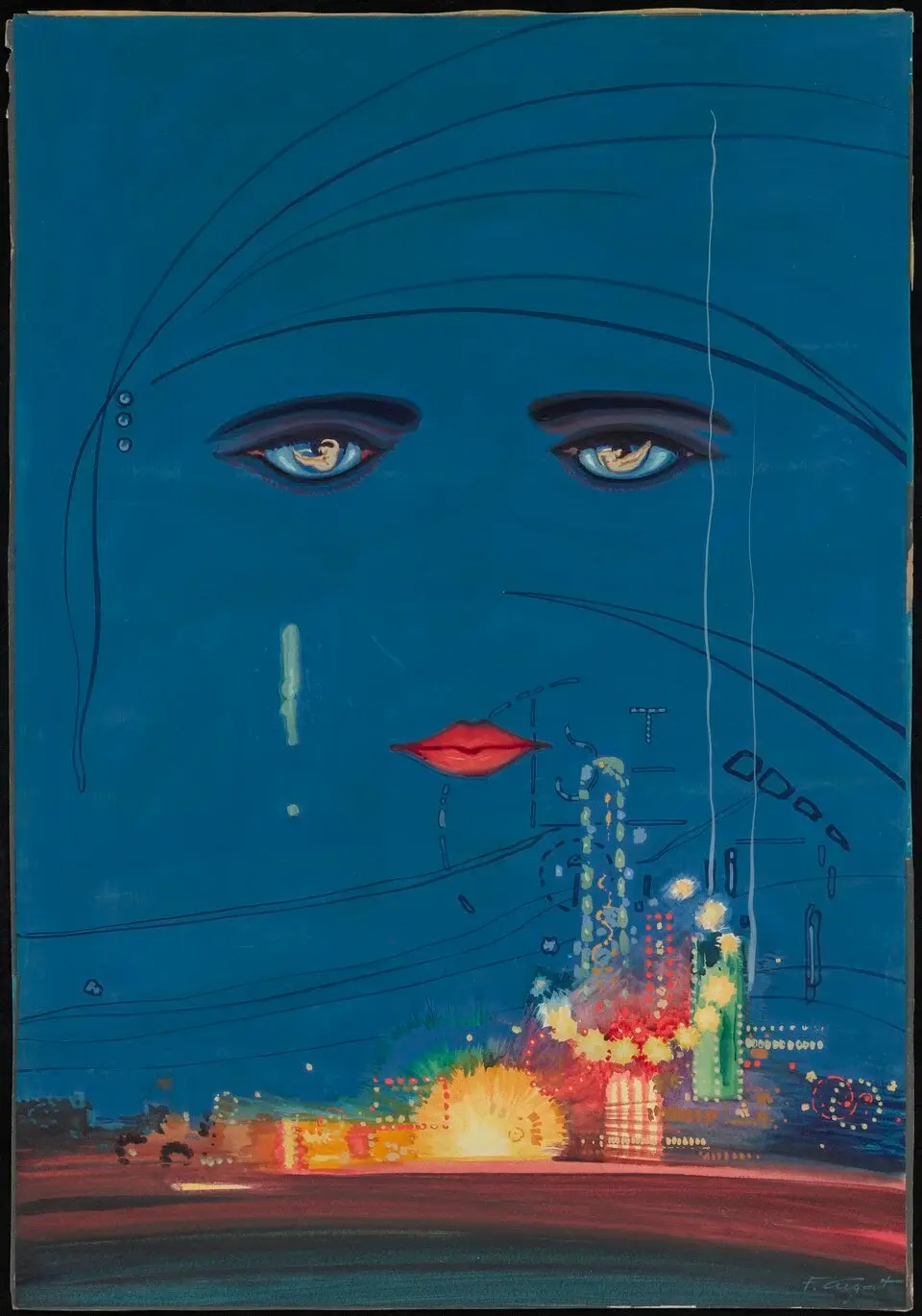
What makes the Celestial Eyes endure is not just the odd trivia of the timing; it's that without even trying to give the cover a meaning, Cugat distilled the emotional architecture of the novel. The TJ Eckleburg symbolism was not about illustrating a scene; it was about the feeling that somebody is watching.
Consider the composition: the eyes are hanging in the sky; there is no body that attaches them to the Earth; indeed, they seem sad and powerless and passive at the same time, and are over an amusement park skyline. Amusement part is the symbol of fun, colors, and joy. It is glamorous, which can possibly be the echo of Gatsby’s parties.
The contrast is clear. The message is concise. Grief floats above, spectacle churns below. Every party that gathers with laughter ends, and then emptiness fills the eyes.
Looks like judgement and indulgence share the same sky but are never meeting.
Eyes of TJ Eckleburg Meaning
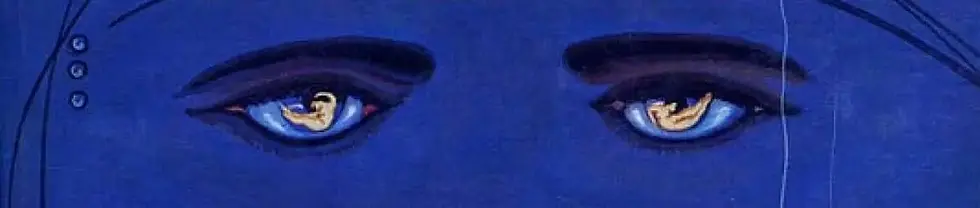
There is a detail that is hidden in the eyes, which reveals itself when you look closely. In the irises of Cugat’s eyes are tiny reclining nude figures. They are easy to miss at first glance but unmistakable once you take a closer look. It was a touch that was very daring, seeing the fact that the book was published in 1925 and that this was a book jacket.
This small detail says a lot; it was an encoded gesture towards the novel’s undercurrent of desire and moral transgression, the reckless appetite running beneath its glittering surface.
The sexual tension of the story was written in its cover even before the story was complete. Isn't it fascinating? It was like a direct comment, but rather, in actuality, it was an artistic flourish.
Gatsby's whole project — the mansion, the shirts, the parties — is desire dressed up as ambition, longing disguised as glamour. The painting seems to know that before the book has said it.
The Rare Kind of Collab
Book covers are usually made after the book is done, when the manuscript is ready. Celestial Eyes, the eyes of TJ Eckleburg, or the cover art of The Great Gatsby inverted that process, and the result was that both the book and the art became a classic, a timeless piece of literature and art.
With only a working title, Cugat drew an image, and that image brought the writer to write the art in the literature; what a damn good collab it turned out to be. Something unique and unexpected.
Today, the original gouache painting is in the Princeton University library; the writer, Fitzgerald, also studied at this university. Occasionally, the painting is exhibited as well.
More than a hundred years have passed—the art preceding and shaping text still remains the strangest and most fitting of events. It is also the best footnote to a book which is obsessed with the gap between illusion and reality. The character Gatsby, in the entire novel, is trying to make an invented image real. And hence, it seems only right that his story was, in its own way, built to match one.