_PNG.png)
8 Stirring War Memorial Art You Must See: From World Wars and Beyond

Updated: Jul 20

Wars are inevitable, whether we challenge them or validate them. From ancient times in history, wars were fought between tribes, clans, and communities to establish power and position. When we speak of visual remembrance of battles, we speak of the famous war memorial art, such as paintings, sculptures, cenotaphs, photographs, and propaganda posters, creating an emotional impact on the viewers. Artworks on warfare thus play significant roles in recording and sharing the experiences of those gruesome episodes in human history.
How Art Preserves War Memories with Impact

If you are wondering what war has to do with art – read on. Art is nothing but a communication between the creator and the receiver. Art helps us understand the hidden emotion behind the creation and to engage with ideas, no matter how complex they seem. War is the most complex of the concepts we can ever perceive.
Artworks chronicle war in vivid and harrowing details while they also try to heal through remembrance.
Historical memorial art is explored by humans from the ancient Egyptian civilizations, Roman war memorials like Trajan’s Column, Arch of Titus, medieval tapestries, to modern-day war portraits.
Whatever the backdrop, the conflict of emotions offers viewers a feeling of intrigue and repulsion at the same time. We cannot help but be impacted by these visual stories, mostly tainted with loss and fear.
In this blog, we will discover some engaging and deeply moving art inspired by war, 8 paintings and graphic illustrations by incredible war artists that stir, overwhelm, and make us think about the legitimacy of the whole exercise. We’ll also discover how war paintings have evolved with time.
The Role of War Artists in Magnifying the Conflict and Drama

How does art preserve war memories? Through war artists and correspondents. These artists were commissioned by patrons of war, and they existed to depict everything about the conflicts and combats, often from the frontline.
What was the purpose of commissioning war artists? Here, we must understand how art contributes to portraying war. There are several reasons –
One of the main mottos of war art is to oppose war by depicting the brutality of warfare.
Artistic depictions of war also suggest a tone of propaganda to promote, encourage, and instigate others into conflicts.
Art helps societies to heal after wars and combats through curated representations. It serves both emotional and practical purposes, offering healing therapy to the veterans of war.
Thus, war artists were appointed to portray the brave hearts of the battles, to commemorate the martyrs and soldiers, to paint their sacrifices, to portray the technical side of the war, and to record the human reaction involved in the combat.
Though the British Empire did not employ artists immediately when the Great War broke out in 1914, it did after two years. Sir Muirhead Bone was one of the first few official war artists of the First World War.
Famous World War Artists and their Paintings
There has been a shift in the style of war portrayals that demands attention. Gradually, the focus shifted from Renaissance and Baroque-styled ornamentation and Victorian era grandeur to abstract, surreal, and psychological representation.
Most famous paintings of the Great Wars were not always the story of gallant soldiers, but the truth of the grotesque battle scenes, revealing the dust, grime, sweat, blood, corpses, barbed wires, gassed men, and more such grim details.
Sir Kenneth Clarke, then the Director of the National Gallery, thought of preserving the realities of war through visual depictions along with the welfare of war artists. He established a committee (WAAC) to protect the livelihoods of such artists during the tough times, appointing them to create war memorials through art.
Some of the remarkable artists who were involved in depicting the mayhem of World War I and World War II and beyond are –
1. William Longstaff – The Ghosts of Vimy
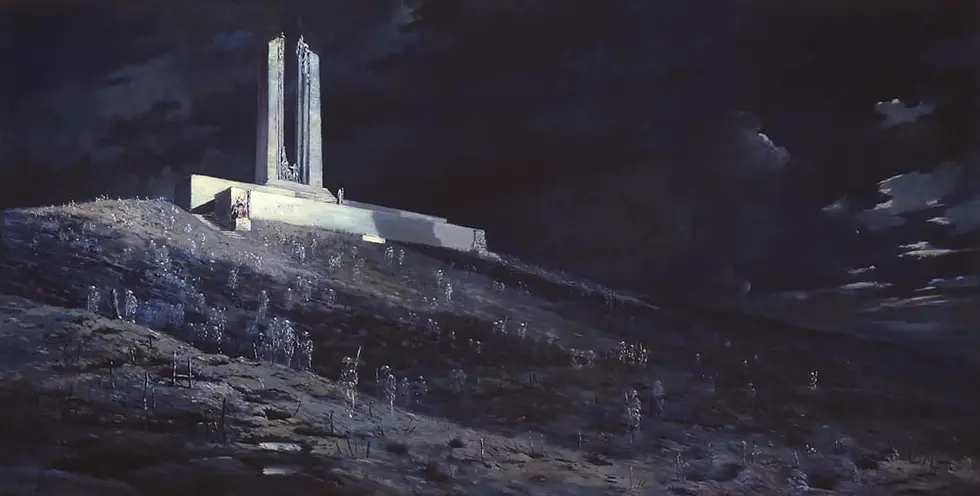
William Longstaff was an Australian artist who created this moving war memorial art in 1929, depicting memories of World War I. ‘The Ghosts of Vimy’ shows the memorial of Vimy glowing in the night, and the viewers can see ghostly soldiers move across the battlefield. Through this symbolic painting, the artist wanted to portray the sacrifice of the Canadian soldiers who lost their lives during the Battle of Vimy Ridge in 1917.
2. John Singer Sargent – Gassed

‘Gassed’ is one of the most remarkable depictions of the Great War. The name itself suggests a connection with gas, which can be toxic. Created by John Singer Sargent, this World War I memorial art portrays wounded soldiers blinded by mustard gas after the Second Battle of Arras in 1918, showing the brutality of chemical warfare.
3. Sir Muirhead Bone – Erecting Aeroplanes
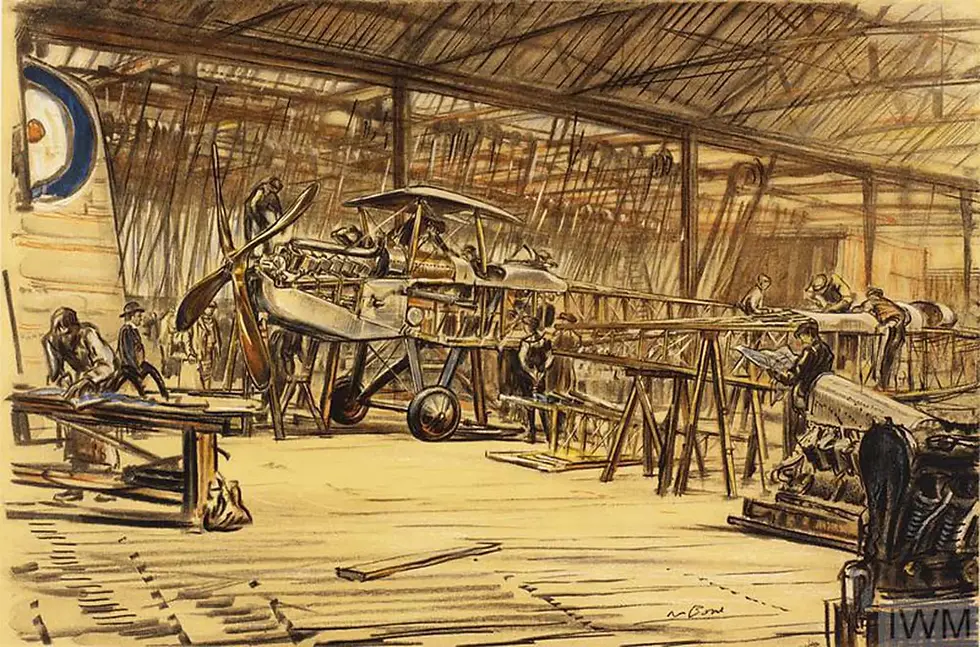
Sir Muirhead Bone, Britain’s first official war artist who was also a draughtsman, had a knack for pencil drawings. He drew the technical complexity of modern warfare with its factories, machinery, cranes, and erecting warships. He enjoyed depicting these industrial scenes while he also projected shattered battlefields, devastated buildings, and landscapes of the Western Front.
4. John Nash – Oppy Wood

John Nash, who was one of the famous British war artists of World War I, served on the Western Front and had many notable war paintings documenting the agony of war with stark realism. ‘Oppy Wood’ shows a devastated French landscape during the war, with shattered earth and shaken trees, as a result of incessant firing.
5. L.S Lowry – Blitzed Site

L.S. Lowry was known for his industrial landscapes, but he also worked as a war artist commissioned by WAAC during the World War II. In his painting ‘Blitzed Site,’ 1942, he showed a ruined and bombarded city with its streets in muted shades of grey with red accents. He captured the aftermath of air raids across cities beyond London, targeted by German bombers.
6. Tom Lea – That 2,000 Yard Stare

Tom Lea was Life magazine’s first official war artist and correspondent of World War II, expressing the emotional intensity, trauma, and exhaustion of the soldiers. Speaking of one of his notable paintings, ‘That 2,000 Yard Stare,’ 1944, Lea said once:
“As we passed sick bay, still in the shellhole, it was crowded with wounded, and somehow hushed in the evening light. I noticed a tattered Marine standing quietly by a corpsman, staring stiffly at nothing. His mind had crumbled in battle, his jaws hung, and his eyes were like two black empty holes in his head … ” - Tom Lea, Peleliu Landing
Other than paintings of the two major World Wars, there are war portrayals of some of the prominent American war artists of the Civil War, African military uprisings, and more.
7. Winslow Homer – Prisoners from the Front (1866) Civil War Paintings
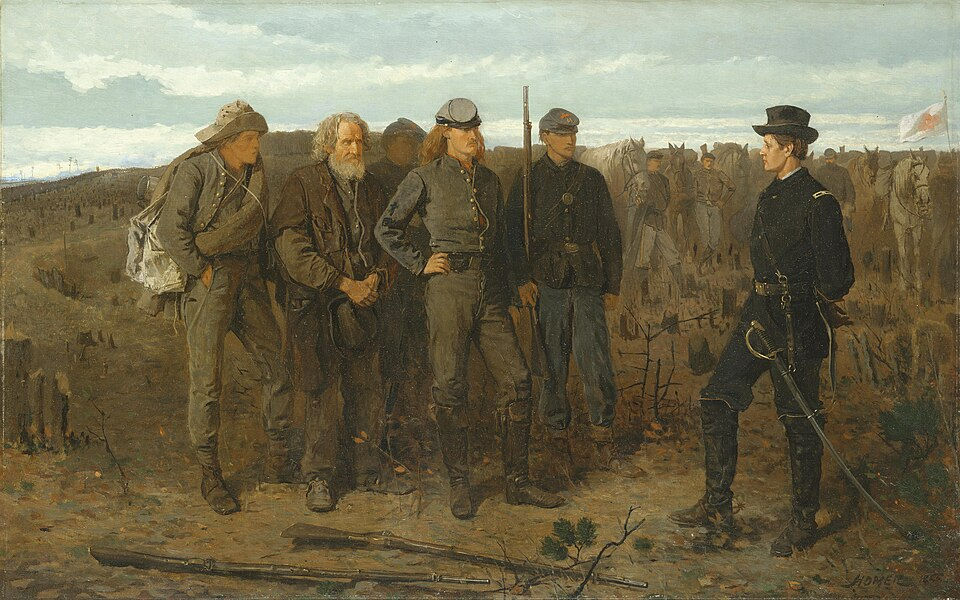
Artist Winslow Homer’s paintings revolve around the American Civil War, while he tried to showcase a different perspective of war. His deeply psychological paintings dealt with emotional strain, quiet moments, and daily lives impacted by the war. His famous artwork ‘Prisoners from the Front’ shows a scene of surrender of Confederate officers to a Union Brigadier General, an ideological divide.
8. Joe Sacco – War through the Eyes of a Graphic Journalist

Joe Sacco was a war correspondent and a graphic artist who could turn the violent atmosphere into a modernist war depiction, approaching war creatively. He tells stories from war-afflicted zones through detailed comic strips and graphic novels based on his on-the-ground reporting. He unveils a unique side of war journalism with a difference.
“It can show you things that the camera can never see, too. You don’t get cameras going into a torture chamber. There were no cameras going over the top at the Battle of the Somme.”
War art through Sketches, Sculptures, Photos, Posters, and Beyond
Remember the stunning holocaust drawings by the 15-year-old German boy Thomas Geve, who drew Auschwitz, a Polish concentration camp during World War II? There are more such drawings, sculptures, photography, posters, and other forms of art inspired by war that reflect the heroism, agony, triumph, and testimonies of warfare.
Some artists were commissioned to create relief sculptures after World War I for the Hall of Remembrance. Though it was never built as planned, we could see some remembrance art inspired by Roman and Greek heroic styles.
The Battle of Ypres, 1914: The Worcesters at Gheluvelt from Charles Sergeant Jagger is such a stone relief. There were artists like Henry Poole, Charles Wheeler, William McMillan, and Esmond Burton whose sculptures can be seen in worldwide memorials, including the World War I Naval Memorials in the UK.
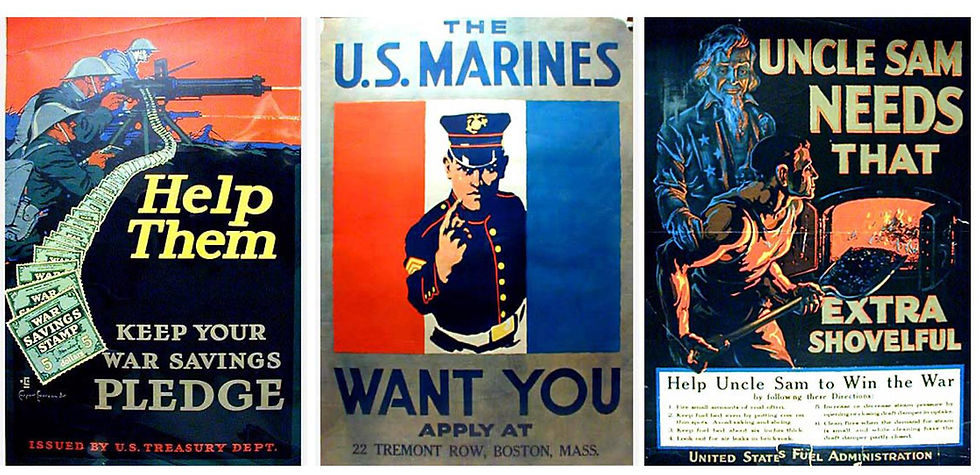
Even wartime posters were widely circulated as propaganda showing the military imagery during World War I. Howard Chandler Christy’s posters were popular during the World Wars.
Robert Capa’s wartime photography of World War II demands attention, while Roger Fenton’s first war photography of the Crimean War (1855), and Ernest Brooks’ snaps of World War I still make us realize the futile hostility of modern warfare.
More wars will be fought in the future, as the world is still grappling with the Russian-Ukrainian crisis. War depictions will inevitably evolve with time through biological warfare and beyond. What will never change is the mass destruction as a deadly aftermath, and the emotions that artists will continue to preserve long after the battles are over.