_PNG.png)
What Happened When Paris Put Rejected Art on Display in the Salon des Refusés


Imagine this scenario: you have invested your energy in a painting that took more than a month to take shape. You were meticulous about every detail: the colors, the perspective, the expression, the shading, and other intricacies. You have spent hours standing before the canvas, figuring out the flaws and strengths. Eventually, you submitted your piece to an exhibition and waited with your fingers crossed.
Then came the verdict: REJECTED.
What would be your instant reaction to this art rejection? A ‘no’ not only points to the flaws in your artwork. The feeling is deeply personal. It makes you question your skill, your talent, and your vision as an artist in this world.
Something similar happened in Paris. The same feeling of rejection tormented hundreds of artists with rejected art pieces in 1863.
But here comes the twist. Instead of feeling demoralized and dejected, the rejected artists did something unique that is remembered to this day.
They helped create one of the most unusual art exhibitions ever to happen in art history, from where the story of the Salon des Refuses took off.
Salon des Refusés: How Rejection Turned into an Exhibition

In the 19th century, the Paris Salon was known for its prestige and esteem. For artists exhibiting in the Salon, it would mean wider opportunities, art commissions, and professional recognition. Thus, the Salon was more than just an exhibition space; it was a place for validation. An official jury represented by the French Academy evaluated submissions. It was financed by the French government and the French Academy of Fine Arts. Acceptance by the official Salon carried weight; no wonder.
But in 1863, the jury rejected more than half of the artworks submitted. Though there is no exact figure to track down, authentic sources suggest that the figure could be around 2800 rejected artworks out of 5000 submissions. According to the Musée d’Orsay, the figure could be approximately 3000 rejected art pieces. The numbers were substantial enough to trigger disbelief and discontent among artists, and they started protesting.
After much uproar was created, Emperor Napoleon III had to intervene. Though he had a conservative taste regarding art, he was sensitive to public opinion. Instead of fanning the discontent of artists, he initiated something remarkable. The emperor ordered an exhibition to be conducted separately for all the rejected works so that the public could see and judge for themselves.
The Salon des Refusés, literally meaning ‘the exhibition of the rejected,’ was set up in another part of Palais de l’Industrie, Paris.

What was thrown aside became a groundbreaking experiment in art history and changed the outlook towards art showcases forever.
The Controversial Painting That Stole the Show

What could be the reason for this mass rejection? According to the protesters, it was the Salon’s elitist take on art and conservatism that shunned innovation and radical experiments happening in the art world. Some famous names whose works were rejected were Camille Pissarro, Antoine Chintreuil, Édouard Manet, Fantin-Latour, Gustave Courbet, James McNeill Whistler, Henri Rousseau, and others.
Several small-scale exhibitions started taking place around this time, which genuinely missed the glamour and expanse of a salon exhibition but attracted a decent crowd who came to watch the works of solo artists. These exhibitions were hardly covered by the Press.
Salon des Refuses 1863 paintings included around 2200 artworks discarded by the main Salon.
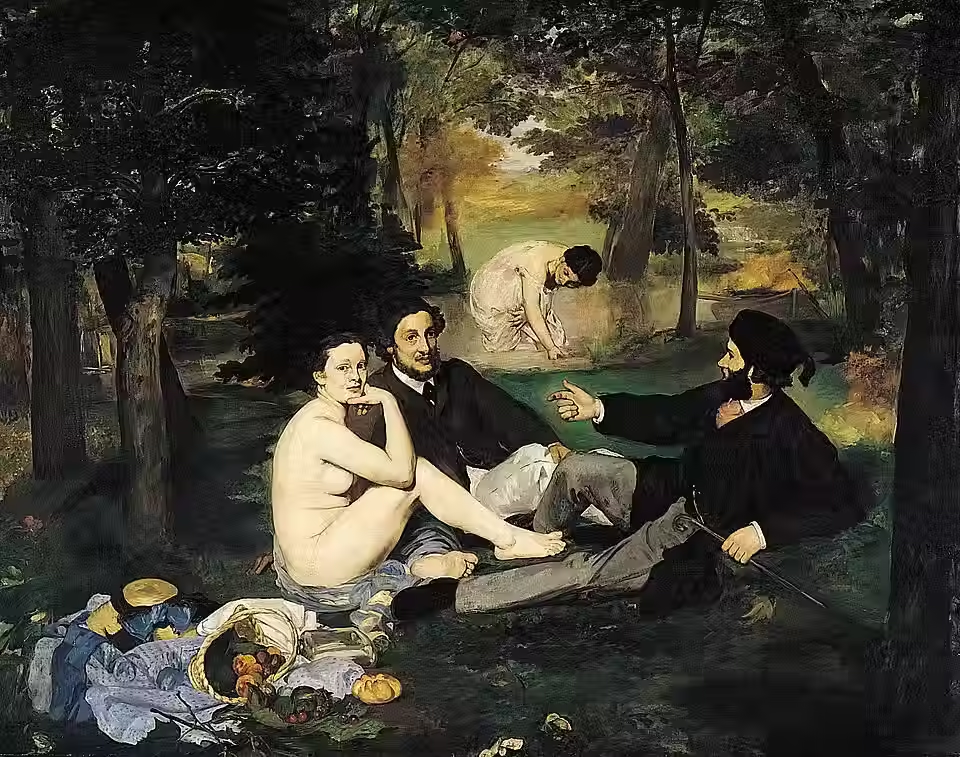
In this rare exhibition, Manet exhibited three of his paintings: Le Déjeuner sur l'herbe (The Luncheon on the Grass), Young Man in the Costume of a Majo (1863), and Mademoiselle V… in the Costume of an Espada (1862). Among these paintings, Le Déjeuner sur l'herbe became the show’s biggest conversation starter.
This painting triggered controversy among the visitors who were shocked by a scene of a nude woman seated beside fully dressed men in a contemporary setting. Though nudes were accepted as mythological references in classical art, the way Manet depicted nudity looked scandalous from a modern perspective. It was radical and extraordinary. The painting was hugely criticized and ridiculed by the public, yet it seized significant attention.
Visitors mocked the work as scandalous. According to the Musée d'Orsay, it became a source of public entertainment.
In other words, Manet’s rejected art stole the spotlight; it made people look.

The Failure Started to Redefine How Art Was Evaluated
Getting rejected by art galleries opened a new horizon for artists, like Camille Pissarro, Gustave Courbet, James McNeill Whistler, Cézanne, Fantin-Latour, and others, alongside Manet. How this artistic rejection became a cornerstone for modern art is another interesting story to explore.
The Salon des Refuses recorded thousands of visitors per day, open to the public and critics. However, some criticized this exhibition for favoring modern and avant-garde expressions like Impressionism to steal the public's attention.

Besides Manet’s controversial art, there were other great artists caught in the mesh of art rejection – Whistler’s Symphony in White, No. 1: The White Girl was another example. The way Whistler treated his subject in this painting challenged conventions.
Even for childlike and naïve Henri Rousseau paintings, Salon des Refusés became a resort to showcase his exotic jungle scenes, otherwise criticized and ridiculed by the French Academy of Fine Arts.
Thus, the significance of Salon des Refusés grew larger than a hub for controversial artworks. It offered new ways of seeing the world rather than adhering to academic artistic standards.
Why Art Gets Rejected: Were the ‘Refusés’ Really Bad Artists?

As practiced in the Paris Salon, the official jury decided the worth of artworks and professed the benchmarks of serious art. What the new Salon revealed was revolutionary: it showed how rejected artists started seeing contemporary life through a new lens, introducing unconventional compositions and a completely different take on realism.
So, the question was no longer limited to whether a painting was good or bad, but it started questioning the authority – who gets to decide what good art looks like!
The artists showcased in Refusés weren’t necessarily bad artists. It was an organizational hierarchy that favored traditional tastes and conventions of the time. That brings us to the moot point of why art gets rejected. It happens with art institutions and premier galleries in the present-day scenario, where artists have to deal with the gatekeeping attitude.
The bottom line: a rejection doesn’t mean a lack of talent or merit. It could simply mean the artwork does not fit into the contemporary standards.
The Irony of the Salon des Refusés: Artworks Were Still Rejected!

What happened next was awe-inspiring.
The rejected artworks were not universally loved and accepted overnight. Visitors still ridiculed and mocked the unusual concepts, compositions, and presentations. The galleries were flooded by curious spectators, mostly composed of people seeking scandals and a reason to laugh.
So, the Salon des Refusés was not an exhibition of glory and triumph; it was remembered for something significant.
The artists were still being rejected, but their works were seen by thousands.
And this visibility mattered.
This exhibition was significant in art history, as it opened a new window for showcasing artistic ideas excluded from mainstream art. It also exposed an authoritarian system where a handful of jurors decided the fate of artworks. And the impact was enormous.
What Contemporary Artists Can Learn from the Rejected Artists of 1863
The story of the Salon des Refusés could end with its irony, but there’s more to it.
What began as a showcase of rejection opened windows for modern art to thrive.
The 1863 Salon didn’t try to prove the worth of every rejected painting as a masterpiece; rather, it established a truth: Art rejection doesn’t necessarily mean the artwork has no value.
Rejection can happen for several reasons: due to technical flaws, incompatibility with an exhibition theme, or being too forward-thinking for the contemporary audience. Most of the time, it happens due to an inherent monopoly in artistic institutions.
That’s the reason Salon des Refuses 1863 paintings remain so relevant today.
It reminds us that art history didn’t always celebrate masterpieces; it celebrated the ones that were rejected, mocked, banned, and excluded – eventually rediscovered.
Manet's The Luncheon on the Grass is now permanently displayed at the Musée d'Orsay as one of the remarkable icons of modern art.
What are the takeaways for modern artists from this rejection story?
Experiment and develop an individual voice that challenges conventional norms defining an artist’s worth.
Perhaps the most enduring learning from the Salon des Refusés is that a ‘No’ can never end a creative journey. Maybe rejection is where the next story begins.