_PNG.png)


Tong Chin Sye (Louis Tong)
SINGAPORE
_p.png)
"Wandering through unfamiliar alleys always reveals hidden pockets of truth."
Tong Chin Sye built a profound visual vocabulary by merging the philosophical depth of traditional Chinese ink painting with the expressive atmosphere of Western techniques. This lifelong dedication to harmonizing two distinct artistic heritages resulted in a highly sophisticated aesthetic language. His practice operated as a continuous meditation on cultural convergence. Through careful study, the painter transformed standard watercolor applications into a sophisticated dialogue between differing global perspectives. The resulting canvases reflect an era of searching for a cohesive national identity within Singapore.

Sultan Mosque, Singapore | Watercolor
$14,000
32 X 44
The area around Sungei Road, Singapore, formerly housed affluent Europeans and Asians, housed many ornately designed buildings and a famous flea market for stolen and cheap goods (closed in 2017). The Sultan Mosque shown in the painting, named after Sultan Hussain Shah, who signed a treaty with the British East India company to facilitate trade in Singapore, was gazetted as a national monument in 1975. This building, completed in 1932, was rebuilt from a previous one dating to 1826.
Global exploration served as the primary catalyst for his creative evolution across several decades. Journeying through diverse regions of Asia, Europe, and Latin America provided an endless stream of visual data for his evolving portfolio. He observed foreign environments not as a passing tourist but as a dedicated scholar of human interaction. Absorbing the subtle rhythms of unfamiliar places allowed him to document authentic local existence rather than superficial landmarks. Every excursion outward ultimately sharpened his internal understanding of spatial relationships and atmospheric conditions.

Singapore River | Watercolor
$14,000
32 X 44
Tong was a member of the historical Sunday group, consisting of several well-known artists that congregated weekly along the Singapore River to paint. Prior to 1977, this River was an important commercial route with plenty of boats and dock workers. After 1985, the new River had been cleaned up and transformed into a waterway lined by modern restaurants, with the disappearance of warehouses and other businesses.
"Mixing pigments requires total surrender to the flow of water."
Ordinary moments of daily labor and quiet communal gathering dominate his expansive body of work. Bustling market scenes and weathered architectural facades receive the same monumental treatment traditionally reserved for grand historical subjects. Elevating the mundane to a level of classical dignity requires a deep well of empathy for the working class. Rendering port laborers and courtyard shadows with equal reverence reveals a democratic approach to visual hierarchy. These unposed glimpses into everyday survival carry a quiet poetic weight.

Greek Parthenon | Watercolor
$14,000
32 X 44
This is a large watercolor inspired by Tong’s visit to Greece. The Parthenon is a former temple on the Athenian Acropolis in Greece, dedicated to the goddess Athena and constructed between 447 and 432 BC. It is widely considered to be the pinnacle of the Doric architectural order and a symbol of Western civilization. Like any large watercolor, such paintings are technically challenging, but Tong was undaunted, based on the number of such paintings he left to the world.
Mastery over fluid mediums enabled a delicate balance between spontaneous gesture and rigid compositional structure. Integrating bold calligraphic strokes alongside translucent watercolor washes created a dynamic tension on the paper surface. A single gray sweep might simultaneously evoke a distant rainstorm or echo the spiritual void found in classic Nanyang landscapes. Controlling the unpredictable nature of water and pigment demanded an exceptional level of technical discipline. This rigorous methodology ensured that every stroke carried deliberate structural purpose rather than mere decorative flair.
Tong had travelled to places in South America at a time when air travel was expensive and undeveloped. He had visited and painted prominent ruins including the temples and pyramids of Chichen Itza, Palenque, Tikal, and Coba, which featured detailed, carved writing and relief art. He had been robbed and pick-pocketed a few times during his travels, but he still preferred to travel off the beaten track and mingle with local villagers.

Mayan Relic | Watercolor
$14,000
32 X 44
"Standing before a blank surface presents a silent challenge where every single deliberate brushstroke must carry the heavy weight of an entire unwritten personal history."

"Carrying a sketchbook through busy marketplaces forces a deep connection with the surrounding environment. The noise of bargaining merchants and the smell of local spices fade into the background when establishing a compositional framework. Catching the posture of a tired worker resting against a stone wall provides more insight into a culture than reading countless history books. Capturing those fleeting moments before they dissolve into memory requires trusting the hand to move faster than conscious thought."

Vatican Square | Watercolor
$14,000
32 X 44
St. Peter's Square (Piazza San Pietro), located in Vatican City in front of St. Peter's Basilica, is a massive, iconic plaza. At the center stands a 25-meter-tall, un-inscribed red granite Egyptian obelisk brought to Rome in 37 AD. Tong, in his travels, painted in many European cities, the birthplace of Western Art. His collection includes scenes from Venice and Rome in Italy, to countries like Spain and Portugal.
Active participation in formative cultural institutions established his standing within the regional arts community. Early affiliations with the Equator Art Society and the Singapore Watercolour Society placed him at the center of a pivotal creative movement. Engaging with these organizations fostered a collaborative environment dedicated to defining a localized aesthetic voice. Such foundational involvement highlights a commitment to building a sustainable creative ecosystem alongside his peers. His influence rippled through local artistic circles during a critical period of cultural development.

Burmese workers | Watercolor
$14,000
32 X 44
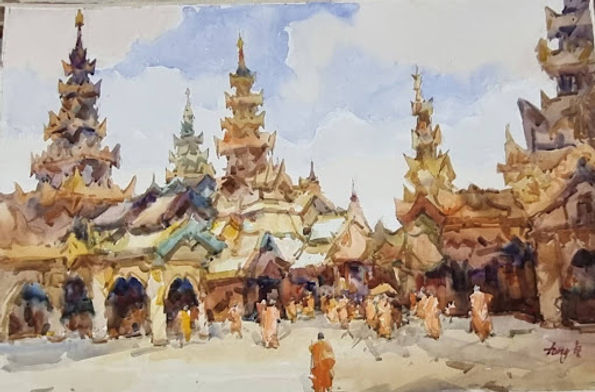
Tong travelled widely and was fascinated with cultural heritage in many South-east Asian countries. Clothing in Myanmar varies depending on the ethnicity, geography, climate and cultural traditions of the people of each region of Myanmar (Burma). There is great diversity in terms of textiles, weaves, fibers, colours and materials, including velvet, silk, lace, muslin, and cotton.
Formal recognition consistently validated his unique approach to environmental observation throughout his expansive career. Securing the top award in the Port of Singapore Authority Open Art Competition marked a significant professional achievement. Representing his nation at an international exhibition in Belgium further cemented his reputation as a master of cross cultural translation. Earning the talent prize in the Teravarna Color International Juried Art Competition posthumously confirms the enduring relevance of his vision. These accolades map a trajectory of sustained excellence and global resonance.
Like several Singapore artists, Tong has a number of landscape paintings composed in various media arising from his trips to Nepal. Kathmandu paintings are a beautiful and unique way to bring the beauty of Nepal's capital city into any home. Stunning architecture and culture. Bustling city. With scenes from ancient temples and monasteries to colorful markets filled with local goods, they evoke feelings of enchantment and wonder while offering an in-depth look at this magical city.
Temple in Kathmandu | Watercolor
$14,000
32 X 44
Operating as a quiet observer allowed him to counter the rapid acceleration of modern society. His compositions demand a deliberate pacing from the viewer, encouraging prolonged engagement with subtle details. Capturing the creeping movement of shadows across a village wall requires an immense capacity for stillness. This inherent slowness acts as a visual corrective to a digitally saturated era focused on immediate gratification. Embracing patience reveals the hidden geometries structuring our shared physical environments.
"Quiet observation acts as the strongest anchor during foreign travels."
Transcending geographical borders reveals a fundamental preoccupation with the universal human condition. Documenting localized rituals and foreign streets serves a broader conceptual purpose beyond simple illustration. Highlighting the shared dignity of individuals across vastly different cultures fosters a deep sense of global interconnectedness. Recognizing the familiar within the foreign constitutes the emotional core of his entire output. The artwork ultimately functions as an accessible bridge between isolated communities.

Five Foot Way, Chinatown Singapore | Oil
$4,500
14 X 18
Five-foot ways, or kaki lima in Malay and wu jiao ji in Mandarin, are iconic covered, pedestrian walkways mandated by Sir Stamford Raffles in 1822 for Singapore's shophouses. Designed to be five feet wide to provide shade from the sun and shelter from rain, these historic, often tiled, spaces serve as vital,,,transient, public-private, links in areas like Chinatown and Joo Chiat.
A vast archive of paintings now stands as a testament to a life spent decoding the essence of varied locations. Preserved and presented by his estate, the collection offers future generations a masterclass in observational sensitivity. Each piece encapsulates a specific moment of lighting and atmospheric pressure forever frozen in pigment. Studying these archived works provides invaluable insight into the evolution of regional painting methodologies. The accumulated portfolio remains a vital educational resource for contemporary practitioners.
Tong was familiar with the multi-ethnic nature of Singapore, and his portraits included people of Chinese, Malay, Asian Indian and European ethnicities. A common theme of this work consisted of a single person or an ensemble of human subjects in various vibrant costumes and traditional settings. Because Tong was influenced by the Russian school of painting, his subjects often include rural workers.

Woman in traditional Turkish costume | Oil
$4,500
18 X 13
Finding extraordinary beauty within overlooked corners of the world defines his ultimate artistic legacy. The commitment to blending stylistic traditions resulted in an entirely original visual lexicon that defies simple categorization. Every composition invites the audience to walk alongside an endlessly curious traveler navigating the complexities of existence. Elevating quiet observation to the realm of high art secures his position as a crucial voice in international art history. His journeying spirit continues to inspire a profound appreciation for our shared global landscape.

Samsui women | Ink
$14,000
30 X 44
Tong painted Samsui women in ink and watercolor. These working migrants came from China and various countries to Singapore in the 1930s to 1940s. Crowned in red headscarves and wearing their trademark samfoo tops, these often engage in hard labor in the docks of Singapore River or in construction. They are now considered an important part of Singapore’s history. From The Straits Times, Singapore: www.straitstimes.com/lifestyle/arts/a-tribute-to-samsui-women-in-ink-and-watercolour
"Translating morning light onto blank paper demands absolute mental clarity."
Not a solo artist yet? Subscribe to our solo exhibitions at TERAVARNA and share your art with the world!