_PNG.png)


Susanne Elisabeth
NETHERLANDS
_p.png)
"From an early age, I had a huge connection with art, nature, and especially animals. Animals have always played an important role in my life."
As a child, she grew up with many animals like cats, dogs, and horses. She had a special bond with all of them. She also loved to go to a zoo as a child to see and observe the animals. She was really fascinated by them and already loved to draw them.

Lewis | Pastel
$1,000
The Pinche Tamarin Monkey is a small New World monkey weighing less than 0.5 kg. The species is found in tropical forest edges and secondary forests in northwestern Colombia, where it is arboreal and diurnal. Its diet includes insects and plant exudates, and it is an important seed disperser in the tropical ecosystem. It is currently classified as critically endangered and is one of the rarest primates in the world, with only 6,000 individuals left in the wild.
Art has always played an important role in her life. From an early age, she has always been involved in drawing and dancing, especially classical ballet. She had an enormous bond with classical ballet. She has danced since she was three years old. She combined her high school education with the preliminary training at the Dance Academy in Tilburg. After obtaining her high school diploma, she went full-time studying performance dancer training at the Tilburg Dance Academy, where she specialized in classical ballet.

Diana | Pastel
$1,000
This is a Diana monkey. This is an old world monkey found in the high canopy forests of Sierra Leone, Liberia, and western Côte d’Ivoire. Named for its white brow, which is said to resemble the bow of the Roman goddess Diana, this black-grey guenon has a white throat, crescent-shaped browband, ruff, and beard.
"Studying animals and painting them keeps me constantly intrigued."
In 2016, she also completed the Veterinary Homeopathy Program at VHCN in Lochem (Netherlands). This has helped her learn more about the animals she paints, their habitats, diets, nature, and anatomy. She has owned a veterinary homeopathy practice for a couple of years. where she helped the animals get better in a natural, holistic way.

Golden | Pastel
$700
The golden lion tamarin gets its name from its bright reddish orange pelage and the extra-long hairs around the face and ears which give it a distinctive mane.[9] Its face is dark and hairless. The bright orange fur of this species does not contain carotenoids, which commonly produce bright orange colors in nature. Susanne Elisabeth has encountered with these little lovely monkeys at the age of six years old at the zoo of Jersey England. Unfortunately, the golden lion tamarin monkey's life is also coming to an end.
Because she loves animals and art so much, she decided to combine these two aspects of her life. Making portraits of animals, especially wild animals, was a natural decision to make. She has a realistic style but not a photorealistic one.
Who doesn’t like the king of all animals? When I came across this reference photo, I knew I had to meet this lovely young guy. Also, lions are listed as vulnerable on the IUCN Red List.

Dreamer | Pastel
$700
"I hope that people will appreciate the beauty of the animals in the paintings and, in doing so, realize that this beauty needs to be protected."
"Animals have so much to tell, and I try to capture this as much as possible in my animal portraits."

Hello | Pastel
$700
The Sumatran tiger is one of the smallest tigers. The Sumatran tiger is the only surviving tiger population in the Sunda Islands, where the Bali and Javan tigers are extinct. This population was listed as critically endangered on the IUCN Red List in 2008, as it was estimated to be 441 to 679 individuals, with no subpopulation larger than 50 individuals and a declining trend.
Animal welfare is very important to Susanne Elisabeth, and she hopes that by making these paintings, she can show people all these beautiful creatures for what they are and make them aware of their situation.

Emas | Acrylic
$950
Emas is the male tiger (also Sumatran) at Blijdorp Zoo in Rotterdam, which Susanne Elisabeth visits often to observe these lovely tigers. It is always a pleasure to meet up with him.
She especially likes to paint wildlife that is endangered. She wants to show them to the world before it's too late. It would be a shame if they went extinct. That’s why she makes a lot of close-up paintings so that you can really connect with their souls. Making people conscious about how their daily habits and choices impact the world around us and all its creatures.
This is also a Sumatran tiger, but a younger one, just staring into the wild.

A lovely cub | Pastel
$700
Because she likes to make close-ups of animals, she loves to work in a larger format. And since she works quite a bit, this takes a lot of time. Also, in terms of preparation, everything is well planned so that she can show the animal as beautifully as possible on canvas, MDF, or a pastel mat (a surface for pastel painting).
"I work in details, depth, and the perspective I have chosen, often working from a couple of references."
When she uses acrylics, she has to prepare the surface with three layers of gesso. When she works on MDF, she also has to prepare the back of the painting. This will protect the painting in the future. Then she will outline the drawing on her surface and start to paint in the background. Then she will start with the eyes of the animal. This way, she can already make a connection with the animal in the painting.
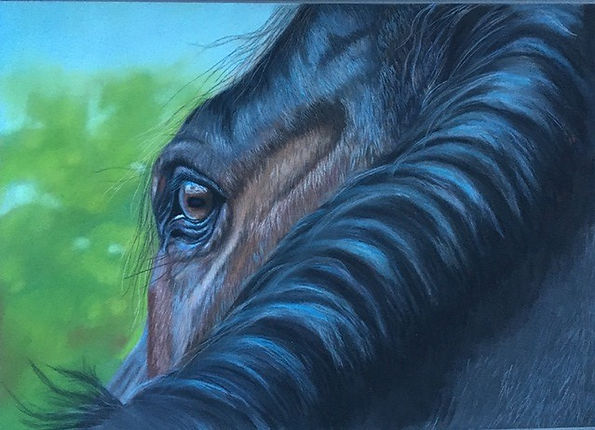
Looking back | Pastel
$250
Horses have been a very big passion of Susanne Elisabeth. She is also a horse owner herself. At the age of six, she got her first horseback riding lesson from her grandma. After that, she started to get more involved in horsemanship. Where she also observe the natural behavior of free roaming horses and rejecting abusive training methods.
When Susanne Elisabeth chooses pastel, she doesn’t have to prepare her surface. However, she chooses to pastel only on pastel mats and not on other paper surfaces. Thanks to its fixing capacity, layer after layer of pastel can be applied without saturation, and it has excellent adhesion. You hardly need to use a fixative anymore. The surface of the pastel mat consists of very fine pumice stone grains, so you can already feel that the pastels adhere well to it. Pastel mat is acid-free, light-resistant, and extremely durable. This way, Susanne Elisabeth can make a lovely, soft fur.
A lovely, small baby gorilla. Those big eyes are staring at something.

Little Pete | Pastel
$1,000
Most of the time, she loves to paint the animals with pastels. She prefers to use pastels because she can achieve high definition in the fur while still achieving a convincing softness. She always aims to create paintings with more depth and vibrance.

Barn owl | Pastel
$250
Every evening in the summer, Susanne Elisabeth sits in her garden, looking over the fields. There she sees almost every evening a couple of barn owls. That’s why she had to pastel-paint one of these birds.
"In my portraits, I find the gaze of the animal very important, so that the character comes more forward."
Not a solo artist yet? Subscribe to our solo exhibitions at TERAVARNA and share your art with the world!