Marek Herburt
AUSTRALIA

“Color is my subject, and it is also my voice; everything I want to say, I say through color.”
Marek Herburt has never run short of reasons to paint. The extraordinary beauty of Australian flora is the wellspring of his art, and the landscape that holds it, rich and complex enough to sustain a whole career, gives him more than any single painting could ever contain. His admiration for this world is wholehearted and unguarded. It is not a sentimental attachment, though. It is the kind of love that sharpens the eye rather than softening it, and it explains why his paintings manage to be both affectionate and exact. Long before anyone notices the rigor of his thinking about color, they feel what is most immediate in his work: the warmth of a painter genuinely moved by Australia. That warmth is the doorway into everything else he does, offering every viewer, expert or not, an easy way in.

On The Way To Andamooka | Acrylic
$2,500
113 x 163 cm
On my way to visit friends in Roxby Downs
His attention moves easily between scales. It can settle on the delicate architecture of a single flower, then widen to the intricate relationships between leaves, branches and the vegetation around them, and at every step he is captivated by the variety of forms and the brilliance of color he finds. A petal matters to him, and so does the way an entire stand of plants grows as one community. That flexible gaze is a quiet strength of his work. It lends his paintings both intimacy and scope, the tenderness of the close view held together with the openness of the wide one. Viewers who come for the grand sweep of a landscape find themselves lingering over its small particulars, and those who love detail are gently led outward toward the larger picture.

Old Road To Bute | Acrylic
$3,000
93 x 183 cm
One day I discovered a forgotten road to Bute
“Nothing in nature is as simple as it first appears, least of all the color of one small leaf.”
The discipline behind his eye took shape at the Łódź Academy of Arts. There Herburt developed the careful observation of color in nature that grounds his practice, and there he learned to read what he saw through the principles of opposition and contrast. What he gained was less a set of rules than a new way of seeing. Colors stopped behaving like isolated facts and became participants in a constant exchange, each one revealing its true character only in the company of others. In his hands, every passage of a painting is weighed this way, against everything that surrounds it. It is an exacting habit of mind, one that favors patience over quick effects. The pairing of a Łódź training with the flora of Australia is an unusual one, and it sets his work apart.

The Morning Sun | Acrylic
$5,000
182 x 262 cm
Inspired by morning walks around my property
Contrast gives his paintings their pulse. Herburt is intrigued by the dynamic interplay between complementary and contrasting hues, and by the way two colors placed side by side can strengthen each other until each seems more intensely itself. From these pairings comes a heightened vibrancy, along with a sense of movement that runs across the entire surface. This understanding still shapes the way he translates nature into paint, and it gives his work a charge that is felt as much as seen. Contrast becomes his way of honoring how color actually behaves in nature, rather than how a tidier world might wish it to behave. Viewers who know nothing of color principles sense it at once, and that quiet intensity is part of what makes his paintings so rewarding to live with.
Travelled to Ayers Rock, Northern Territory

In The Shadow Of Uluru | Acrylic
$2,500
112 x 168 cm
“A slight shift in hue, temperature or intensity can change everything. It can unsettle a calm painting, bring a restless one into harmony, or fill it with sudden excitement. What I hope to catch is more than the colors themselves: it is the energy that leaps between them.”
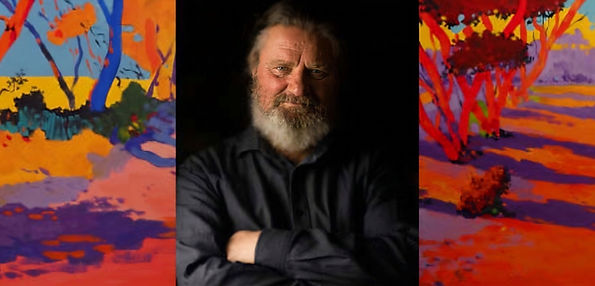
“The Australian landscape could never be a mere subject waiting to be represented. It is alive. Color, light, form and atmosphere come together in it, and the spectacle they create is always changing. When I am immersed in that landscape, I am not trying to record it. What I paint is an interpretation, my personal response to being there and to everything I see. Each painting becomes a meeting between the natural world and me as an artist, and no two of those meetings are ever alike. I want each one to carry the vitality of that land, the same vitality that keeps drawing me back to it again and again.”

At The Woronora River | Acrylic
$3,000
132 x 182 cm
I often visit the Blue Mountains in New South Wales
Three forces shape his work from first glance to final decision. Everything begins with direct observation, which provides the initial impulse. His knowledge of how colors behave and relate to one another then gives that impression a structure he can work with, and intuition, finally, guides the choices that lend each finished work its individual character. None of the three operates alone, and each would falter without the others. Observation without knowledge would scatter into impressions, knowledge without observation would harden into habit, and both without intuition would produce paintings that are correct but cold. In combination, they stay in conversation from start to finish. Thought and instinct end up sharing the same frame, and the result is work that rewards both the analytical eye and the open heart.

Close Up Number Twelve | Acrylic
$4,000
152 x 202 cm
Always amazed by Australian nature displays
How can color alone persuade the eye that a scene stretches far away? That question drives an important strand of Herburt's work: atmospheric perspective, the visual impression of space and distance within a landscape. It fascinates him because it shows that color can communicate depth without relying solely on the physical arrangement of objects. A painting does not need converging lines or shrinking shapes to feel deep; color, handled with understanding, can do much of that work by itself. Close observation has made him increasingly aware of the way colors change in appearance as they recede, and that knowledge has grown steadily, one observation at a time. It has become one of the finest instruments in his practice, allowing his landscapes to open up space with a subtlety that rewards time spent in front of them.
I photograph close up on my way to the small town of Clare

Close Up Number Five | Acrylic
$4,500
152 x 202 cm
Standing before one of his landscapes, a viewer senses this principle at work without needing to name it. Warmer colors often occupy the foreground, close and present, while cooler, softer or less intense colors establish the farther reaches of the scene. Together they build a convincing sense of depth that pulls the eye into the picture and hints at the vastness beyond the frame. The play of warm against cool also organizes each painting from within and gives it much of its mood, so that the depth he creates is emotional as well as optical. The warmth near at hand feels welcoming, almost within reach, while the cooler distance offers calm and breathing room. Moving between the two, the viewer comes close to the experience of being out in open country, letting the gaze travel slowly toward the horizon.
“If I keep looking long enough, even the most familiar subject still has something new to show me.”
Herburt lets the landscape set the terms. His handling of distance is never a formula applied mechanically. Weather and vegetation alter the colors he encounters from one scene to another, so he stays attentive to every variation and allows the distinctive qualities of each place to guide his choices. A bright, clear day and a heavy, overcast one do not offer the same colors, and he would never paint them as though they did. It is a humble way to work, and a demanding one, asking him to trust what he sees over what he expects. The paintings that emerge carry an honesty that is easy to recognize, the kind that comes from listening carefully before ever lifting a brush. That respect for circumstance is also a form of respect for the viewer, who is offered something observed rather than something assumed.

Where I Found Wombat | Acrylic
$4,000
132 x 262 cm
During my photography session, I met a wombat
Few subjects could serve his curiosity better than Australian flora. Its extraordinary diversity places an almost limitless range of color contrasts and tonal relationships within reach, from striking juxtapositions to the faintest transitions from one area of color to the next. Every grouping of plants presents its own arrangement of color, its own set of puzzles to work through. Herburt approaches this abundance with a researcher's precision and a devotee's affection, testing what he knows against what grows before him. The plants become partners in his investigation, and the work that follows carries both the seriousness of that inquiry and the pleasure he takes in it. For collectors, this gives his body of work a remarkable range. The paintings share a single sensibility, yet each opens onto a different corner of the same rich world.
Mid-spring trip to the Flinders Ranges

Peaceful Place | Acrylic
$4,000
132 x 262 cm
Beneath all the theory lies a very human motive. Herburt paints out of a deep desire to understand the beauty he finds through observation, and an equally strong wish to share it with others. Beauty, in this sense, is not decoration. It is something to be grasped, explored and then handed on, and his paintings are where that handing on takes place. They are studies, but they are also offerings, made so that what moved him might move someone else. There is nothing distant or academic about that impulse, and it turns private observation into a shared experience. Collectors will find in his art a lasting companion, fellow artists a thoughtful lesson in the workings of color, and every viewer a reminder of how generous nature can be.

Late Afternoon Long Shadows | Acrylic
$2,800
122 x 163 cm
Visiting my friends in Paringa on a pistachio farm
“Every composition is its own challenge, and each time I have to find the balance between technique and creative freedom.”
Not a solo artist yet? Subscribe to our solo exhibitions at TERAVARNA and share your art with the world!