_PNG.png)


Kwong Kwok Wai
CHINA
_p.png)
“I believe abstract art is a vehicle going deep into people’s fluid souls as it provides possibilities and uncertainty.”
As an artist, Kwong is intrigued by the motif of human existence. He ponders over it in the context of people’s relationship with time and place, with memories, and the wider social environments. People’s past events “scaffold” their values, beliefs, and the logic of thinking. As Austrian-British philosopher Ludwig Wittgenstein described, “Form of Life” is contextual if not situational, by which Kwong is genuinely fascinated.
The Map of A Myth III | Oil
$2,600
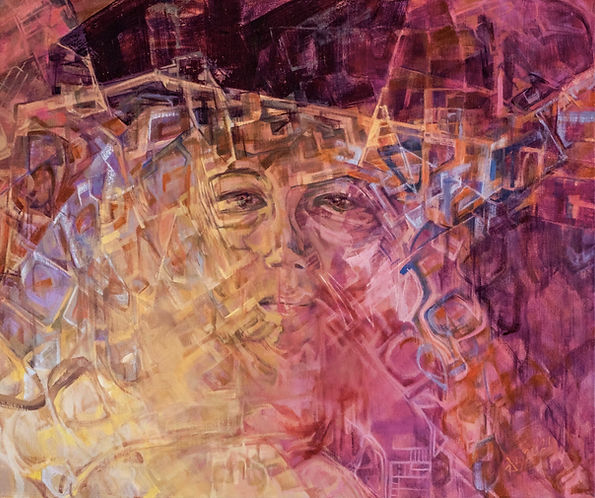
Using fragments of the maps of my hometown Hong Kong, this painting reflects the reminiscence of the local history and anticipation of the future from a first-person narrative. For reference, Kwong employed both old and new maps of the Kowloon Peninsula, where 40% of the population resides. With vigorous colors and weltering brushstrokes, he intends to explore the nature of the existence of a community.
Does it not change the fact of who we are, and what we believe? Our sentiments and perceptions of what has happened around us are very vivid and undeniable!” Kwong keeps asking himself such questions. So, are we “solid” or “fluid”?” With these questions in mind, he transforms them into evocative imagery of contemplation and self-exploration.

The Map of A Myth I | Oil
$2,600
Maps provide perspective, those necessary details needed for an overview. They establish where you are within a larger context. Kwong employed road maps for reference as a depiction of the city’s current status. Road map of Central, the core financial and government area; and Shumshuipo, an old district with a low-income population.
“I think memories constitute a crucial part of our identity.”
This ambivalent state would be best presented in abstractions. He intends to depict this emotional and philosophical condition - a condition of asking questions, instead of providing answers. He wants to picture fluidity, not concealability. Turning concrete into ambiguity, and reality into abstract, this artistic approach indicates both refusal and whimsy.
The Map of
A Myth II | Oil
$3,000
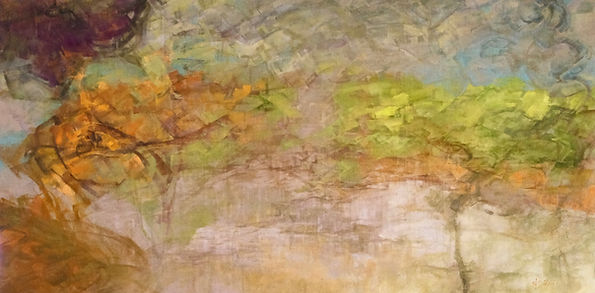
Kwong applied vigorous colors and spontaneous brushstrokes over portions of the local streets to reflect the inherent chaos of using a confusing template. It is intended to elicit contemplation and reflection on the city’s future. The reference used for this painting is a satellite map of Kowloon, where 40% of the Hong Kong population resides.
In 2018, he quit his job in journalism and became a full-time painter. As a journalist, Kwong had always believed that reporters were the “independent voices," and that they had to be impartial and objective in reporting. He also reminded himself to be detached from the dominating political powers in order to avoid bias.
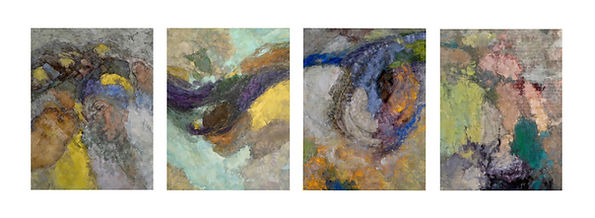
The four pieces are to display Kwong’s birth year left to right: 1, 9, 6, and 5. Though this is viewed as hopscotching across four blocks, it is not intended to be viewed as ‘in one piece’. Rather, each block in this sequence has its own character. The marked price is for the whole series, while the size is the dimension of each piece. Each painting could be purchased separately.
Hopscotching Through Time (4 pieces series) | Oil
$11,000
“Alongside the change of the city, from being a British colony to returning to Chinese sovereignty my artwork is all about reminiscing about this historical phase.”
"Symbols roam among reality, concepts, and the unknown. ‘Road maps’, ‘vines’, ‘numbers’; what do you think of them? I want to know if they tell you a story?”

Hopscotch #1 | Oil
$3,000
“Hopscotch #1,” the first painting, is a depiction of some far distant moment in life.
However, after becoming an artist, there was no reason for him to be in the opposing position anymore, he realized people are all surrounded by politics. It is part of our lives. This transformation of ideas enlightened his paintings, which were presented in his two solo exhibitions in 2019 and 2020. Real life politics are portrayed as fables and presented in visual forms.
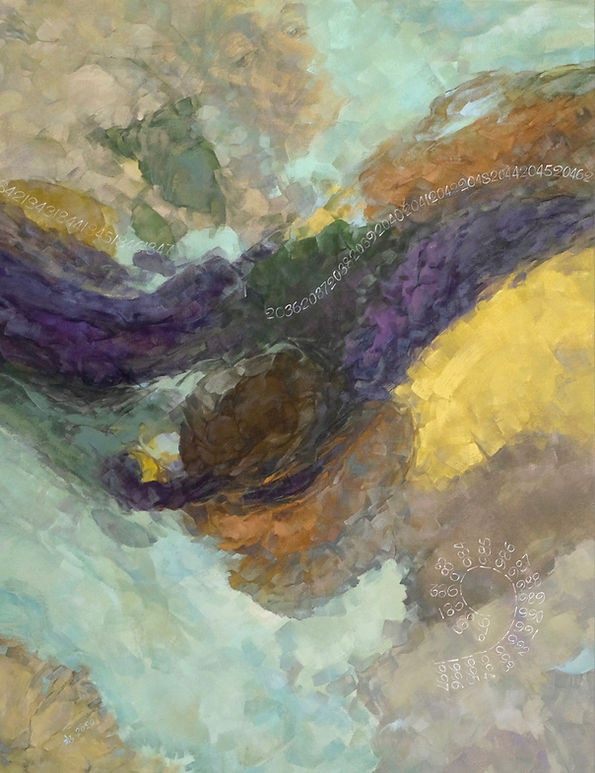
Hopscotch #9 | Oil
$3,000
For “Hopscotch #9, Kwong asked himself: how significant are major historical events to an individual? What about from 1842 to 2046? Several events depicted here may be tangential to some while others may feel hopeless or helpless.
In his series “The Map of a Myth”, the ideas of ‘road,' ‘map,' ‘city,' and ‘city inhabitants’ and what these concepts meant kicked off the investigation. Inhabitants of a city share their vision of living. As a result, city development symbolizes what the community has done for survival, and this process is documented in maps.
In the third square, Kwong represented the status of an inescapable course of events with a big loop that depicts the number 6.

Hopscotch #6 | Oil
$3,000
In the paintings, road maps are transformed into maze-like patterns to depict the condition of his being. In vigorous colors and spontaneous brushstrokes, the paintings reflect the reminiscence of local history and anticipation of the future from a first-person narrative.
“I usually start with concepts in my painting process.”
In his series entitled, “Hopscotching through Time,” each color block represents a numbered block in this children’s game. Kwong has replaced numbers 1 through 10 with 1, 9, 6 and 5, the year in which he was born. If studied closely one can see in each painting smaller four-number sets, all more recent than 1965. These were his personal benchmarks.
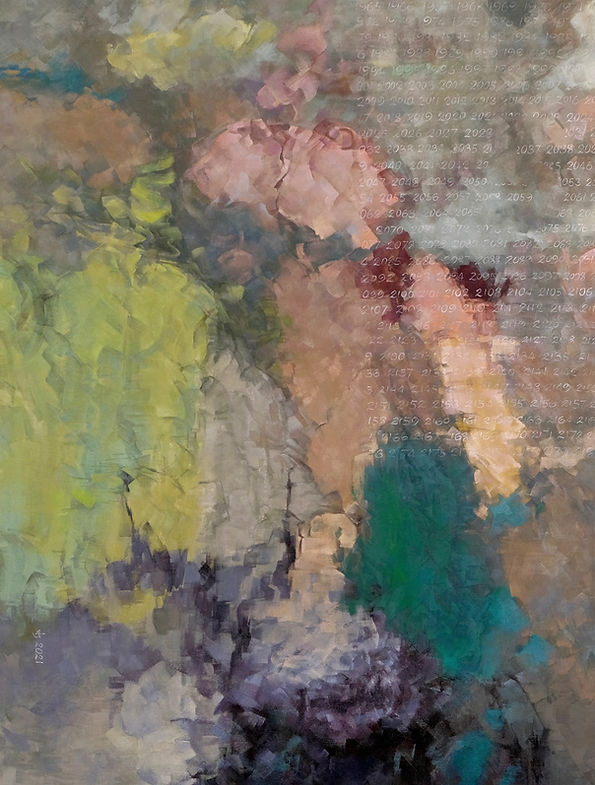
Hopscotch #5 | Oil
$3,000
In Hopscotch #5,” Kwong depicted the struggle between two forces: the constraint of history unfolding against the will of individuals to reject predetermination. These color blocks exhibit rock-like texture to represent a shaping force. Cloud-like strokes break solid color blocks into fragments, a symbol of individuals’ spontaneity and awareness.
Time is often represented by numbers, daily, monthly, and annually, for instance. A year could be perceived as simply a marker, with no significance, or it might represent the most important events a person experiences, something defining. Seeing a four-digit year, then, can prove a stimulating trigger or be devoid of meaning. The four pieces are to display Kwong’s birth year from left to right: 1, 9, 6, and 5. Though this is viewed as hopscotching across four blocks, it is not intended to be viewed as ‘in one piece.' Rather, each block in this sequence has its own character.
Initially Kwong tried a different sketch with some uncertainty. Unease grew stronger as political tension in the community mounted in mid-2019. With no clear idea, he continued to rework this painting by adding vines, a familiar object he had been working on for years. Brush-stroke by brush-stroke, the image emerged. The painting reflects his state of mind as well as the distress and hysteria in the city at that very moment in time.

Whirling Mass I | Oil
SOLD
In search of individual dignity and identity, he also published three full-length novels and a short story collection. Through the pieces, he tries to find his cultural origin. He showcased the changes of this territory in his novels as well as paintings."

The Well | Oil
$3,000
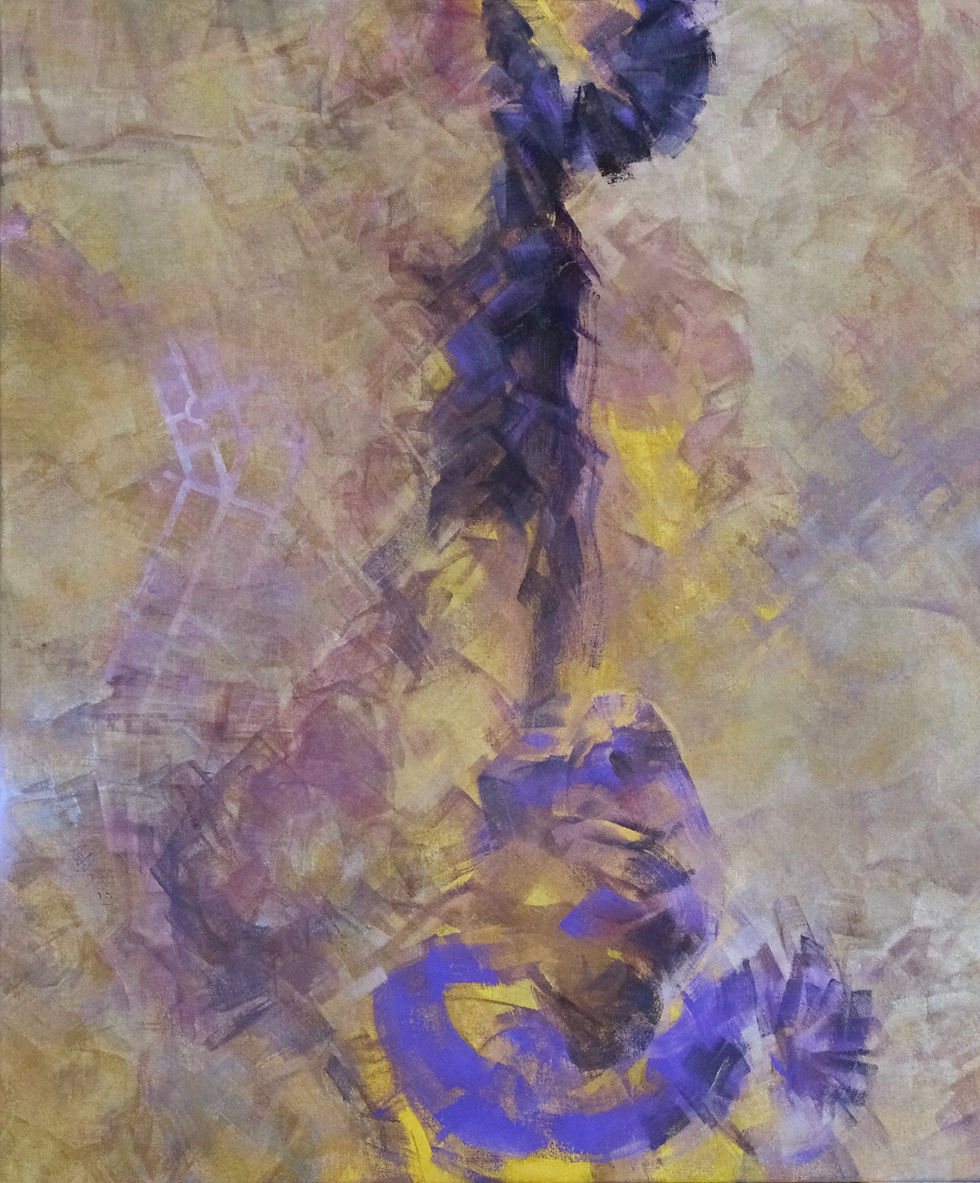
There is an old Chinese idiom: a frog glancing at the sky from the bottom of the well. Kwong transformed the saying into this painting, with the big ‘O’ representing either the opening of a well or the earth seen from afar. Earth is the origin of life, but in contrast a corner of the sky as seen from the perspective of a frog at the bottom of the well is a limitation, a dead end. Through the ambiguity of the ‘O’, the question of what are we looking for is raised.
“My skills were mostly self-taught while I served in the journalistic field for 30 years.”
Not a solo artist yet? Subscribe to our solo exhibitions at TERAVARNA and share your art with the world!