_PNG.png)


Eugene Kuperman
USA
_p.png)
"Painting teaches patience, discipline, and respect for time earned slowly."
Eugene Kuperman is a published and award winning artist whose practice is grounded in disciplined study, historical continuity, and sustained commitment to painting as a serious craft. His work reflects a deep respect for tradition while maintaining a personal voice shaped through years of mentorship and formal training. Kuperman’s paintings demonstrate a thoughtful balance between technical rigor and expressive clarity, positioning him within a lineage that values mastery, patience, and intentional development.

The Maestro | Graphite
A portrait of my mentor and friend, Lance Richlin, who posed for a portrait drawing study. I measured his head with a caliper so the portrait is life sized, due to lack of time, I had to finish this drawing from a photograph.
Kuperman’s work has entered numerous private collections, including that of Robert Harris Rothchild, whose holdings include significant works by artists such as Rembrandt, Chagall, Dalí, Ernst, and Lichtenstein. To be collected alongside such historical and modern masters speaks not only to the quality of Kuperman’s work but also to its ability to hold dialogue with established artistic legacies. His inclusion reflects recognition from collectors who value depth, provenance, and artistic seriousness.

The Devil is in the Details | Oil
A conceptual work I did regarding the pandemic that has been sweeping the nation as well as the world for a long time. In 2019, two people I personally knew overdosed from hardcore drugs.
"I trust process over speed, study over shortcuts, depth over noise."
In 2012, an art catalog was published featuring works from Rothchild’s collection, presenting pieces by historically important artists alongside commissioned works by Eugene Kuperman. This publication marked a meaningful moment in Kuperman’s career, situating his practice within a broader historical and contemporary context. The catalog affirmed his work as part of an ongoing artistic conversation rather than an isolated endeavor.
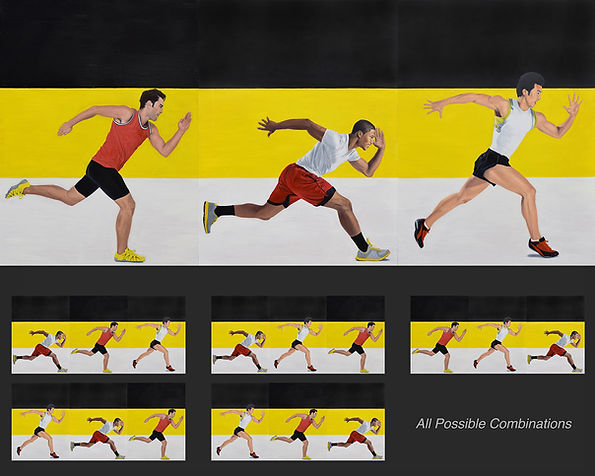
Race (Interchangeable Triptych) | Oil
A three piece work, showing the three most identified groups of humans being Asian, black and white. This piece is a commentary on the term "race", and what it actually means. This term is sometimes identified as a social construct, rather than a physical difference, because humans share 99.9-% of each other's DNA.
From 2010 until 2014, Eugene Kuperman studied under the renowned Russian artist Leonid Steele, a pivotal period that deeply shaped his artistic foundation. Steele’s works are held in major museums around the world, including the Tretyakov Gallery in Russia. Under Steele’s guidance, Kuperman absorbed a disciplined approach to painting that emphasized structure, observation, and respect for classical methods.
This painting shows a part of a historical event that took place around WWI. It is the first genocide of the 20th century, The Armenian Genocide. This piece is based off of an old historic photograph, which was so pixelated that it was practically a silhouette.

1915 | Oil
"My work grows from sustained learning, where technique becomes language and painting transforms into a lifelong commitment shaped by mentors, persistence, and respect for artistic continuity."

"I approach painting as a discipline that rewards attention, endurance, and accountability. Each session in the studio builds upon years of study, correction, and observation. I do not seek quick resolution or surface appeal. Instead, I focus on developing clarity through repetition and refinement. What matters to me is the quiet confidence that comes from knowing a painting has earned its presence through time, effort, and understanding. In that process, the work becomes both a personal record and a continuation of something much larger than myself."

Motherly Love | Oil
This painting is about a newborn baby coming into this world with the mother and the brother welcoming a new member of the family. This theme can be referenced back to paintings by old masters such as Raphael, Michelangelo, Leonardo, Titian, etc. for it being as if it’s Madonna and Child, Adoration of the Magi, or Madonna and Saint John the Baptist with infant Jesus. In the execution of this painting, I referenced back to artists such as Raphael and Michelangelo. Raphael for his Madonna and Child themes and Michelangelo as well but with the divine sense that comes through his work such as in his Doni Tondo which hangs at Uffizi Gallery in Florence. This painting although not that large in size took me over a year to paint due to the fact that I wanted every square inch of the painting done with utmost love and care. This was a very intimate and spiritual project for me as I felt somewhat connected to the Renaissance masters of the past with their traditional themes.
Leonid Steele’s own training traced directly back to influential figures in Russian art history. One of Steele’s teachers studied under Isaac Levitan, a master of Russian landscape painting, while another was trained by Ilya Repin, one of Russia’s most celebrated realist painters. Through this lineage, Kuperman became connected to a tradition that values emotional depth, compositional integrity, and painterly honesty.
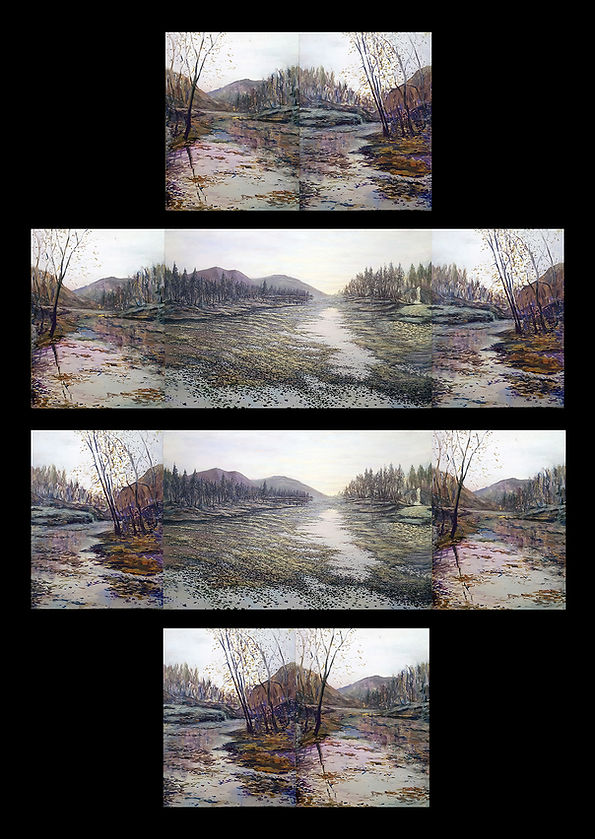
Peaceful Silence (Interchangeable Triptych) | Acrylic
The very first prototype I've created of an interchangeable canvases idea. As far as I've researched it is my own invention, which I later explored with several other works. I did this painting in 2008, after a trip to Northern California's Yosemite and Sequoia national parks. It is all out of my imagination as I didn't use any references for this piece. The main concept is that while nature changes, it essentially remains the same and eternal. Nature is priceless, we are a part of it and we should protect it, because without it, we have nothing.
Following Steele’s passing in 2014, Kuperman continued his studies rather than allowing his practice to stagnate. From late 2014 through 2016, he studied with award winning artist Lance Richlin. This period reinforced Kuperman’s commitment to technical refinement and expanded his understanding of academic painting principles rooted in European tradition.
A painting I did on the subject of The Holocaust during a time then and now a rise of antisemitism and Nazi propaganda. Being Jewish myself, I have encountered antisemitism periodically throughout my life.

Never Again | Oil
Lance Richlin’s technical lineage extends back to the French Academic Masters of the nineteenth century, adding another historical dimension to Kuperman’s training. Through this mentorship, Kuperman further developed an appreciation for precision, tonal control, and disciplined craftsmanship. These studies strengthened his ability to execute complex compositions while maintaining structural coherence.
"Tradition is not limitation when approached with curiosity and humility."
Kuperman’s artistic development reflects a rare continuity of instruction across generations of painters. Rather than relying on fragmented influences, his education followed a clear and traceable path through Russian and French academic traditions. This continuity informs his approach to painting as a lifelong discipline rather than a stylistic experiment.

Vita | Oil
This is a social commentary work about life in general and also about how religion or the notion of the divine fits into this scene. With the general aspect of this scene being taken place in front of an Italian church. In this day and age, religion, more specifically Christianity is under attack, for no other notion than the loathing of the idea of God. I find it ironic, as many who hate religion, but love most of the Renaissance and Baroque art, which was inspired by religion and paid for by the church, even many artists that I know, who may look down at Christianity and people who believe in Jesus Christ, yet are fascinated by Michelangelo’s St. Peter’s Pieta which is located at the St. Peter’s Basilica at the Vatican. Without The Bible it would be impossible to understand most works by Michelangelo Buonarroti, who happens to be my favorite artist. Many people who hate religion, also may not know that the moral standard which society revolves around, started with religion. The example of this being the Code of Hammurabi from the Ancient Babylon which states rules for society such as “Do not steal from rich people”, which was a progress in terms of ethics, but wasn’t perfected until the Ten Commandments said the same rule but with a slight change of “Do not steal”, as not only from rich people but from anyone in general. Religion had an enormous impact on human history and human civilization, whether it be positive or negative as how some people used religion for their own agenda. Regardless of the kind of influence religion had, it shaped the world that exists today, which we are all a part of.
Throughout his career, Eugene Kuperman has remained dedicated to growth through study, mentorship, and sustained practice. His work reflects not only his personal vision but also the accumulated knowledge passed down through his teachers. Each stage of his education reinforced the importance of humility, rigor, and responsibility to the medium.
The same model as in the painting "Allegory of Spirit". This was a life drawing study and it also shows the model contemplating as well as within her own thoughts. What is on her mind, is up to the viewer to interpret.

In Contemplation | Graphite
Today, Eugene Kuperman’s work stands as a testament to the value of lineage, persistence, and respect for artistic tradition. His paintings carry forward techniques refined over centuries while remaining grounded in his own experience and discipline. Through his practice, Kuperman continues to honor the past while contributing thoughtfully to the present.

Hospital Parking Lot | Oil
This idea started many years ago, when I drove my father to a hospital. While I stepped out of the car, I noticed an elderly woman being helped by a much younger woman, possibly a granddaughter to walk over the step toward possibly their car. Right as they went there, I saw a black bird, which was most likely a crow hover above them. This painting has a philosophical inclination as the period of life, one person's life is ending, while another person's life is beginning, yet in those two different states, these people share this intimate moment together, while their lifetimes intersect. It's always good to remember that parents and grandparents don't live forever, so it's important to spend more time with them, while they are still alive.
"Each canvas becomes a quiet conversation between effort, history, and vision."
Not a solo artist yet? Subscribe to our solo exhibitions at TERAVARNA and share your art with the world!