_PNG.png)
Cyclops, Sirens, and Scylla: How The Odyssey's Monsters Evolved from Canvas to Cinema

Updated: Jul 29
Introduction: The Monsters That Never Stopped Evolving
The Odyssey movie, by Christopher Nolan, has sparked worldwide interest once again in Homer's epic tale. The film takes place on Odysseus' epic journey back home after the Trojan War, culminating in the inclusion of figures like the Cyclops, Sirens, and Scylla in a reworking of the ancient epic that has never been captured on IMAX before. The film is the first feature film shot entirely on IMAX cameras.
Yet, these indelible monsters in the Odyssey did not begin on the silver screen. Long before CGI, painters, sculptors, and potters, fueled by their imagination, were portraying these magical creatures in their work, matching the words of Homer.
Over the course of almost 3000 years, these mythical creatures have been re-imagined by each successive generation. Whether in painted Greek vases, Roman mosaics, Renaissance pictures, or modern cinema, the creatures have evolved with art. All adaptations, including the Odyssey movie, are grappling with this stunning visual legacy instead of reinventing it.
From Homer's Words to Ancient Art
Homer Left Room for Imagination
One way in which the Odyssey has been inspiring artists for centuries is that Homer rarely described his characters in detail. He did not note down every feature. He picked up on mood, danger and suspense. That ambiguity became an opportunity for the artist to create, to fill in the gaps.
These stories were known to all in ancient times, but each painter and sculptor depicted the gods and the monsters in the Odyssey differently. These artists, in many respects, were the first designers to create a concept for future generations to imagine Homer's famous creatures.
The First Visual Storytellers
The earliest surviving interpretations are from Greek pottery of the sixth century BCE. Oral storytelling was brought to life by black-figure and, later, red-figure vase painters.
The most famous of these was the Attic vase portraying Odysseus and his men blinding Polyphemus, the fearsome Cyclops. Rather than as a grotesque fantasy beast, the artist offers this image of him in the guise of a huge shepherd, with recognizably human features. The impact of his one eye is juxtaposed with his humanity, which further contributes to the disturbing feeling of the encounter.
Back then, the Sirens appeared different from how they are represented now. In early Greek mythology art, they were portrayed as women with wings and the bodies of birds. They were not the sign of romantic temptation, but of death, grieving, and the journey of the soul, and were often carved on the funerary monuments.
On the other hand, in Roman mosaics and classical sculpture, Scylla appeared as a hybrid creature that was part human, part sea monster, and surrounded by dogs. These works were different in their approach and portrayed movement and terror, instead of anatomical realism.
These ancient masterpieces set the foundations for every artistic rendition that followed.
Cyclops: The Giant Who Grew with Every Generation
From Savage Shepherd to Tragic Figure
Of all the magical creatures in the Odyssey, the Cyclops has undergone the most significant transformation.
Polyphemus is more than a giant with one eye in Homer's epic. He is a shepherd who despises civilization and hospitality. In contrast, Odysseus is intelligent. Ancient Greek artists were no exception in their depiction of him as both monstrous and deeply human.
In the Renaissance, European art shifted its focus, with artists venturing into the realms of emotion and spectacle. Later myths surrounding Polyphemus and Galatea inspired painters, including Annibale Carracci and Nicolas Poussin, who had a surprisingly benign vision of the cyclops, Polyphemus. They captured an unspoken sense of longing, loneliness, and vulnerability—pictured in a sweeping landscape of classical backdrop, rather than capturing only violence.
Later romantic painters were to make his presence all the more dramatic, using monumental scenery as well as dramatic lighting, to present him as a force of nature instead of a mere villain.
The Rise of the Modern Monster
Centuries of Greek mythology art were inherited by fantasy illustrators, comic artists, and game designers in the twentieth century. In all the ‘modern' versions of the Cyclops, they have merged Renaissance anatomy with Romantic scale and cinematic drama.
This change was naturally accelerated by film. The initial productions used forced perspective, large sets, and heavy make-up to make convincing giants. Eventually, the painters and sculptors who had been working on this monster for centuries influenced the appearance of the creature through the use of realistic texture and movement, with later advances in visual effects.
Christopher Nolan's the Odyssey movie is the latest chapter in this visual journey. Instead of using digital spectacle, Nolan uses practical filmmaking, authentic locations, and new IMAX technology, helping to create a world that feels physically real.
Thus, Nolan’s interpretation is especially interesting. Rather than reinventing the Cyclops, he seems likely to keep the visual dialogue going, which started on painted Greek pottery almost 3000 years ago, proving that the greatest monsters in the Odyssey are still evolving through the imagination of artists.
Sirens: From Bird-Women to Hollywood Mermaids
Few monsters in the Odyssey have changed as dramatically as the Sirens. In today's popular culture, they are routinely conjured into our thinking as attractive mermaids who seduce sailors with their allure. But Homer's Odyssey is another story.
In ancient Greek mythology, the Sirens were a group of hybrid creatures that had a body and wings of a bird, and a woman's head or torso. Their strength was not just from beauty, but from irresistible knowledge. They tempted Odysseus with knowledge and understanding, not treasure or romance. Their song was an expression of inquisitiveness to the extreme, a theme with great significance to the Greeks.
In this original depiction, the Sirens took the form less of sea creatures and more of supernatural powers standing between life and death.

How Artists Changed the Sirens
In early Greek mythology art, the Sirens were faithfully represented as bird-women. In addition, they were often represented in relief sculptures and painted ceramics, as symbols of mourning and the passage from the earthly to the spiritual world.

During that same era (the medieval period), however, mythology was combined with folklore and Christian symbolism. Over time, feathers were replaced by fish tails. The bird-woman took the form of the mermaid, symbolizing temptation, vanity, and moral danger.
This had been completed by the 19th century. These sirens would be depicted as ethereal, mysterious, and beautiful women with hidden agendas, particularly by Victorian and Pre-Raphaelite artists like John William Waterhouse. These paintings were more emotional, with more colors and more sensuality than the early symbolism of myth, and established an image that remains firmly in the popular consciousness today.
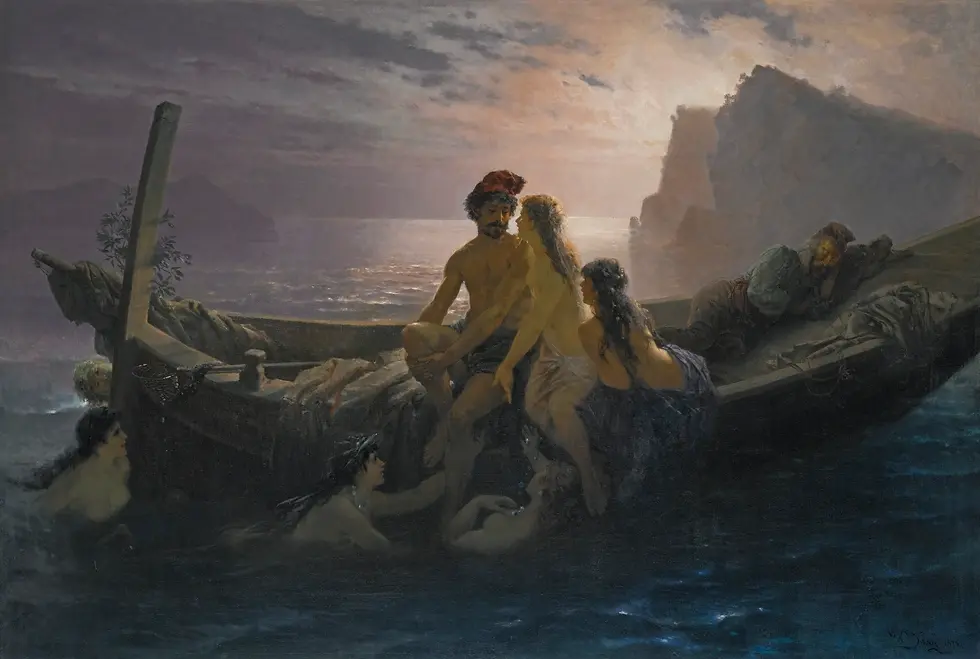
This artistic evolution demonstrates that Greek mythology art is never static. In each era, the mythological creature is reinterpreted in a very specific way to be reflective of each culture's lens.
Scylla: The Monster Artists Never Stopped Reinventing
Scylla is certainly the most complex of the magical creatures encountered in The Odyssey. Homer refers to her as "a dreadful sea monster, sixty feet in length, frowning at all winds, with many heads in a cave in the coast; she snaps at sailors stealing from ships, lets them go back to their home again.
Scylla, as a creature, is a far cry more complex than the Cyclops and so has ample creative room. That which is ambiguous has captured the interest of artists for thousands of years.
In mosaics and Greek ceramics, usually Scylla is depicted as a sea-goddess with a snake tail, or as a woman emerging from the sea, with the wicked dogs suggested by the notice of them growing out of the sea. Instead of making an attempt at anatomical realism, this art tended to focus on movement, fear and the supernatural powers.

Reinventing a Sea Monster
Scylla would change with the times and the ways of art.
She became a part of the larger interest of the Renaissance painters in fantastical sea creatures and later Romantics heightened her diabolical features to evoke a stronger emotional response. Twisted anatomy, crashing waves and the dramatic lighting make Scylla into a creature of nature's most wild and violent forces.
In the modern era, fantasy illustrators have carried on this tradition, mixing marine biology, horror art with digital creature design. From modern depictions, the anatomy, the textures, or the scale changes: a focus on layers, realistic materials and terrifying forms– that has evolved from achievements of artist technique and scientific knowledge about animal forms.
Each generation has received their own heritage of interpretations and brought their own visual vocabulary.
From Canvas to Cinema: Why the Monsters in the Odyssey Keep Changing
This is the beauty of Cyclops — and the Sirens and Scylla, too — that they've never been given just one look. The stories of these monsters were added by Homer in the Odyssey, and their faces were added by artists. All eras have reinterpreted these mythical beasts in their art style, thus keeping them current for the next generation.
Now the newest instalment in that visual odyssey is the the Odyssey film by director Christopher Nolan. The film was filmed entirely on the IMAX film with newly developed cameras and filmed across the actual locations in Greece, Italy, Morocco, Iceland and Scotland and would try to convey the scale and the physicality of Odysseus' world instead of just the showy digital special effects.
Just as the painters and sculptors did before him, Nolan is translating the Odyssey to a modern audience. His take on Cyclops, Sirens and Scylla is not a Trojan horse that's taking over the centuries-old Greek mythology artwork, it's just an addition. While the medium has evolved from painted pottery to IMAX camera and incredible visual effects, the creative challenge has not: to make Homer's indelible monsters come to life in an ancient but fresh way.
Conclusion: Every Artist Leaves a New Monster Behind
Aside from the heroic story of Odysseus, the timeless charm of the story of the Odyssey is the incredible magical monsters that test Odysseus on his voyage. Cyclops, Sirens and Scylla have never been still. Instead, they've developed and changed with each generation of artists who dared to think of them that way.
Their mythical influence was here through Greek mythology art, Renaissance paintings, through digital concept art or even in modern films. These magical beings have always evolved ever since to new styles and technology with hardly any losing touch with their mystery.
When watching the Odyssey film, viewers are not just watching a retelling of Homer's epic; they are viewing a different adaptation. They're becoming a part of a pictorial culture that dates back almost three thousand years—and it's not just that stories are repeated here, artists never tire of casting new faces for this myth.