_PNG.png)


Zurab Natsvaladze (Kartveli)
POLAND
_p.png)
"I paint the mind at work and keep thought visible."
Zurab Natsvaladze, who paints under the name Kartveli, approaches the canvas as a site of genuine inquiry rather than mere illustration, treating each surface as a place where something is worked out rather than simply shown. His practice belongs to what he himself terms cognitive art, a sustained effort devoted to giving visible form to the ordinarily hidden workings of the mind. Thought, in his hands, becomes something that can be looked at directly and studied at leisure, while emotion gradually acquires a genuine architecture of its own. Line, color, and rhythm operate throughout as precise instruments of observation, patiently tracing the quiet machinery of perception, so that nothing in his compositions ever feels decorative by accident.
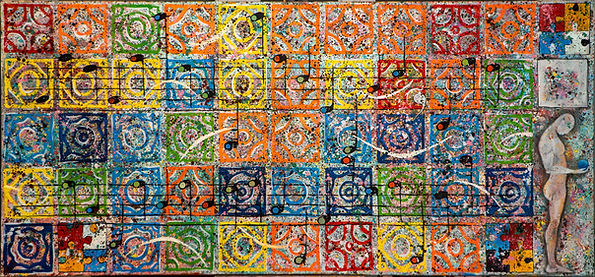
Chadar | Oil on Canvas
Price on Request
220 W X 100 H X 2 D cm
Do you feel it? How pleasant it sounds, on any instrument you play. Can you feel the warmth that spreads through your body when you listen to enjoyable music? Who created this comfort for you? Guido of Arezzo, who developed the first musical notes and wrote the first hymn, Ut Queant Laxis (Hymn to St. John the Baptist).
Imagine that each note is not just a sound, but has a shape that reaches your ear in its own beautiful form. Ernst Chladni, the German physicist, demonstrated through experiments that each frequency carries its own unique shape. At 432 Hz, the notes appear as distinct geometric forms.
The colors are not a simple choice either. Seven notes, seven colors, seven chakras: Do (Muladhara), Re (Svadhishthana), Mi (Manipura), Fa (Anahata), Sol (Vishuddha), La (Ajna), and Si (Sahasrara).
I composed the work according to my own interpretation of how Ut Queant Laxis might look, and how it might sound from the canvas. Mozart loved building rhythms from the alphabet. If each letter corresponds to its own note (Do – cjqx, Re – dkry, Mi – elsz, Fa – fmt, Sol – gnu, La – ahov, Si – bipw), then Ludwig Wittgenstein's famous line, "Not how the world is, but that it is, is the mystery," might look like this in musical notation.
As for the faceless grey figure on the right, lost in this world: it is hope, waiting for the light.
Born in Georgia in 1977 and later settled in Warsaw, Natsvaladze arrived at painting through a genuinely unusual route that continues to shape everything he makes today. He studied radiophysics, a demanding discipline built entirely on structure, measurement, and the strange behavior of unseen forces, and that early scientific training left a permanent and unmistakable mark on how he now sees the world around him. Where another painter might begin with a raw feeling, he tends instead to begin with a careful question about how that very feeling is assembled and held together. This analytical instinct never cools his work; it lends his intuition a firm framework to push against, so that reason and pure sensation share one restless surface.

You Invented, We Refined | Oil on Canvas
Price on Request
100 W X 70 H X 2 D cm
Boss! How, for what, and why did you invent this gender I don't know, but the idea is valid.
"My canvas is a laboratory where perception becomes a language."
For more than two full decades he practiced spatial and interior design, shaping in real detail how ordinary people move through and quietly inhabit their physical rooms. That long and genuinely demanding apprenticeship in structure, composition, and material taught him to think naturally in volumes and relationships long before he ever committed a single deliberate mark to a surface. When he at last turned his full and undivided attention to painting, these deeply ingrained habits followed him directly onto the waiting canvas. A picture, for Natsvaladze, is therefore always a carefully constructed space, one in which the forms are positioned with exactly the same care a thoughtful designer gives an entire room, and the viewer is quietly invited inside.

You Are My Toy | Oil on Canvas
Price on Request
100 W X 70 H X 2 D cm
When fear — a white rabbit (like adrenochrome) — stands above you; when someone holds a weapon, has power, and writes the law for you, dictates when you're allowed to breathe; when they create a god for you — with a specific image, character, shape, and weight; defines how you must worship and why; constructs a slogan for you:
"Faith is the insurance paper for getting in heaven"
— and you believe it, or you're forced to believe it — if you don't belong to this category of people, then who are you? A hammer, a nail, or a tree?
Morse legend: Dot, Dash.
His canvases function openly as working laboratories, a description he embraces entirely without irony or any trace of false modesty whatsoever. Each individual painting is an open-ended experiment whose final outcome he does not fully know in advance, and layer steadily accumulates upon layer as the thought itself revises and corrects itself in something close to real time. What eventually appears on the surface is never a fixed or tidy conclusion but instead a living record of searching, the honest visible residue of a mind genuinely at work. This deliberate willingness to leave the whole process legible, rather than quietly polishing it away at the end, gives the finished paintings their peculiar honesty and their persistent sense of motion.
The person standing on the left — is he a writer? A scientist? A journalist? An accountant? Or simply a person to whom we have attached a label?
The person standing on the right — is he a politician? A businessman? A mafioso? A gigolo? Or is he also merely a product of our imagination?
We can switch their places. We can redistribute their titles. We can remove all the labels altogether. Because roles are often the result of perspective, not truth.
Both of them love the same woman. One sees her as an ideal. The other — as desire. Or perhaps both see within her what they themselves lack?
Imagine the face of this woman as seen through their eyes. Now imagine it through your own — what do you see? A woman? A symbol? A desire? An illusion?
Perhaps the woman does not change at all — only the observer does.
The meaning of this painting is not only to ask questions, but to respond to the answers as well — to the desired and the undesired alike.
P.S. If you don't like this idea, there's a reload button in the bottom left corner — press it and...

Three Shadows | Oil on Canvas
Price on Request
70 W X 100 H X 2 D cm
"I do not resolve the questions of existence and self on canvas; I hold them open long enough for another mind to feel their weight."

"A canvas, to me, is closer to a laboratory than a window. I begin not with an image but with a question about how a thought holds its shape, then I let the answer build itself in layers, burying each stage beneath the next and allowing the corrections to stay faintly visible rather than sanding them away. What I am really painting is the slow movement of perception becoming a language I can see. Nothing I make is ever truly finished on its own, because the final layer belongs to whoever stands before it, decoding the symbols through their own memory and carrying the inquiry somewhere I could never have reached alone."

John Coltrane | Oil on Canvas
Price on Request
70 W X 100 H X 2 D cm
If you want to discover the world's secret, then you must understand its pain. John Coltrane was able to do this, and he used it in his work. With this work I presented one "minute" of his life, with his feelings.
In the drawing there is used his famous quote:
"One positive thought produces millions of positive vibrations" — John Coltrane
which I have written with my interpretation of Samuel Morse's (Samuel Finley Breese Morse) alphabet, where:
White – Space
Blue – Dot
Red – Dash
Green – Pause
Philosophy and psychology feed and quietly sustain the work at every single turn, though never merely as flat illustration of borrowed or secondhand ideas taken from elsewhere. Natsvaladze reads these two demanding fields much the way another artist might patiently study human anatomy, slowly absorbing their underlying structures until they eventually become pure instinct rather than knowledge. The deep questions that animate him most directly concern self-awareness, existence itself, and the genuinely slippery nature of whatever it is we so casually agree to call reality. He does not attempt to answer these questions outright on canvas, which would only flatten and cheapen them, but instead to hold them patiently open for the viewer.

My Demon | Oil on Canvas
Price on Request
114 W X 130 H X 2 D cm
He is merely a creation of a dream, yet within me, he is a seeker of truth. He alone sees my thoughts and discerns nihilism, fear, and defiance within them. He often whispers to me: Dare to take a step beyond your limit.
There is written "Fuck all those perfect people!" with the Morse code alphabet, in which a dot and an underscore are used. The ladder is hierarchy.
Symbols carry a great deal of the meaning in his work, functioning throughout as tightly compressed codes standing in for otherwise hidden inner states. A single form that reads as purely abstract at first casual glance often turns out, on longer looking, to be a carefully constructed cipher for something psychological, a passing mood or a fixed mental posture translated directly and economically into shape. These symbols never announce their own meanings openly or conveniently to anyone. They wait patiently and indefinitely to be decoded, and the very act of decoding pulls the observer steadily and irreversibly inward, toward their own buried private associations, so that no two viewers ever quite arrive at the same reading.
God, that laughs at me,
God, that punishes me,
God, that tests me,
God, that compels me and restricts my freedom,
God, that kills,
God, that breaks the regularity (names the man in the woman's body or the opposite),
God, that threatens me with the end of the world and so on.
Who created him and where did he come from in general?
In this artwork I have used Carl Gustav Jung's words with the help of the Morse Code alphabet:
"No tree, it is said, can grow to heaven unless its roots reach down to hell" — Carl Gustav Jung
Ask questions and try not to leave any of them answerless.
"Don't look for where's nothing, look for where's everything" — Zurab Kartveli

Holy Shit | Oil on Canvas
Price on Request
120 W X 70 H X 2 D cm
The shifting, restless relationship between the conscious and the subconscious sits directly and permanently at the very center of his whole larger project. Natsvaladze treats these two forces not as bitter and separate opponents but as fully equal participants in one single continuous exchange, a quiet ongoing dialogue that his paintings choose to stage rather than merely to describe from a distance. What actually surfaces on the canvas is only ever the visible upper portion of that deeper exchange, while a great and silent deal remains fully submerged, implied entirely by what little is shown. This is precisely why his images so richly reward slow looking, since their fuller meaning gathers only gradually.
"Each symbol hides a state awaiting the viewer to decode."
Oil on canvas remains his firmly chosen medium, valued always both for its remarkable depth and for the patient way it permits genuine accumulation over long stretches of time. The characteristic slowness of oil suits an artist for whom the working process itself is the true and lasting subject of the work, since it uniquely allows revision, burial, and later recovery all within one continuous surface. He builds up his paintings in much the way a genuinely difficult thought is built, provisionally and with constant patient correction, carefully letting the earlier states show faintly beneath the later ones. The finished work therefore carries its own long private history inside it, a visible sediment of thinking.

Dot On The Third Page | Oil on Canvas
Price on Request
100 W X 70 H X 2 D cm
Fear has worse smell than the corpse. Here the sun never rises and probably will never rise either. Here words are priceless: hope, faith, path, trust, longing, life (especially if you surrender it for someone else), fight, mind without emotions. Here only grass knows their full story; here only ground hugged 206 unit bones + 206 + 206...
"Only here they know that war isn't the worst, but the subjects participating in it"
The quote on the wires is presented in the Morse Code alphabet. Legend: Dot, Dash, Pause.
"With God in the loge, me on the stage, it is equally difficult for him to love and think soberly, life is an axiom, not a theorem" — Zurab Kartveli
He deliberately and consistently offers no final answers, and this quiet refusal is entirely purposeful and considered rather than evasive or intellectually lazy in any way. Natsvaladze instead constructs genuinely open systems, paintings that behave far less like fixed and finished statements and much more like generous standing invitations, in which the viewer steadily becomes a true and active participant in the ongoing research. Meaning here is never simply handed over or delivered but is instead actively generated, arising in the charged living space between the painted canvas and the particular person standing before it. The work is only ever fully complete when someone brings their own living consciousness to bear.
What was Cervantes' world like?
A patchwork of colors and cracks,
Blinded by love, yet brimming with wisdom.
Chivalrous, big-hearted, otherworldly,
Inwardly gray — a man who laughs and weeps at once.
He was, in truth, Don Quixote.
This is his story.

Don Quixote | Oil on Canvas
Price on Request
70 W X 100 H X 2 D cm
Taken together as a single whole, his paintings amount to a genuinely sustained investigation into human consciousness rendered patiently in fully visual form, a coherent body of work that treats the mind itself as a landscape and the canvas as its slowly evolving map. Thought, feeling, and form steadily and repeatedly converge into one single wordless conversation, sensitive and exacting all at once and without contradiction. Natsvaladze continues to expand this open inquiry with each new painting he begins, quietly adding fresh rooms onto a large structure that has no single obvious or predetermined end. What he truly pursues is never mere resolution but genuine depth, rewarding all who look.

Chef's Gospel, Bullet with Powder | Oil on Canvas
Price on Request
70 W X 100 H X 2 D cm
Protest to everyone and everything! I am not the saint either!
"If you wish to see both sides of the coin, there's no big pressure required, only a small amount of mindfulness" — Zurab Kartveli
"I layer oil so older thoughts survive beneath newer ones."
Zurab Natsvaladze (Kartveli)
Not a solo artist yet? Subscribe to our solo exhibitions at TERAVARNA and share your art with the world!