_PNG.png)


Steve Fogel
USA
_p.png)
"Medicine taught me to look; photography taught me to see."
Steve Fogel is a retired physician whose devotion to photography has now spanned more than four decades, a commitment that began alongside his medical career and gradually deepened into the central creative pursuit of his life. The two callings were never rivals, and they never competed for his loyalty in the way that demanding professions so often force a person's passions into retreat. Medicine occupied his professional hours, his intellect, and his sense of service, while photography occupied something subtler and more private, a parallel channel of attention through which he could observe, interpret, and connect with the world on terms that clinical practice did not permit. A physician's day is structured by obligation, by the needs of others, and by the weight of consequence, and within that structure the camera offered Fogel a different kind of encounter with reality, one in which looking carried no burden beyond the looking itself. Over forty years that parallel channel widened steadily, absorbing his travels, his daily surroundings, his quiet hours, and his abiding fascination with the overlooked, until it became impossible to say where the habit of looking ended and the art of seeing began. What started as a pursuit conducted in the margins of a demanding career matured, decade by decade, into a complete artistic identity with its own philosophy, its own convictions, and its own unmistakable voice.

African Lily | Color Photography
$400
20 x 20
In this photograph, I explore the quiet elegance of an African lily through a close, intimate perspective. The cool blue tones and delicate textures draw attention to the flower’s graceful form, while the soft, blurred blooms in the background create a sense of depth and tranquility. By isolating a single blossom, I invite the viewer to slow down and appreciate the subtle beauty, fragility, and rhythm that exist within the natural world.
The kinship between his two disciplines runs far deeper than coincidence, and understanding that kinship is essential to understanding the photographs themselves. Both medicine and photography demand sustained attention, genuine patience, restless curiosity, and an unusual sensitivity to detail, and both reward the practitioner who refuses to glance when careful looking is possible. A physician learns to gather small signals that untrained eyes dismiss, assembling them into comprehension, trusting that the truth of a situation is almost always present in its particulars, and a photographer's relationship to light and form rests on precisely the same faith. Yet the two callings diverge at a crucial point, and that divergence is where Fogel's artistic identity took root and flourished. Medicine trained him to observe in pursuit of diagnosis and understanding, where ambiguity is an obstacle and the goal is certainty, resolution, and the relief of an answer. Photography offered him the opposite gift, a space where observation leads not to answers but to interpretation, reflection, and open-ended creative exploration, where ambiguity is not the enemy of the work but very nearly its purpose. One discipline taught his eye its rigor, its thoroughness, and its refusal to be hurried. The other gave that rigor somewhere to wander, somewhere the act of looking could finally serve wonder instead of necessity, and the photographs that resulted carry both inheritances in equal measure.

The Soul of Leaves | Black & White Photography
$400
20 x 20
In this image, I transformed familiar foliage into an abstract landscape of light, shadow, and form. By stripping away color and emphasizing contrast, the leaves become sculptural shapes that seem to move across the frame. The photograph explores the quiet elegance hidden within nature, inviting the viewer to look beyond the botanical subject and discover rhythm, texture, and emotion in its flowing contours.
"A camera slows the world until its secrets become visible."
Across the decades his lens has refused every form of confinement that photographers commonly accept. People, landscapes, travel, documentary scenes, and the small incidental details of everyday life have all passed through his viewfinder, each genre approached not as a category to master and then defend but as a fresh territory of discovery to be explored for exactly as long as it kept revealing something new. Fogel never settled into a single style, never branded himself with one recognizable subject, and never narrowed his practice for the sake of consistency, because settling would have contradicted the very impulse that drew him to the camera in the first place. Every new subject, in his understanding, presents its own unrepeatable opportunity to explore perspective and to reveal something unexpected, and a practice built honestly on discovery must remain willing to follow wherever discovery leads. There is a quiet conviction in this refusal, since the art world often rewards repetition and recognizability, but Fogel's allegiance has always belonged to curiosity rather than to category. The breadth of his archive is therefore not eclecticism or indecision but evidence, the visible accumulated record of an attention that never learned to stop, and the connective tissue binding all of it together is not subject matter but a singular quality of looking that remains constant no matter what occupies the frame.
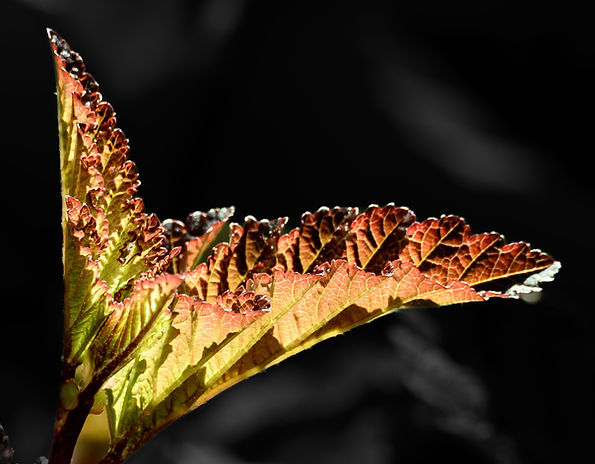
Radiance in Shadow | Color Photography
$400
18 x 24
Bathed in a shaft of light against a field of darkness, this leaf becomes more than a botanical subject—it transforms into a luminous landscape of texture, color, and form. The glowing veins and serrated edges reveal intricate details often hidden from view, while the surrounding shadows create a sense of mystery and isolation. By emphasizing contrast and selective illumination, the photograph invites the viewer to pause and appreciate the quiet drama within a single leaf, where nature's ordinary forms are elevated into something both abstract and evocative.
Within that breadth, macro photography emerged over time as one of his most enduring and revealing passions, the genre in which his philosophy of attention finds perhaps its purest expression. Magnification became his instrument for entering worlds that exist in plain sight yet go almost universally unnoticed, the textures, structures, and hidden relationships folded inside ordinary objects and natural forms that daily life trains every one of us to walk past. These subjects hold visual events too small, too quiet, or too familiar for the casual eye to register, and the macro lens grants Fogel entry into their concealed complexity. Through patient magnification and careful, deliberate composition, he transforms such subjects into images that feel newly understood, compelling precisely because the viewer half-recognizes them and cannot quite complete the recognition, suspended in that productive space between the known and the strange. Familiar things become visually arresting once the scale of attention changes, and that transformation is the entire engine of this body of work. The macro lens, in his hands, functions less like a piece of equipment and more like permission, permission to look longer, to move closer, and to take seriously the proposition that the unnoticed world deserves the same compositional respect as any celebrated vista.
In this abstract black-and-white image, flowing strands of light and shadow spiral toward a dark center, creating a sense of movement, mystery, and depth. The photograph invites viewers to lose themselves in the interplay of texture and form, where familiar shapes dissolve into an expressive landscape of energy and emotion. By stripping away color, the image emphasizes contrast and rhythm, encouraging a personal interpretation of the journey into the unknown.

Ghost | Black & White Photography
$400
18 x 24
"I want a viewer to stand before a familiar object and realize they have never once truly looked at it in their entire busy life."

"Forty years behind a camera have convinced me that nothing is actually ordinary. The patterns across natural forms, the textures time leaves on surfaces, the shadows moving quietly through an afternoon, all of it is waiting for someone patient enough to notice. Medicine gave me discipline and the habit of careful observation, but photography gave that discipline a place to wander without needing a diagnosis at the end. I do not impose meaning on what I photograph. I wait, I watch, and when the subject, the light, and the perspective finally agree with each other, the image reveals what it wanted to be all along. Strip away the color and even the soul of it shows through. That moment, after all these decades, is still the entire reason I pick up the camera."

In the Presence of Small Things | Color Photography
$400
20 x 20
This macro photograph reveals a world that often goes unnoticed. By moving in close, I sought to highlight the intricate textures, delicate hairs, and remarkable structure of a bee, transforming a familiar insect into a subject of wonder and significance. Against the dark background, every detail emerges with clarity, inviting the viewer to pause and appreciate the beauty, complexity, and quiet importance of one of nature’s smallest workers.
Abstraction extends that investigation one decisive step further, moving past magnification into the realm of pure perception itself. Fogel is captivated by photography's singular capacity to alter how a thing is seen, to take an everyday object that a viewer has encountered countless times and render it so that the viewer meets it through the artist's eyes rather than through the dulling filter of their own assumptions. By isolating details, removing context, and emphasizing form, line, contrast, and texture above all else, his abstract work deliberately shifts attention away from identification and toward interpretation, dismantling the reflex that makes people name a thing and immediately stop seeing it. The question the image poses stops being what is this and becomes what does this make me feel, and that substitution changes everything about how the photograph operates. Ordinary subjects turn unfamiliar, sometimes wholly unrecognizable, and in that engineered unfamiliarity the viewer is invited into an emotional and visual engagement that simple recognition forecloses. The abstractions are, in this sense, the most generous of his works, because they hand the viewer not a depiction but an experience, an open structure into which each person brings their own associations and from which each departs carrying a private meaning the photographer neither dictated nor could have predicted.

After the Rain | Color Photography
$400
18 x 24
This photograph celebrates the quiet transformation that follows a rainfall. The leaf becomes a canvas of reflected light, its surface adorned with countless droplets that magnify texture, color, and form. I was drawn to the contrast between the rich green foliage and the luminous beads of water, revealing a fleeting moment when nature appears refreshed, vibrant, and alive. The image invites viewers to slow down and appreciate the extraordinary beauty hidden within an ordinary scene.
Nature supplies the deepest and most constant reservoir of his inspiration, and it has done so without interruption across the entire span of his photographic life. Patterns, textures, shadows, and the subtle visual moments that pass unremarked through ordinary days are exactly what routine trains people to ignore in the name of efficiency, and they are exactly what Fogel has spent four decades refusing to ignore. Photography gives him both the means and the standing invitation to slow down and examine these details closely, uncovering complexity and beauty in places most would pass without a glance and would never suspect of holding anything worth a second look. His images carry an implicit argument accumulated and refined over forty years of looking, the argument that meaningful visual experience does not require the spectacular, the exotic, or the monumental, and that the commonplace, attended to honestly and without condescension, contains more than enough wonder to sustain a lifetime of work. In an age that manufactures spectacle relentlessly and rewards the loudest possible image, there is something quietly radical in a body of work insisting that the extraordinary was here all along, distributed evenly through the ordinary world, waiting only for someone patient enough to give it attention.
This photograph explores the transformation of the ordinary into the abstract through reflection, distortion, and form. By isolating shape, line, and color, the image dissolves familiar references and invites a more intuitive way of seeing. Fluid contours and layered reflections create a sense of movement and ambiguity, encouraging the viewer to pause and discover unexpected relationships within the composition. The work reflects an interest in revealing how everyday subjects can become expressive.

The Shape of Reflection | Color Photography
$400
18 x 24
Black and white holds a singular and defining place in his artistic identity, the closest thing his wide-ranging practice has to a signature. He values the expressive possibilities of color, has worked within them often, and acknowledges everything color can accomplish in the right hands and circumstances, yet he returns again and again to monochrome with the devotion of someone returning home. For Fogel, the removal of color is never a subtraction but an act of clarification with a precise purpose. It strips away distraction, simplifies the image to its essential elements, and reveals what he describes as the soul of the photograph, the irreducible core of structure and feeling that color, for all its beauty and seduction, can sometimes decorate into invisibility. The choice is never nostalgic, never an affectation borrowed from photography's history, and never a stylistic default adopted without thought. It is structural, philosophical, and renewed deliberately with each image, a decision about what a photograph should ask of the person standing before it and about how much visual noise ought to stand between a viewer and genuine seeing. Where color reports what the world looked like, black and white asks the viewer to consider what the image actually is.
"Black and white removes everything except what actually matters most."
Once color departs, everything that remains intensifies, and this intensification is the entire point of the discipline. Emphasis shifts wholly to light and shadow, to texture and contrast, to the underlying architecture of composition itself, and the emotional and structural qualities of the image step forward with nothing left to hide behind and no chromatic charm to lean upon. A monochrome photograph succeeds or fails on its bones alone, and Fogel embraces that exposure willingly. His black-and-white photographs pursue a deliberate quality of timelessness, an existence slightly outside the dated specificity that color so often imposes, and freed from those anchors they encourage viewers to engage more thoughtfully and more slowly with the subject before them. The reduction allows what matters to become more apparent rather than less, which is the paradox at the heart of his devotion to the form. Absence becomes instrument. What the photograph withholds turns out to be precisely what permits it to see more clearly and to be seen more completely, and in Fogel's hands the absence of color is never experienced as a limitation but as the very condition of clarity.

Midnight in Bloom | Color Photography
$400
20 x 20
In this image, I used a monochromatic blue palette to transform a familiar flower into something dreamlike and mysterious. The tightly clustered buds suggest a moment of anticipation, poised between stillness and emergence. By isolating the bloom against a dark background, I sought to emphasize its delicate textures, sculptural form, and quiet elegance. The result is a study of beauty in transition—a fleeting moment suspended between shadow and light, concealment and revelation.
His process rests on patience, observation, and a philosophy of discovery rather than imposition, and this distinction matters more to him than any technical consideration. Fogel does not arrive at a subject carrying a meaning he intends to install, and he distrusts the impulse to force an image into a predetermined statement. He seeks instead to uncover what already exists, trusting attentive looking and thoughtful composition to find it, and he waits with genuine willingness for those rare alignments when subject, light, and perspective converge to reveal something unexpected that no amount of planning could have produced. Such moments cannot be scheduled or manufactured, only prepared for, and the preparation is the discipline itself. The approach carries the unmistakable imprint of his first profession, the diagnostic faith that truth is present and discoverable if the observer is rigorous enough, transposed here into a gentler register where the truth being sought is visual and emotional, where nothing depends on the outcome, and where the reward for patience is not resolution but revelation.
This photograph explores the expressive beauty hidden within weathered wood. Through the interplay of light, shadow, and texture, the grain transforms into a flowing abstract landscape, revealing forms that suggest movement, memory, and time itself. I was drawn to the organic curves and intricate patterns carved by nature, allowing the image to exist somewhere between reality and imagination. The work invites viewers to discover their own stories within the silent language of the wood.

Whispers in the Grain | Black & White Photography
$400
20 x 20
Retirement has not diminished the practice but liberated it entirely. Photography now serves Fogel as both creative outlet and ongoing method of engaging with the world, a continuing exploration that unites his analytical background with his artistic curiosity in a single sustained act of attention, no longer confined to the margins of a professional life but free to occupy its center. Through every macro study, every abstraction, and every monochrome frame, he extends the same quiet invitation to his viewers, to slow down, look more closely, and reconsider the familiar things they believed they already knew. The ambition threading through all of it is modest in its statement and profound in its consequence, to transform ordinary subjects into images that inspire curiosity, contemplation, and a genuinely renewed way of seeing, and after more than forty years the pursuit shows no sign of concluding, because a practice founded on discovery has no natural endpoint, only the next subject, the next light, and the next opportunity to look again.

Quiet Explosion | Color Photography
$400
18 x 24
This photograph explores the delicate balance between structure and spontaneity in nature. By isolating the flower against a dark, subdued background, I emphasize its radiant, starburst form and the intricate geometry of its filaments. The image transforms a fleeting botanical detail into a sculptural study of line, rhythm, and light. What fascinates me is how something so fragile can appear both energetic and precise, creating a sense of quiet movement suspended in time. Through this close observation, I invite the viewer to appreciate the extraordinary elegance hidden within an ordinary natural form.
"Magnify the ordinary closely enough and it becomes extraordinary instead."
Not a solo artist yet? Subscribe to our solo exhibitions at TERAVARNA and share your art with the world!