_PNG.png)
Anastasiya Ihnatovich
BELARUS
_p.png)
"Every painting is a small rebirth. I begin in one state and finish in another."
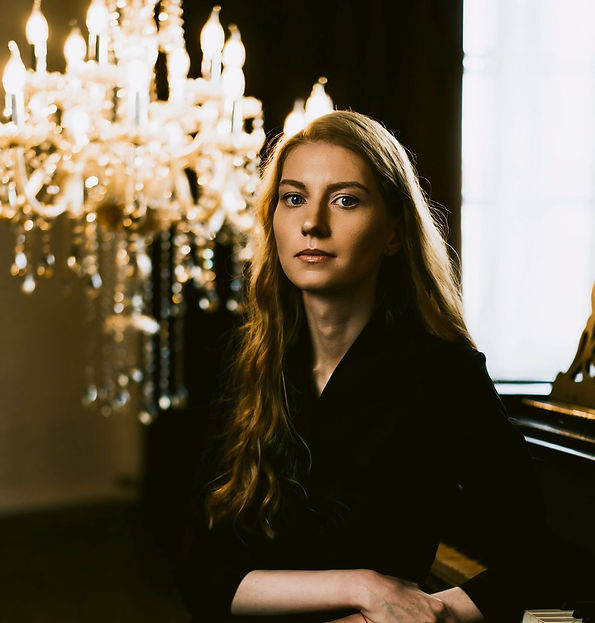
Anastasiya Ihnatovich is a multidisciplinary artist and scientist whose creative practice emerges from an ongoing dialogue between emotion, perception, memory, and intellectual curiosity. Working across neoclassical music composition and performance, oil painting, and photography, she does not regard these disciplines as separate or competing pursuits but as interconnected dimensions of a single creative identity, each informing the others in ways that are sometimes deliberate and often not. Her paintings are abstracted landscapes and cityscapes built from intense, fiery color and loose, energetic brushwork, in which recognizable places are transformed into subjective visions of lived experience. Luminous, vibrant, and emotional are perhaps the three words that most succinctly describe the sensibility beneath the work. What connects the music, the painting, and the photographs is a persistent wish to give visible form to what is felt rather than merely seen.
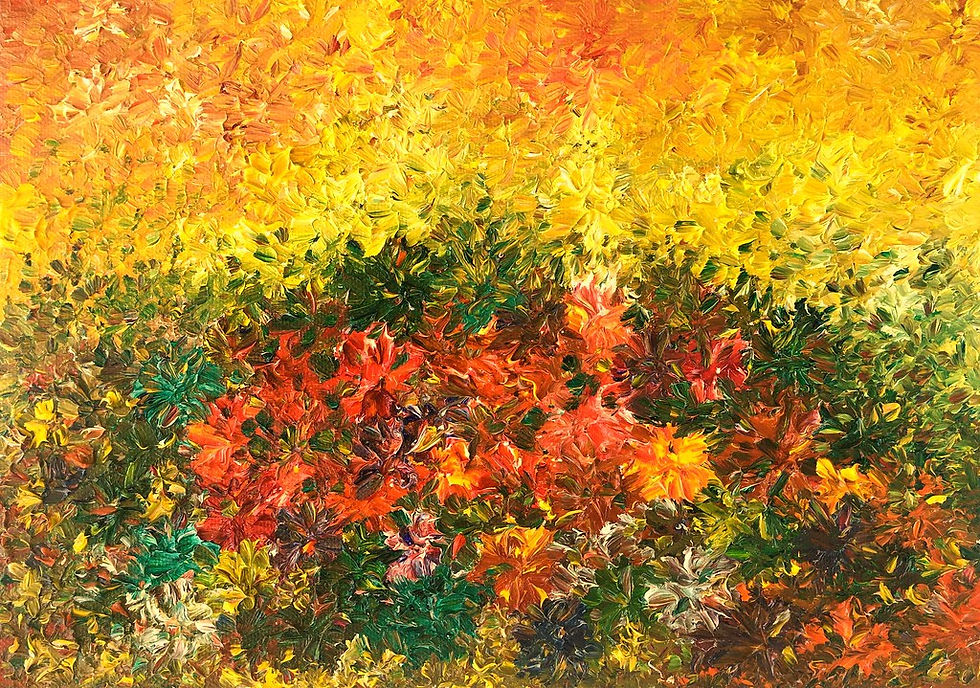
Serenum | Oil
$1,200
20" x 30"
“Serenum” portrays a colorful tapestry of blooming flowers inextricably interwoven with one another. Particular emphasis is given to the fiery hues, which create a warm, uplifting, sunny atmosphere. The artist's inspiration for the painting came from Henri Matisse's quote: “There are always flowers for those who want to see them.”
Self-taught as an oil painter, Ihnatovich approaches the medium with a strong emphasis on immediacy and physical expression. Emotion is central to this approach. A painting frequently begins with an internally felt impulse, a need to articulate an emotional state that may range from profound sadness to sheer joy, and the canvas becomes the place where that state is worked through rather than described. She describes the experience of creative work as a sense of being continually reborn, of transforming inner experience into something visible and tangible that did not exist before. This is not a metaphor she uses lightly. Each finished painting represents a passage from one condition to another, and the physical act of moving paint across a surface is inseparable from the emotional movement that prompted it. The result carries the energy of its own making.
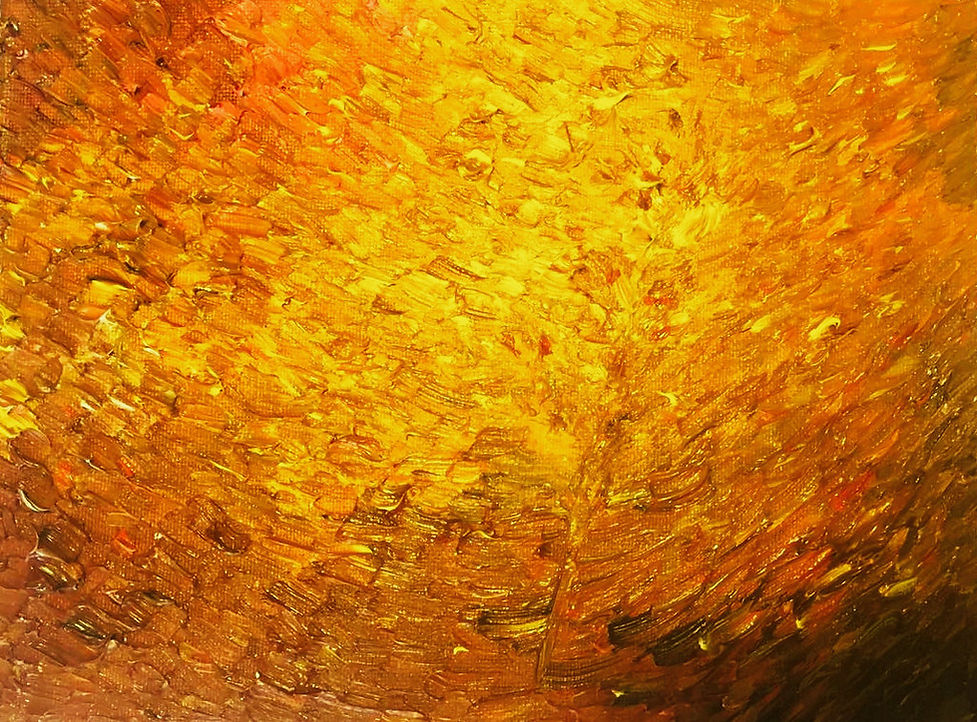
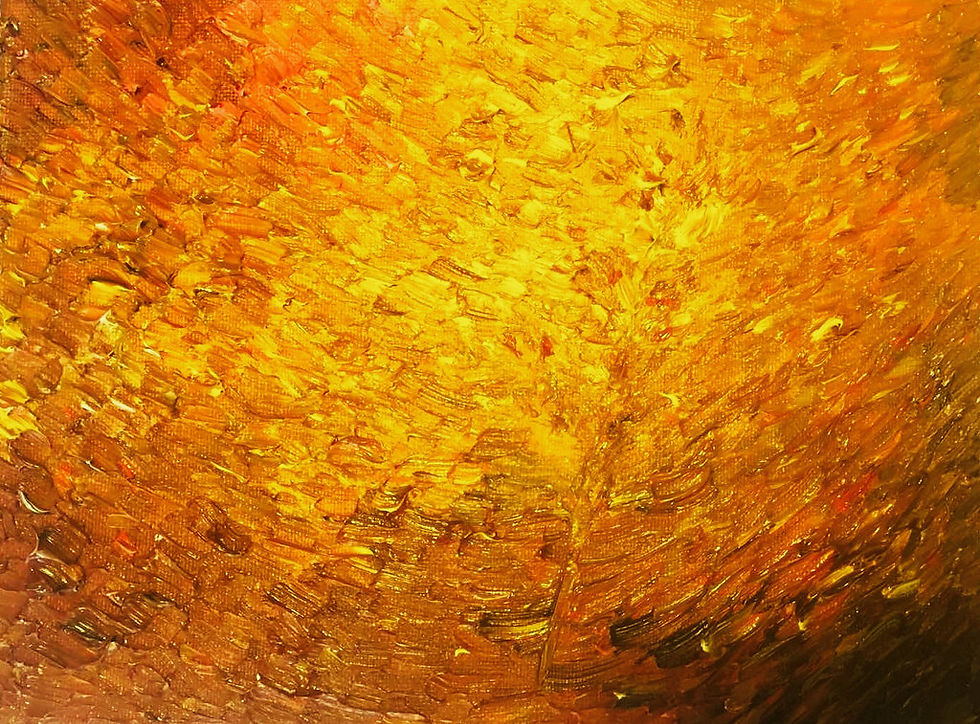
Arbor Vitae | Oil
$1,000
18" x 24"
“Arbor Vitae” features the glowing silhouette of a branched tree, celebrating the quiet magic of “life” and “creation” in the most profound sense of these words. The golden light and tones highlight the pristine, sublime atmosphere of the divine source. The artist's inspiration for the painting came from Pablo Picasso's quote: “Everything you can imagine is real.”
"Mozart is usually playing, and by the end of the session I can hear him in the brushstrokes."
Music runs through the studio and through the work. Classical music is frequently present while she paints, and the compositions of Mozart in particular serve as a source of inspiration whose structures, rhythms, and fluctuations become translated, almost unconsciously, into the movement of the brush. The translation is rarely deliberate. It happens because the music is in the room and in her, and the hand that holds the brush is the same hand that plays. In this way her musical and visual practices meet directly on the surface of the painting, and the boundary between composing and painting grows thin. The longstanding idea articulated by Walter Pater, that all art constantly aspires toward the condition of music, resonates deeply with her approach. For Ihnatovich it is less a theory than a description of what actually happens when she works.
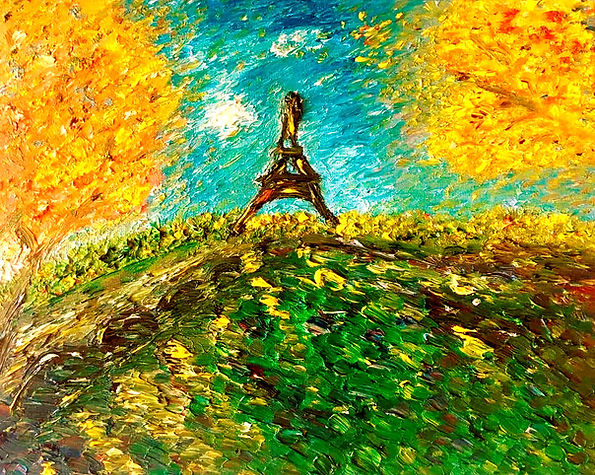
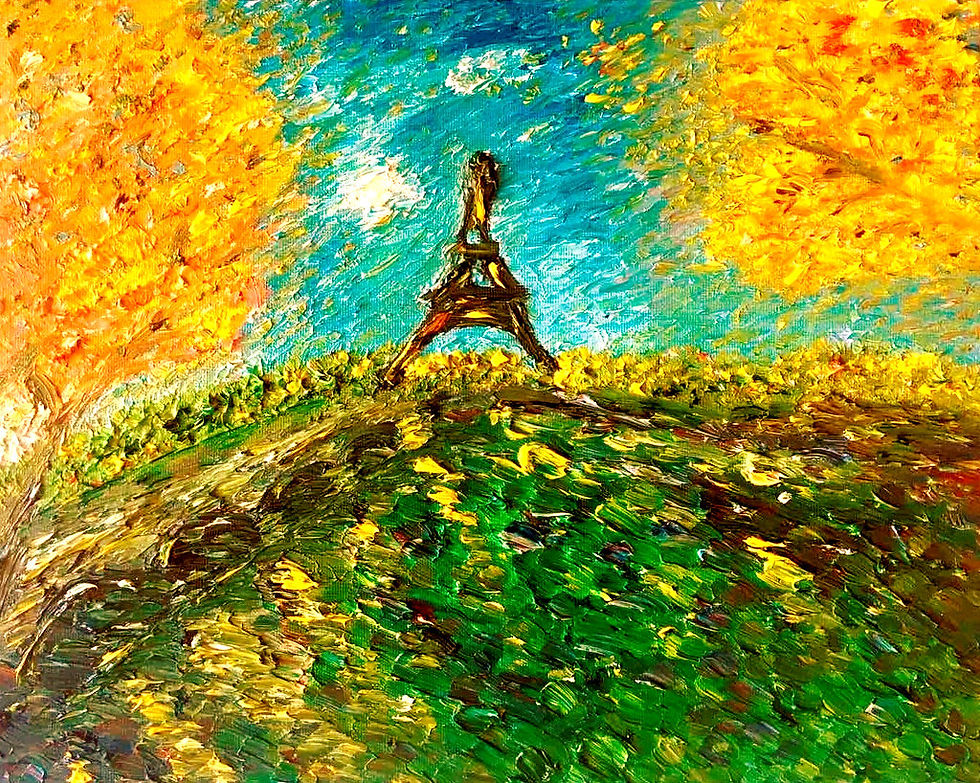
Paris De L'Amour | Oil
$1,400
24" x 30"
The painting was inspired by the unparalleled beauty and charm of the “City of Light.” With a colorfully fresh approach, the artist offers a view of the iconic Eiffel Tower from a new perspective.
Light is a fundamental element of her visual language. Intense yellows, golds, and oranges appear repeatedly across the paintings, functioning not simply as colors but as carriers of philosophical meaning. For the artist, light represents the essential vitality of existence and points toward something beyond the immediately visible world. It can suggest the spiritual, the divine, the transcendent, or the otherworldly, depending on the painting and the moment it holds. In this sense illumination is what gives a work its inner life. Light becomes its soul, or anima, and the luminous palette provides a visual expression of her fascination with beauty in its most sublime form. A painting without light, in her understanding, would be a painting without a center, and so light is rarely absent and never incidental.
The painting, sparked by the artist's fascination with the enchanting “La Serenissima,” depicts the Grand Canal as seen from the Ponte dell'Accademia. The luminous palette underlines the magical atmosphere that is especially prevalent in Venice during the golden hour.
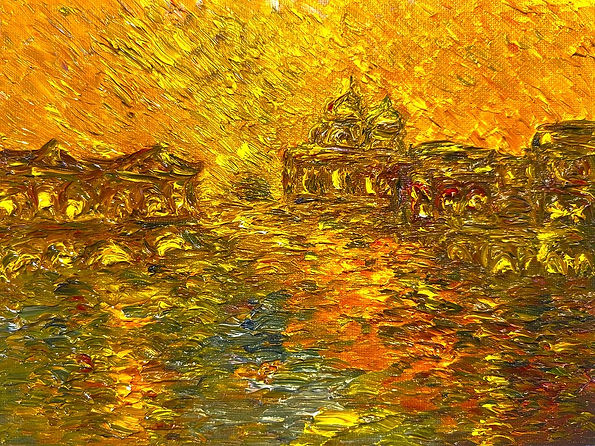
La Serenissima | Oil
$1,000
18" x 24"
"Light is the soul of the work for me, its anima. Without it there is only pigment on a surface. With it, the picture begins to breathe and to point past itself, toward whatever lies beyond the scene it shows. That is why gold and orange keep returning. They are not decoration. They are the life in it."
"There is a strange magic in taking something that already exists, a canal, a cathedral, a road disappearing into hills, and letting it pass through me and come out changed. The original is still there. Anyone can go and stand in front of it. But the version on my canvas belongs to a single afternoon, a single mood, a single person who happened to be looking. I think of it as a renaissance, a second birth for the place, on a different plane from the first. It is objective because it started outside me, and subjective because it ended inside me, and it needs both halves to be true. That in-between territory, where what was seen and what was felt can no longer be separated, is the only place I really want to work. It is where the invisible finally becomes visible, and that has always been the point."
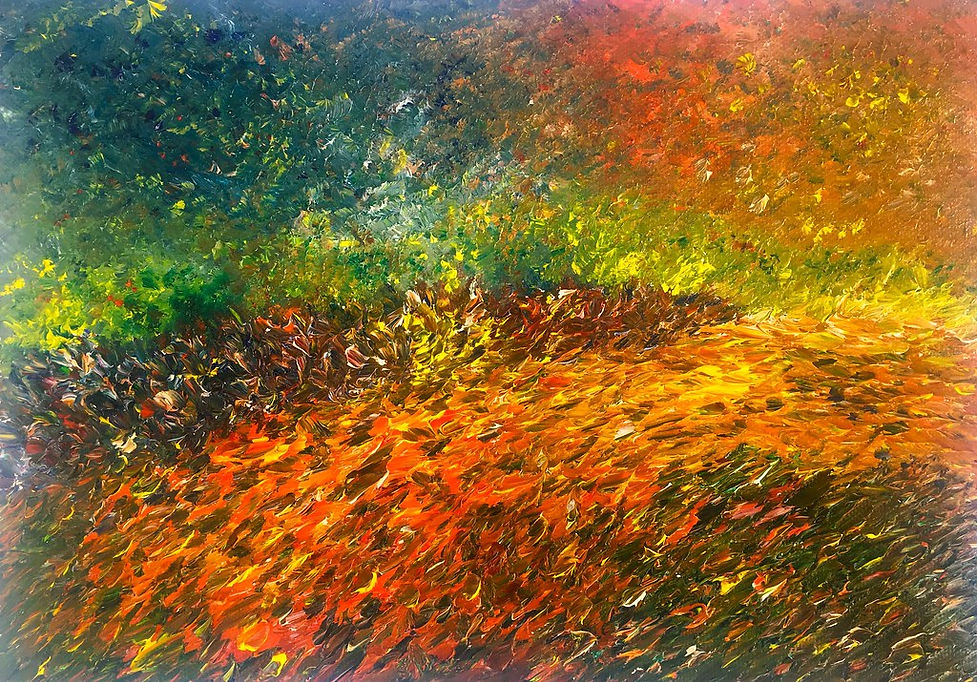
Intemporel | Oil
$1,200
20" x 30"
The painting, showing an abstracted landscape in a timeless dimension, was sparked by Jack Kornfield's quote: “The trouble is, you think you have time.” Through the element of color, the artist reimagines the scenery as a fluid, surrealistic experience.
Color, closely bound to this emphasis on luminosity, serves as her principal vehicle for emotional atmosphere. Rather than relying on literal representation, she uses fiery hues to communicate a particular emotional temperature, so that a canvas can feel warm or urgent or serene before a viewer has identified what it depicts. Gold, yellow, and orange, evoking warmth, radiance, and transcendence, allow color to function almost musically, establishing rhythm, mood, and intensity without the need for narrative explanation. This is where her training as a composer becomes most visible in the paintings. A palette is arranged the way a key is chosen, for the feeling it produces rather than for what it names. The viewer is invited to respond to that feeling first, and to the subject only afterward, if at all.
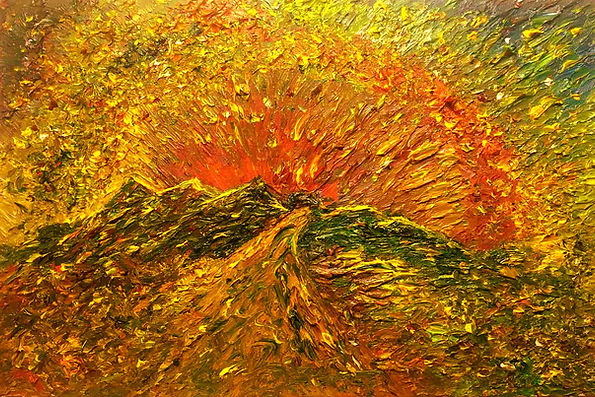
Ad Astra | Oil
$1,200
20" x 30"
“Ad Astra” illustrates a spectacular scene with a winding road leading toward majestic mountains. The painting captures a profound feeling of excitement about achieving new heights and reaching the “pinnacle” in the broadest sense of the word.
Places are where many of the paintings begin. Cities and landmarks recur, and Paris and Venice in particular have served as important sources of inspiration because of her deeply personal encounters with their beauty and atmosphere. Yet these places are never treated as subjects to be documented objectively. They are filtered through memory, emotion, imagination, and individual perception, and familiar architecture and landscapes are radically transformed through a personal painterly language into subjective interpretations of what it was to be there. The Eiffel Tower appears, but seen through a colorfully fresh approach that offers it from a new perspective. The Grand Canal appears from the Ponte dell'Accademia, its luminous palette holding the magical quality that settles over Venice in the golden hour. What is painted is not the city but the encounter with it.
“La Vita È Un Viaggio” is a visual illustration of the artist's reflections on the eponymous quote: “Life is a journey, and those who travel live twice.” The painting, depicting a vast mountainscape, is an attempt to represent the vicissitudes of life, its constant ups and downs, in a highly imaginative way.
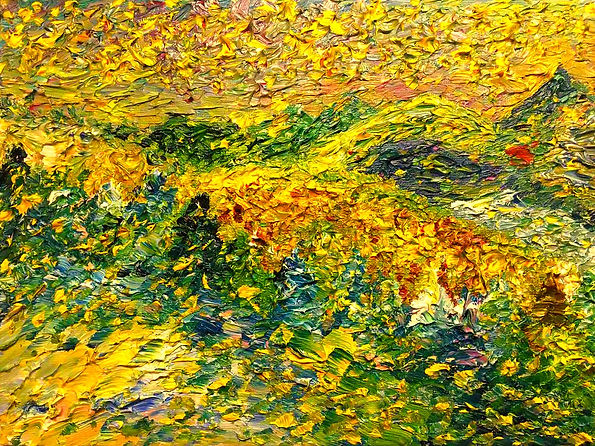
La Vita È Un Viaggio | Oil
$1,000
18" x 24"
Transformation of this sort is, for Ihnatovich, one of the most compelling possibilities that art offers. It gives the creator the opportunity to portray reality through a unique lens, and the resulting work contains both objective and subjective dimensions at once. It originates in something encountered in the external world, a building, a canal, a road climbing toward mountains, but it is ultimately reshaped by an inner world that is hers alone. She describes the process as almost magical, a renaissance of sorts in which existing forms are given new life on an entirely different plane. The place still exists, unchanged, for anyone who wishes to visit it. The painting exists separately, as a record of what one particular person saw and felt there, and that separateness is the point.
"Paris is Paris for everyone who goes there. What I paint is the Paris that was mine alone."
Memory, then, is the starting point for the majority of her works: a living memory, an experience associated with a particular place, moment, or emotional state. While such direct encounters provide the initial spark, imagination and atmospheric photographs participate in the development of a painting as well. Her background in photography has cultivated an acute awareness of the decisive moment, the fleeting instant in which light, atmosphere, composition, and emotion converge and cannot be separated. That sensitivity to immediacy contributes significantly to her preference for loose, expressive brushwork and for alla prima techniques, in which a painting is completed while the paint is still wet and the impulse still fresh. Working quickly is not a stylistic choice so much as a way of staying faithful to the moment that started everything.
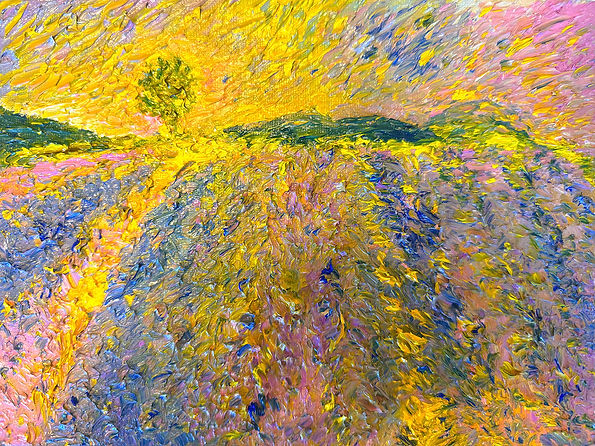
Champs De Lavande En Plein Jour | Oil
$1,000
18" x 24"
The painting portrays the natural beauty and magnificence of the variations of sunlight across the lavender fields at midday.
Her recent paintings show the range of that method. Serenum is a tapestry of blooming flowers in fiery hues, prompted by Matisse's observation that there are always flowers for those who want to see them. Arbor Vitae sets the glowing silhouette of a branching tree against golden light, a celebration of life and creation in the deepest sense. Ad Astra follows a winding road toward mountains and the feeling of reaching new heights, and La Vita È Un Viaggio turns a vast mountainscape into a meditation on the ups and downs of a life. Lavender fields at midday, a fiery sea sunset titled In Transitu, and the domes of Zaragoza's Cathedral Basilica of Our Lady of the Pillar reflected in the Ebro at twilight complete a body of work in which every subject is a doorway rather than a destination.
The painting conveys the vibrant atmosphere of a fiery sea sunset, where the sky and water are filled with radiant shades of gold, orange, and red. “In Transitu” is an attempt to visually depict the eternal process of transition, movement, and change, whatever form it may take, as well as the transient nature of everything in life from a spiritual perspective.
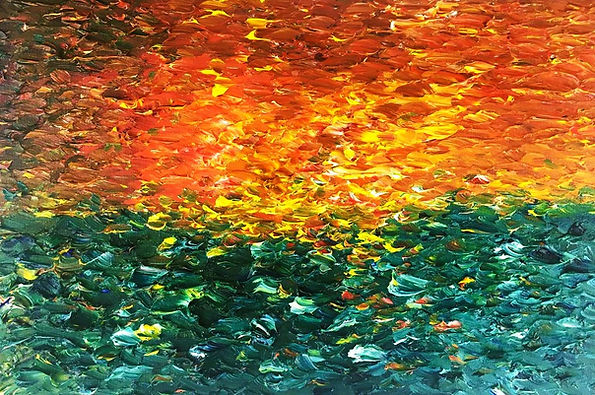
In Transitu | Oil
$1,200
20" x 30"
Ultimately, her work is an attempt to make the invisible visible, to give form to memory, emotion, beauty, and the fleeting sensations that accompany encounters with the world. Through a luminous palette, energetic gesture, musical rhythm, photographic observation, and intellectual curiosity, she continually searches for a personal language capable of capturing both the reality of the external world and the equally powerful reality of inner experience. The paintings exist in the space between what is seen and what is felt, where recognizable places become subjective visions and where the physical act of creation becomes a means of discovering, expressing, and finally understanding the self. Ihnatovich does not paint to show what a place looks like. She paints to show what it did to her, and to find out, in the process, who she is.
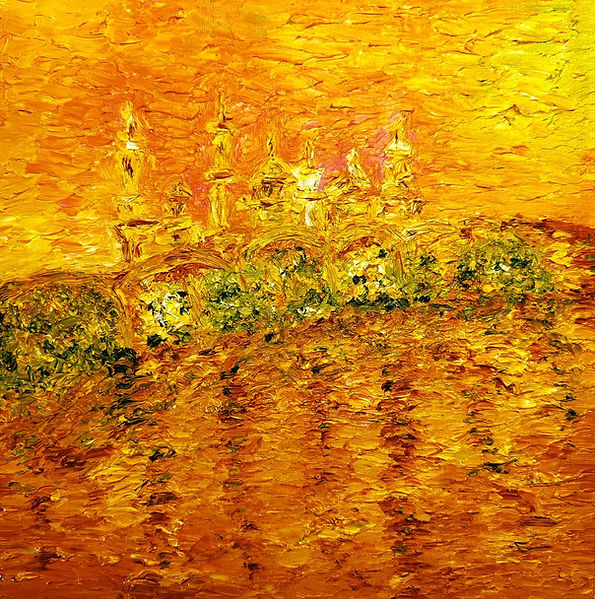
Zaragoza | Oil
$1,500
30" x 30"
The painting illustrates the Cathedral Basilica of Our Lady of the Pillar, the crown jewel of the Spanish city of Zaragoza. It was inspired by the splendor of the glowing reflections of the cathedral's domes and towers in the waters of the Ebro River at twilight.
"Photography taught me that the decisive moment does not wait, so I learned to paint before it left."
Not a solo artist yet? Subscribe to our solo exhibitions at TERAVARNA and share your art with the world!